HEPA Filter Cost: What Homeowners Should Expect in 2026
Discover realistic HEPA filter cost ranges, what drives price, and smart buying tips for true HEPA replacements in home air purifiers. Quick cost timing.


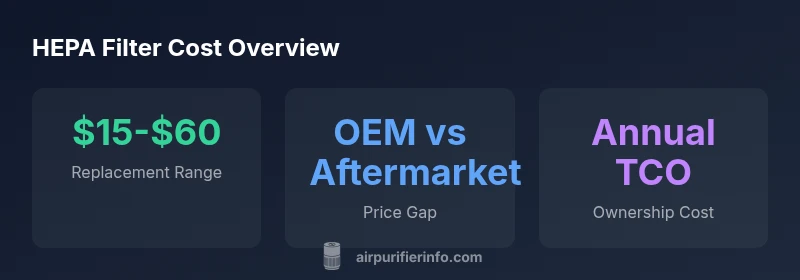
The typical replacement cost for a true HEPA filter in residential purifiers ranges from about $15 to $60 for standard household purifiers, with premium or specialty filters reaching $80 or more. Larger unit filters or allergen-specific cartridges tend to be on the higher end. Prices can vary by cartridge design (washable vs. replaceable), and some brands bundle filters with warranties or long-term replacement plans.
What affects HEPA filter cost
According to Air Purifier Info, the true HEPA filter cost you pay for a home purifier is driven by several key factors. The term hepa filter cost appears across brands and models, but the price you see is not random; it's tied to performance targets, compatibility, and ongoing maintenance. The main drivers are the filter type (true HEPA vs HEPA-like), the physical size and fit of the cartridge, certifications and filtration media (e.g., activated carbon, carbon-impregnated media), and whether you buy OEM (original equipment manufacturer) replacements or aftermarket equivalents. In addition, you’ll see price variation based on where you shop (direct from manufacturer, big-box retailers, or specialty online stores), as well as any bundled warranties or subscription programs. For homeowners and renters, understanding these factors helps separate value from marketing hype and makes it easier to estimate total cost of ownership over 3–5 years, which is often the relevant horizon for a purifier’s cost planning. We’ll unpack these categories with practical guidance and concrete examples to empower your next purchase.
- Dimensional fit and connector compatibility can add 5–15% to the price if you need a larger cartridge for a higher-capacity unit.
- Filters with additional media layers (like activated carbon for odor control) typically cost more than plain true HEPA layers.
- Availability matters: OEM parts from a specific purifier brand may be pricier but guarantee fit and performance, whereas aftermarket options may offer savings with variable quality.
- Usage context matters: homes with pets, smokers, or high dust loads demand more frequent changes, increasing annual costs.
If you’re shopping, keep a simple rubric in mind: compatibility first, true HEPA labeling second, carbon or specialty media third, and price last. This approach reduces the risk of buying a cheaper filter that underperforms or doesn’t fit your unit.
TL;DR: Heavier media packs and larger cartridges raise costs; aftermarket options can save money but may alter performance. Air Purifier Info emphasizes verifying true HEPA labeling and fit before purchase.
Cost ranges by filter type
HEPA filter costs vary by the kind of replacement you buy and how the purifier is designed. For most standard residential units, true HEPA replacement filters sit in a practical range of about $15-$60 per cartridge, depending on size and brand. If you opt for filters that incorporate carbon or specialty media (for odors or VOCs), expect to pay toward the higher end of that spectrum, sometimes $60-$80 or more per filter. OEM replacements are typically the most expensive, but they offer guaranteed compatibility and performance guarantees. Aftermarket replacements can be substantially cheaper—often 20-50% cheaper than OEM—but quality can vary, so reading reviews and confirming filtration efficiency is wise. Washable prefilters are a different category entirely; they cost roughly $0-$15 upfront and don’t replace the HEPA cartridge, serving instead to extend life by capturing larger particles. All-in-one cartridges that combine HEPA with activated carbon can be convenient but may command a premium price.
- For larger purifiers, price can scale with cartridge size and the number of filter layers.
- Some brands offer bundled replacement costs with warranties; this can shift the perceived value, especially if you expect to replace filters frequently.
- Seasonal sales or subscription programs can provide meaningful savings but evaluate total ownership cost over the product lifetime.
Quick takeaway: Expect higher prices for larger units and blends (HEPA + carbon). Always compare the replacement’s cost per year, not just per filter. Air Purifier Info’s analysis shows price tends to stay steady within the 3–5 year ownership window, with spikes mainly tied to media complexity and cartridge size.
Total cost of ownership for home purifiers
When assessing the cost of HEPA filters, you must consider total cost of ownership (TCO) over the purifier’s life. Even if an OEM replacement is more expensive upfront, it can deliver consistent performance and easier maintenance. Conversely, cheaper aftermarket filters may require more frequent changes or result in slightly reduced filtration efficiency if the media isn’t up to standard. A practical framework is to estimate the annual cost by assuming a typical replacement interval (6–12 months) and multiplying by your expected usage. For many households, this yields an annual expenditure in the $40-$120 range for standard purifiers, with higher totals for pet-heavy homes or smokers. Over a 5-year window, plan for roughly $200-$600 in filter replacements, plus any initial purchase of the purifier itself. If you opt for a subscription model, ensure the savings on each filter offset any service fees.
- Usage intensity and household factors (pets, allergies, smoking) directly impact cost by accelerating replacement schedules.
- If your purifier supports carbon-activated filters, weigh the added cost against odor control benefits, especially in compact living spaces.
- Maintain records of replacement dates to avoid overpaying for filters you don’t need yet.
Bottom line: Your 5-year TCO for HEPA filters is a better predictor of value than a single upfront price. Air Purifier Info’s 2026 analysis highlights that disciplined replacement timing and media selection balance cost with indoor air quality gains.
How to compare filters and brands
Comparing HEPA filters requires a structured approach. Start with model compatibility: only use replacements designed for your unit; mismatched cartridges can reduce performance or damage the purifier. Verify the filter’s true HEPA designation (often labeled as HEPA H13 or H14 in higher-end units) and confirm the percent particle capture (0.3 microns). Check the presence of any additional media—activated carbon, antimicrobial coatings, or specialty layers—that add cost but improve odor removal or VOC reduction. Review energy use and airflow ratings in conjunction with filter performance to ensure you don’t compromise CADR (clean air delivery rate) to save a few dollars. Finally, compare total ownership costs: price per filter, expected lifespan, and any ancillary costs (pre-filters, seals, or bundled warranties).
- Read customer reviews focusing on fit and performance over time.
- Use price-per-filter analysis across brands to identify real value, not just upfront price.
- Consider the availability of filters in your region; a stubborn supply can raise effective costs if you must pay expedited shipping.
Takeaway: The cheapest option isn’t always the best value. Look for the right balance of true HEPA performance, fit, and total cost of ownership. Air Purifier Info notes that smart purchasing comes from comparing per-year costs across multiple brands and models.
Money-saving tips to lower HEPA filter costs
Saving on HEPA filter costs is often a mix of strategy and timing. First, compare OEM vs aftermarket filters using a cost-per-year lens rather than just the upfront price. Aftermarket filters can be substantially cheaper; read reviews to gauge filtration performance and longevity. Bulk buying or taking advantage of promotions, loyalty programs, or manufacturer rebates can yield meaningful savings. If your purifier supports it, subscribe to a filter delivery plan that aligns with your replacement interval—some plans offer price protections or bulk discounts. Don’t overlook washable prefilters; although they don’t replace the HEPA cartridge, they can reduce the frequency of expensive replacements by catching larger particles first. Finally, consider using a purifier that offers an extended warranty or service plan; a longer warranty can offset future replacement costs by reducing the risk of early component failures.
- Plan replacements to coincide with major sale events (where applicable).
- When feasible, choose cartridges with carbon media only if odor control is a priority; this provides targeted benefits without a massive price jump.
- Keep a simple replacement log to avoid unnecessary early replacements.
Practical tip: If you’re unsure about the long-term cost, do a quick 2-year projection comparing OEM vs aftermarket costs with and without carbon media. You’ll often find aftermarket filters offer compelling value without sacrificing essential performance.
When to replace and what affects replacement frequency
Replacement frequency is influenced by several real-world factors. The number one determinant is household air quality: heavy dust, pet dander, smoking, and high pollen seasons will accelerate filter loading. Another factor is unit size and airflow: larger purifiers with higher CADR tend to require more frequent replacements simply due to greater air throughput. Finally, the media composition—filters with activated carbon or additional antimicrobial layers—can also impact the service life of the cartridge. A common consumer rule of thumb is to plan replacements every 6–12 months for typical use, but in environments with heavy pollutants or odors, you may need to change filters more frequently. Always follow the manufacturer’s recommended replacement interval, but use your own experience as a practical guide to maintain indoor air quality. Regular maintenance, including checking seals and ensuring proper airflow, helps maximize filter efficiency and minimize cost.
- Pets typically reduce filter life by increasing dander and fur accumulation.
- Smoking indoors dramatically reduces filter life due to smoke particulates and VOCs.
- Proper placement away from direct heat sources can help extend filter life by keeping airflow steady.
Bottom line: Replacement timing should be personalized to your environment. Air Purifier Info’s 2026 guidance emphasizes balancing cost with your home’s air quality needs to maintain healthy indoor air without overspending.
Common mistakes that drive up HEPA filter costs
Homeowners often incur unnecessary costs by misinterpreting what a “true HEPA” label guarantees. Common mistakes include buying oversized filters for a purifier that doesn’t require them, choosing low-quality aftermarket pieces that wear out quickly, and neglecting prefilters that can extend filter life significantly. Another pitfall is ignoring compatibility requirements and trying to force generic cartridges into proprietary units, which can reduce filtration efficiency and potentially harm the purifier. Failing to track replacement schedules regularly is another costly error; skipping or delaying replacements risks reduced air quality, higher energy use, and premature unit wear. Finally, not considering bundled warranties or service plans can mean paying more over time if a replacement is needed sooner than expected. By focusing on fit, true HEPA labeling, and total cost of ownership, you can avoid these common traps and keep your indoor air clean without surprises.
FAQ-SECTION
items:[{"question":"What is a true HEPA filter?","questionShort":"True HEPA definition","answer":"A true HEPA filter meets the industry standard of capturing 99.97% of particles at 0.3 microns. This level of filtration is what distinguishes true HEPA from lower-grade or HEPA-like media. The price tends to reflect this performance, with true HEPA replacements often costing more than non-true options.","voiceAnswer":"A true HEPA filter meets the official standard for capturing tiny particles, which is why it costs more. When buying, look for the true HEPA label and model compatibility.","priority":"high"},{"question":"What drives HEPA filter cost the most?","questionShort":"Key cost drivers","answer":"The largest cost drivers are filter size, added media (like activated carbon or antimicrobial layers), and whether the cartridge is OEM or aftermarket. Compatibility and warranty terms also significantly influence price.","voiceAnswer":"Size and extra media drive most of the price. OEM parts are pricier but offer guaranteed fit.","priority":"high"},{"question":"Are washable HEPA filters cost-effective?","questionShort":"Washable HEPA cost","answer":"Washable options typically reduce ongoing costs but are not true HEPA replacements in the sense of single-use media; they may require more frequent maintenance and cleaning. Always verify the filtration efficiency of any washable option.","voiceAnswer":"Washable options can cut ongoing costs but verify they meet true HEPA standards.","priority":"medium"},{"question":"OEM or aftermarket filters: which is better?","questionShort":"OEM vs aftermarket","answer":"OEM filters guarantee compatibility and often consistent performance but cost more. Aftermarket filters can save money but vary in quality; read reviews and check match to your purifier model.","voiceAnswer":"OEM costs more but fit is guaranteed; aftermarket can save money with wise selection.","priority":"high"},{"question":"How can I save on HEPA filter costs?","questionShort":"Saving tips","answer":"Shop during promotions, compare price-per-filter over time, consider subscriptions with price protections, and use appropriate prefilters to extend HEPA life. Always prioritize true HEPA labeling and model compatibility.","voiceAnswer":"Look for promotions, compare long-term costs, and use prefilters to extend filter life.","priority":"medium"}]
mainTopicQueryNameForWikidataLookupValueForWikidataLookupForTheTopicQuery":"hepa filter cost"},
Cost ranges for HEPA filters by type
| Type | Typical Cost Range | Notes |
|---|---|---|
| OEM replacement filter | "$20-$70" | Higher price, guaranteed compatibility |
| Aftermarket replacement filter | "$10-$50" | Cost savings, variable quality |
| Washable prefilter | "$0-$15" | Low ongoing cost; not true HEPA |
| All-in-one cartridge | "$25-$80" | Convenience, may include carbon |
Questions & Answers
What is a true HEPA filter?
A true HEPA filter meets the standard of capturing 99.97% of particles at 0.3 microns. This level of filtration is why true HEPA replacements often cost more than non-true options.
A true HEPA filter meets the official standard for tiny particle capture, which is why it can be pricier.
What drives HEPA filter cost the most?
The largest cost drivers are filter size, added media (carbon or specialty layers), and whether the cartridge is OEM or aftermarket. Compatibility and warranty terms also influence price.
Size and extra media drive most of the price; OEM parts are pricier but guaranteed to fit.
Are washable HEPA filters cost-effective?
Washable options can reduce ongoing costs but are not true HEPA replacements in the traditional sense; they may require more frequent maintenance and should be evaluated for filtration efficiency.
WASHABLE options can cut ongoing costs but check if they meet true HEPA standards.
OEM vs aftermarket: which is better for HEPA filters?
OEM filters guarantee compatibility and consistent performance but cost more. Aftermarket filters save money but quality varies; review accuracy, fit, and filter efficiency before buying.
OEM costs more but fit is guaranteed; aftermarket can save money if you pick carefully.
How can I save on HEPA filter costs?
Shop during promotions, compare price-per-filter over time, consider subscriptions with discount protection, and use prefilters to extend HEPA life. Always verify true HEPA labeling and compatibility.
Look for sales, compare long-term costs, and use prefilters to extend life.
“Cost-conscious buying comes down to balancing upfront price with how often you’ll replace the filter and how well the unit maintains air quality over time.”
Main Points
- Identify true HEPA labeling and fit before buying
- Expect $15-$60 for standard replacements; higher for carbon/media blends
- Consider total cost of ownership, not just upfront price
- OEM vs aftermarket: balance price with quality and warranty
- Use prefilters to extend cartridge life and reduce costs