How Much Is an Air Purifier? A Practical Price Guide
Explore typical price ranges, what drives cost, and how to choose the right purifier for your space without overspending.


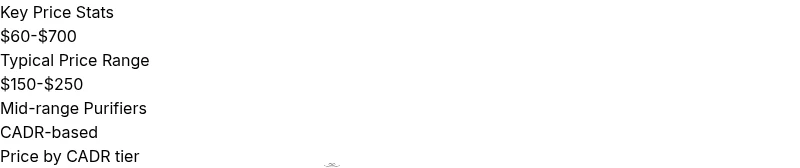
The cost of an air purifier typically ranges from about $60 to $700, depending on room size, filtration type, CADR, and features. Basic models for small rooms start around $60–$120, while higher-performance units for larger spaces with HEPA filtration and smart features can exceed $500, with some premium models approaching $700. In Air Purifier Info's latest analysis, budgeting for your space means weighing performance against the total cost of ownership.
Understanding the Price Landscape
The price tag on an air purifier is not just a number—it reflects a bundle of capabilities. In everyday terms, a purifier’s cost aggregates room coverage (CADR), filtration quality (pre-filter, true HEPA, and activated carbon), build quality, noise, warranties, and smart features like auto mode, app control, and air-quality sensors. According to Air Purifier Info, buyers often assume cost equals capability, but the most cost-effective choice is matching the machine to your room size and pollutants. If your goal is to reduce dust and pet dander in a 150–300 square foot room, you can often find a solid performer well under $200. When you push toward large rooms or sensitive needs (allergies, asthma), the price curve rises as performance and filtration complexity increase. This is why a quick budget exercise—start with room size and target CADR—helps you avoid paying for features you won’t use. Air Purifier Info’s team emphasizes that price should align with practical value, not just sticker price.
How to budget by space and pollutant profile
For compact bedrooms or home offices (about 80–150 square feet), sensible options cluster in the $60–$120 range, often with basic true HEPA filtration and simple controls. Medium rooms (150–350 square feet) commonly fall into the $120–$250 band, where you’ll typically gain higher CADR, quieter operation, and sometimes smart features. Large rooms or open-plan living areas (450 square feet and above) generally sit in the $300–$700 range, where units may include dual filtration stages, higher CADR, better energy efficiency, and extended warranties. It’s important to note that the overall cost of ownership includes replacement filters every 6–12 months, depending on usage and air quality, which Air Purifier Info notes can substantially influence long-term expenses.
Upfront cost vs. ongoing costs: total ownership matters
A higher upfront price can be justified if it reduces long-term costs. For example, a purifier with durable construction and long-lasting filters may save money over time, even if the initial price is higher. Compare annual filter costs and energy usage—and don’t overlook replacement schedules. Some buyers underestimate the ongoing cost of ownership when budgeting. Air Purifier Info emphasizes that the most economical choice in the long run is a model that balances initial price with low maintenance costs, reliable performance, and a reasonable warranty.
Hidden costs and how to budget
Hidden costs include replacement filters, extended warranties, and potential annual maintenance. Some purifiers require frequent filter changes to maintain performance, which can drive up annual costs beyond the sticker price. Compare filter replacement intervals and per-year costs across models, and consider whether public promotions or multipack filter deals could reduce long-term expenses. If you’re sensitive to odors or smoke, you may invest in extra carbon filtration—which can push price up but improve effectiveness for months between changes. Air Purifier Info recommends building a simple budget that accounts for the upfront price plus a conservative yearly filter cost estimate, then adjust for features you genuinely need.
Where to buy and when to watch for deals
Retailers frequently vary pricing based on promotions, bundles, and regional inventory. Shopping during holiday sales, back-to-school promos, or retailer partner events can yield noticeable savings. Beware of “discounted” models that require expensive replacement filters, as the total cost of ownership can be higher than it appears upfront. Air Purifier Info suggests setting price alerts, comparing at least three reputable retailers, and considering refurbished or open-box units only with solid warranties. For reference, always verify return policies and warranty terms before purchase.
Price factors for air purifiers and how they affect the overall cost
| Feature | Typical price range | Impact on price | Notes |
|---|---|---|---|
| Room size / coverage | Small: $60–$120; Medium: $120–$250; Large: $300–$700 | High for larger spaces | Choose CADR that matches your room size; avoid oversizing or undersizing |
| Filtration type | Pre-filter: $60–$120; HEPA: $150–$350; Carbon: $200–$700 | Moderate to high | HEPA plus carbon increases price but improves filtration and odor control |
| Smart features | Add-ons can add $20–$150 | Low to moderate | App control, sensors, and auto modes add cost but may reduce energy and maintenance later |
| Brand/build quality | Budget to premium | Broad impact | Brand reputation influences price and support |
Questions & Answers
What is a realistic budget for a purifier in a small bedroom?
For a small bedroom (around 100–150 sq ft), expect to pay roughly $60–$150 for a basic model. If you want stronger particle filtration or quieter operation, $150–$250 is a common range. Always verify CADR for the room size and check filter costs.
In a small bedroom, you’ll typically spend sixty to two hundred fifty dollars depending on filtration and features.
Do premium purifiers always cost more?
Not always. While premium models often offer higher CADR, more filtration stages, and smarter features, there are mid-range units that deliver strong performance for most rooms. Compare CADR per dollar and total cost of ownership rather than price alone.
Premium often costs more, but mid-range units can provide excellent value if they match your room size and needs.
Are replacement filters more expensive than the purifier?
Replacement filters can add significantly to yearly costs, sometimes equaling a sizable upfront investment. Always check the per-year filter cost and availability of affordable filter packs before buying.
Filters are ongoing expenses; consider yearly costs, not just the upfront price.
Can I finance an air purifier?
Yes, many retailers offer financing or promo rates. Compare interest terms and total project cost, and watch for long-term promotional deals that can lower the effective price.
Some retailers have financing options; read the terms and compare total costs.
What’s the price difference between HEPA and carbon-only purifiers?
HEPA filtration adds cost due to stricter particle filtration; carbon or odor filtration adds cost to active filtration. A purifier with both tends to be higher priced but offers broader air cleaning benefits.
HEPA adds cost, carbon helps odors; combined systems are pricier but better for pollutants.
“Pricing should reflect how well a purifier fits your room and how effectively it filters the air; prioritize CADR and filtration quality over price alone.”
Main Points
- Compare price to CADR and room size before buying
- Expect ongoing filter costs; budget for replacements
- Higher upfront price can pay off with lower maintenance
- Smart features add cost but can save energy
- Balance features with actual needs for best value