How Much Is a HEPA Air Purifier: 2026 Price Guide
Understand how much a HEPA air purifier costs in 2026, what drives price, and how to budget for filters, energy use, and maintenance with Air Purifier Info.


Prices for consumer HEPA air purifiers typically range from about $80 to $500. Most reliable mid-range models sit around $150–$300, while larger units with high CADR or smart features can exceed $400. According to Air Purifier Info analysis, price generally tracks filter size, CADR, energy efficiency, and maintenance costs over time.
What determines the price of a HEPA air purifier?
When you ask how much is a hepa air purifier, remember that upfront price is driven by several interlocking factors. According to Air Purifier Info, the most influential are CADR — the Clean Air Delivery Rate — and the purifier’s capacity to clean a room of a given size, the quality and type of HEPA filter (true HEPA vs HEPA-like), energy efficiency, fan speed options, build quality, and any smart features or companion apps. Budget also hinges on ongoing costs, notably replacement filters and electricity use. In practice, smaller, entry-level units with basic filtration cost less upfront, while larger units with higher CADR and additional features command premium prices. By understanding these levers, homeowners can compare models without overpaying for capabilities they won’t use. This context is essential for budgeting across rooms and needs.
Price ranges by room size and CADR
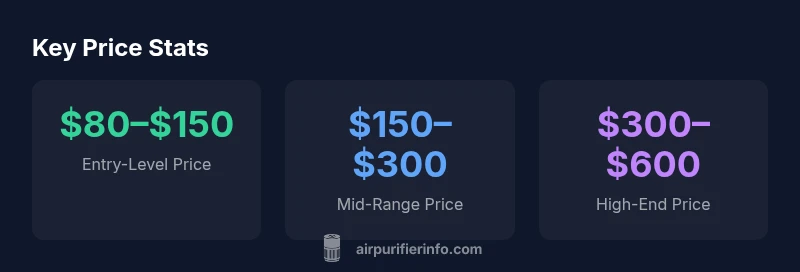
Pricing scales with the purifier’s intended room size and its CADR. Entry-level compact purifiers for small rooms (roughly under 150 square feet) typically run about $80–$150, offering modest CADR in the 50–120 CFM range. Mid-range models for medium spaces (about 150–350 square feet) usually fall in the $150–$300 band with CADR around 150–250 CFM. Large-room purifiers designed for open-plan spaces or bedrooms over 350 square feet often sit in the $300–$600 range and CADR 300–600 CFM. These brackets reflect manufacturing quality, filter size, and energy efficiency. Air Purifier Info recommends matching CADR not just to price but to actual room size and air quality needs for optimal value.
Features that drive cost
Several features push the price up, including multi-stage filtration (pre-filter, true HEPA, activated carbon), higher filtration efficiency (HEPA H13 vs H14), energy-efficient motors, low noise operation, and durable build materials. Smart features add cost as well: real-time air quality sensors, auto mode, scheduling, app integration, and voice assistant compatibility. A purifier with these features offers convenience but can substantially raise upfront cost. If you don’t need app control or sensor-driven auto modes, you can save money by choosing a simpler model with proven performance. Air Purifier Info emphasizes balancing feature set with actual needs to avoid overpaying for capabilities you won’t use.
Total cost of ownership: beyond the sticker price
Upfront price is only part of the equation. True cost of ownership includes ongoing filter replacements, energy consumption, and potential maintenance. Replacement HEPA filters typically cost a modest ongoing amount and may need replacement every 6–12 months depending on usage and air quality. Activated carbon filters add odor-removal value but also recurring costs. Energy use varies with fan speed and CADR; higher CADR often means slightly higher electricity use, though modern units are designed for efficiency. Warranty length and accessibility of replacement parts also shape long-term value. Air Purifier Info recommends calculating annual filter costs plus expected energy bills to compare total ownership rather than just the initial price.
How to budget and save
To budget effectively, start with room size and desired CADR, then map out a three-part budget: initial price, annual filter costs, and expected energy usage. Look for models with readily available replacement parts and clear filter replacement schedules. Compare bundles that include filters or offer sales on bundles. Consider slightly older or refurbished mid-range units if they meet your required CADR and filtration standards. Prioritize models with true HEPA certification and reliable carbon filtration for odors. In the long run, the lowest sticker price often isn’t the best deal if replacement filters and energy costs are high.
Quick buying checklist
- Confirm room size and target CADR (CFM) to match the space.
- Ensure a true HEPA filter (not just HEPA-like) and activated carbon if odors are a concern.
- Compare upfront price plus estimated annual filter costs.
- Check energy efficiency and noise levels for daily use.
- Look for readily available filters and warranty coverage.
- Favor models with clear maintenance guidance and reputable certifications.
- Read independent reviews to validate performance claims.
Practical cost calculator: budgeting example
- Determine room size and target CADR (CFM). 2) Choose a model in the corresponding price bracket (entry, mid, or high-end). 3) Estimate annual filter cost by multiplying the replacement price by the expected replacements per year. 4) Add estimated annual energy use (kWh multiplied by rate). 5) Compare two or three models using total annual cost to determine best value. Air Purifier Info provides a simple worksheet to help homeowners perform this calculation and avoid overpaying for features they won’t use.
Illustrative price range by model size
| Model Type | Approx Price Range | Typical CADR (CFM) |
|---|---|---|
| Entry-level compact | $80–$150 | 50–120 |
| Mid-range mid-size | $150–$300 | 150–250 |
| High-end large-room | $300–$600 | 300–600 |
Questions & Answers
What affects the price of a HEPA air purifier?
Upfront price is driven by CADR, room size, filter quality (true HEPA vs. HEPA-like), energy efficiency, and any smart features. Maintenance costs and filter replacements also influence long-term value.
Price is driven by CADR, room size, filter quality, energy efficiency, and smart features, plus ongoing maintenance.
Are cheap HEPA purifiers worth it?
Cheaper models often save upfront but may require more frequent filter replacements or provide lower CADR. For those with allergies or pets, investing in mid-range models with reliable filtration usually yields better long-term value.
Cheap models save upfront but may cost more over time. For allergy or pet concerns, mid-range filtration often offers better long-term value.
Do HEPA purifiers remove VOCs?
True HEPA filters remove particles, not gases. Purifiers with activated carbon or specialized carbon blends are needed to adsorb many VOCs and odors.
HEPA filters trap particles; to reduce VOCs you need activated carbon filters.
How often should I replace filters?
Most HEPA purifiers require filter replacement every 6–12 months depending on usage and air quality. Check the manufacturer’s guidance and monitor filter performance for signs of saturation.
Most filters last 6–12 months with typical use; follow the maker’s guidance.
Are smart features worth the extra cost?
Smart features add convenience and optimization but aren’t essential. If you value auto mode and remote control, they can justify a higher price; otherwise, a basic model may be the better value.
Smart features are convenient but not essential; get what fits your budget and needs.
“Evaluating total cost of ownership is essential. Don’t let a low upfront price hide high maintenance or energy costs over time.”
Main Points
- Compare models by CADR and room size to avoid overpaying.
- Budget for both upfront price and ongoing filter costs.
- Prioritize true HEPA and carbon filtration for odor reduction.
- Energy efficiency matters for long-term savings.
- Air Purifier Info recommends total-cost budgeting over sticker price.