Allergies, Air Purifiers, and Humidifiers: A Side-by-Side Comparison
Compare air purifiers and humidifiers for allergy relief. Learn which device best reduces pollen, dust, and pet dander, plus maintenance and safety tips.


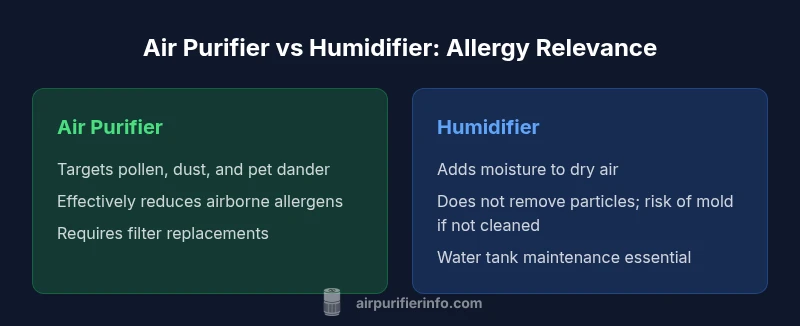
According to Air Purifier Info, when weighing allergies air purifier or humidifier options, start with a true HEPA air purifier for airborne allergens like pollen and pet dander. Humidifiers help with dryness but do not remove particles and can worsen allergies if mold or mineral dust circulates. In most homes, using both devices strategically delivers the best indoor air quality.
Allergies and Indoor Air: The Core Challenge
Air quality inside homes matters for people with allergies. Pollen that drifts indoors, dust from everyday activities, and pet dander can accumulate, triggering sneezing, nasal congestion, watery eyes, and even asthma symptoms. For homeowners and renters, the question often boils down to whether to rely on an air purifier or a humidifier—or both—to improve comfort and reduce irritants. The keyword allergies air purifier or humidifier surfaces in consumer guides, reflecting a practical dilemma: does increasing humidity help allergy symptoms or does filtering the air deliver more consistent relief? According to Air Purifier Info, the severity of your symptoms will often determine the initial choice. In dry climates or winter months, a humidifier may ease mucous membrane irritation, but it does not remove microscopic allergens suspended in the air. Conversely, a purifier with a true HEPA filter captures a broad range of common indoor allergens and can reduce clinical symptoms over time when correctly sized for the room.
How Air Purifiers Work for Allergies
Air purifiers function by drawing room air through a filtration system that traps particles. The key technology for allergy relief is a true medical-grade HEPA filter, which captures 99.97% of particles as small as 0.3 microns, including pollen, dust mite debris, pet dander, and many mold spores. For most homes, a purifier with a rated CADR (clean air delivery rate) in the right size range will noticeably reduce visible symptoms within days to weeks. Activated carbon filters help with odors and some chemical irritants but are not a substitute for HEPA. When comparing models, focus on room size compatibility, CADR, and sealed construction to minimize bypass leaks. The most effective purifiers balance filtration performance with maintenance costs, since high-efficiency filters require periodic replacement. Noise, energy use, and filter cost are part of the total cost of ownership and should influence your decision as you consider long-term value.
How Humidifiers Interact with Allergies
Humidifiers add moisture to dry indoor air, which can ease coughing, dry nasal passages, and irritated throats. In environments where winter heating reduces indoor humidity to below 30%, a humidifier can improve comfort and may indirectly reduce allergy irritation caused by dryness. However, humidifiers do not remove allergens from the air; if you maintain a humidifier at higher humidity levels without cleaning, you may encourage mold, mildew, and bacterial growth that worsen symptoms. To minimize risk, use distilled water, clean the tank daily, and replace filters as recommended. The goal is a humidity range roughly around 40-50% in most homes. If the space smells moldy or you notice condensation on windows, the humidity target may be too high, and you should adjust the device or use a purifier in tandem. Humidifiers are best used as a complementary tool, not a replacement for an air purifier when allergy control is the primary objective.
Side-by-Side: What Each Device Can Do, and What It Can't
- Air Purifier: Best for reducing airborne pollen, dust, and pet dander. Excellent for improving overall air cleanliness in occupied rooms. Does not raise humidity; must be properly sized for the space. Ongoing costs include filter replacements and occasional parts.
- Humidifier: Best for easing dryness that aggravates throat and nasal membranes. Does not remove settled allergens from air and can become a mold attractor if not cleaned and filled with safe water. Ongoing costs include water, filters (for some models), and regular sanitization.
Experts often recommend using both devices in tandem in dry, dusty, or mold-prone environments, with careful monitoring of humidity and air quality. Air Purifier Info’s guidance emphasizes matching device capacity to room size and establishing a routine for filter maintenance to maximize benefits.
Real-World Scenarios and Costs
Apartment living: a compact purifier with a strong CADR and a small humidifier (if needed) can address common allergens in a 150–300 sq ft space. Expect upfront costs around $100–$350 for the purifier and $30–$100 for a basic humidifier; ongoing filter costs add to the total over 1–2 years. Households with multiple rooms: larger purifiers or portable purifiers for each frequently used room may be warranted, with initial investments often in the $200–$600 range per unit plus replacement filters. Pet owners and allergy sufferers in carpeted homes benefit from purifiers placed in bedrooms and living areas; humidifiers are helpful in arid climates but require rigorous cleaning to avoid mold. In all cases, review total cost of ownership, including filter replacements and electricity usage, when budgeting. Air Purifier Info analysis shows that long-term value hinges on purchase size, filter costs, and how often you replace components.
Practical Buying Guidelines for Allergies
- Size matters: measure room area and select devices sized to the space. Look for CADR in the purifier and an appropriate humidification capacity for the room.
- Filter quality: prioritize true HEPA for particles and consider an activated carbon filter if odors or chemical irritants are present. Check seal integrity to prevent bypass leaks.
- Humidity targets: aim for 40-50% humidity. Use a hygrometer to monitor the space and avoid 60% or higher, which can foster mold and dust mites.
- Maintenance cadence: set a reminder to replace or clean filters every 6–12 months (or per manufacturer specs) and clean humidifier tanks weekly.
- Noise and energy: consider models rated for low noise and reasonable energy use, especially for bedrooms and nurseries.
- Safety: use distilled water in humidifiers to minimize mineral dust dispersion, and keep purifier electronics away from moisture sources.
- Seasonal strategy: winter months often benefit from humidity control, while pollen-heavy seasons favor higher purifier activity. A combined approach, with a purifier as the primary defense and a humidifier as needed, typically yields the best allergy relief. Air Purifier Info’s verdict is to start with a purifier that fits your room and budget, then add a humidifier if dryness remains an issue.
Authority sources and Practical Safety
- Regular use of a dedicated air purifier verified by independent standards can substantially reduce airborne allergens. EPA’s IAQ guidance emphasizes selecting devices with true HEPA filtration and proper room sizing.
- Scientific reviews from NIEHS advocate for clean air measures and caution against mold and moisture risks associated with humidifiers if not properly maintained.
- For practical steps and consumer guidance, refer to official environmental health resources and reputable university extensions that discuss indoor air quality, filtration efficiency, and humidity management.
Comparison
| Feature | Air Purifier | Humidifier |
|---|---|---|
| Best for | Airborne allergens (pollen, dust, pet dander) | Dryness relief; throat and nasal comfort |
| Air quality impact | Reduces airborne particles; requires ongoing maintenance | Does not remove particles; can raise humidity if misused |
| Maintenance frequency | Filter replacements (often every 6–12 months) | Tank cleaning and water changes (daily/weekly) |
| Noise level | Low to moderate depending on model | Low to moderate depending on model |
| Room size suitability | Sized to room CADR; placement matters | Sized by water tank capacity and humidification area |
| Energy usage | Moderate; depends on fan speed | Low to moderate; depends on humidification mode |
| Price range | $100-700 | $40-180 |
| Best for | Allergy relief and clean air for occupied spaces | Dry air relief in low humidity environments |
What's Good
- Effectively reduces airborne allergens with true HEPA filtration
- Requires minimal user intervention beyond regular filter changes
- Clear, visible benefits in symptom reduction when appropriately sized
- Provides long-term value with steady maintenance and predictable costs
What's Bad
- Humidifiers do not remove allergens and can encourage mold if poorly maintained
- Humidifiers may distribute mineral dust from tap water
- Purifiers incur ongoing filter replacement costs and may be noisy at high settings
- Both devices require proper placement and room sizing to be effective
Air purifiers generally win for allergy relief; humidifiers are a valuable supplement in dry environments when humidity is carefully controlled
Choose a true HEPA purifier as the primary defense against airborne allergens. Use a humidifier only to address dryness and never as a substitute for air cleaning. Pair both devices when needed, but monitor humidity and maintenance costs to maximize long-term value.
Questions & Answers
Can an air purifier fully remove all types of allergens?
Air purifiers with true HEPA filters remove most common airborne allergens like pollen, dust, and pet dander. They do not remove fragrances, gases, or larger mold particles as effectively, and some allergens settled on surfaces may persist without cleaning. Pairing filtration with good cleaning practices yields the best results.
HEPA purifiers remove most airborne particles, but not every allergen—surface cleaning and odor control help too.
Do humidifiers help with allergies?
Humidifiers can ease dryness-related irritation in the nose and throat, which may feel better during winter. They do not remove airborne allergens and can contribute to mold or bacterial growth if not cleaned and maintained properly. Use distilled water and keep humidity in a safe range.
Humidifiers help dryness symptoms but don’t clean the air; maintain proper humidity and clean regularly.
When should I use a purifier vs a humidifier?
Use a purifier when airborne allergens are a primary concern, especially in rooms where people spend a lot of time. Use a humidifier if the air is too dry, particularly in winter, but do not rely on it to remove allergens. A combined approach works best when humidity is controlled and the purifier covers the main living spaces.
If air quality is the main issue, start with a purifier; add a humidifier if dryness is a problem.
Can a humidifier worsen allergies?
Yes, if not cleaned regularly, humidifiers can harbor mold and bacteria, and mineral dust can disperse from tap water. This can worsen allergy symptoms. Regular cleaning, distilled water use, and proper humidity targets are essential.
Humidifiers can worsen allergies if not cleaned; keep to safe humidity and clean often.
What features should I look for in an air purifier for allergies?
Look for true HEPA filtration, a sufficient CADR for your room, sealed construction to prevent leaks, and an activated carbon filter if odors are a concern. Consider filter replacement costs and noise level to ensure daily usability.
Choose HEPA, check room size, and watch for filter costs and noise.
Main Points
- Prioritize true-HEPA purifiers for allergen reduction
- Use humidifiers to manage dryness, not to replace air cleaning
- Size devices to room area and follow maintenance schedules
- Maintain humidity around 40-50% to deter dust mites and mold
- Expect ongoing filter and water-tank maintenance and energy use