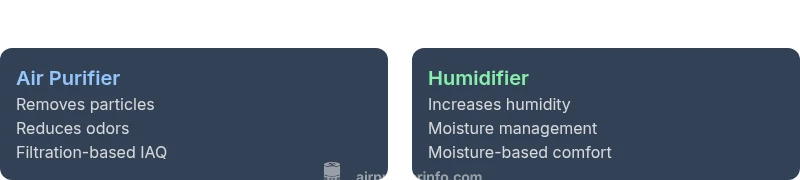
Air Purifier vs Humidifier: Is Air Purifier Similar to Humidifier?
A detailed, analytical comparison of air purifiers and humidifiers, outlining their distinct purposes, mechanics, and impacts on indoor air quality. Learn which device suits dust, allergies, odors, and moisture needs for homes in 2026.


Air purifiers and humidifiers are not interchangeable. An air purifier cleans the air by capturing particles and odors, while a humidifier adds moisture to the air to reduce dryness. For dust, allergies, and odors, a purifier is typically the better choice; for humidity control, a humidifier helps. In some homes, using both can be beneficial if humidity is monitored and maintained.
is air purifier similar to humidifier? Core distinctions
According to Air Purifier Info, many homeowners wonder whether an air purifier and a humidifier are two names for the same device. The short answer is no: they address different indoor air quality problems. An air purifier focuses on removing particles—like dust, pollen, pet dander, and smoke—from the air. A humidifier, by contrast, adds moisture to the air to alleviate dryness that can irritate skin, nasal passages, and wood furniture. When homeowners ask is air purifier similar to humidifier, the practical takeaway is that these tools serve complementary, not identical, purposes in most homes.
In 2026, the guiding principle is to match the device to the dominant indoor air quality need: filtration for cleaner air versus humidity control for comfort. The Air Purifier Info team emphasizes that understanding your space, climate, and occupancy will determine whether you prioritize a purifier, a humidifier, or a combination. The distinction matters for allergy management, scent control, and moisture balance.
How air purifiers work
Air purifiers use a combination of filtration technologies to reduce airborne particles and odors. A true HEPA filter captures 99.97% of particles at 0.3 microns, while activated carbon absorbs volatile organic compounds and smells. Some models include ionizers or UV-C components, but these features vary by model and may have safety considerations. The purifier’s performance is typically described by CADR (Clean Air Delivery Rate) values, which help you estimate effectiveness in a given room size. Importantly, greater filtration normally means higher upfront cost and ongoing maintenance, but it can yield meaningful improvements in IAQ when used correctly.
How humidifiers work
Humidifiers introduce moisture into indoor air through different mechanisms: ultrasonic mist, evaporative wicks, warm mist, or cool mist. Each type has pros and cons related to noise, mineral dust from evaporation, and maintenance demands. Humidifiers help alleviate dryness-related discomfort, reduce static electricity, and can protect wooden furniture and musical instruments. However, over-humidification can create damp conditions that foster mold growth and dust mites. The essential trade-off is controlling humidity to a comfortable range (generally around 30-50% relative humidity) without tipping into excess moisture.
Why the distinction matters for health and comfort
From a health perspective, air purifiers address particulate matter and odors, which can trigger allergies or asthma symptoms for sensitive individuals. Humidifiers influence moisture levels that affect nasal passages, throat comfort, and skin hydration. Misusing either device can inadvertently worsen conditions: over-reliance on a purifier without addressing humidity may leave mucus membranes dry in winter, while over-humidification can promote mold, mildew, and dust mites. The distinction is particularly relevant in homes with pets, heavy pollen seasons, and urban pollutants. A nuanced approach recognizes that IAQ is multi-faceted, combining filtration and humidity management as needed.
Air Purifier Info analysis shows how environmental context (season, climate, occupant sensitivity) shifts the balance toward one device or the other. In dry, heated indoor environments, humidity can be a priority; in areas with high outdoor pollution or indoor smoke sources, purification matters more. The practical implication is to assess your space first, then select devices that deliver the right balance of air cleanliness and moisture.
When to use each device in a typical home
If your main issue is dust, pollen, pet dander, or odors, an air purifier is typically the first choice. For households experiencing chapped skin, nasal irritation, or squeaky wooden floors during dry months, a humidifier can provide relief. In multi-room homes, it is common to run a purifier in living areas while a humidifier maintains humidity in bedrooms or offices. Renters may prioritize compact purifiers with real-time air quality indicators, while homeowners with HVAC systems might opt for built-in filtration or whole-home humidification. The decision should consider room size, occupancy, climate, and existing air quality sensors.
Combining functions: should you buy a purifier-humidifier combo?
There are multi-function units and “combi” devices that offer filtration and humidification in a single cabinet. While convenient, these designs often compromise on peak performance compared to dedicated devices in their respective roles. If you pursue a combo, ensure the purifier portion meets your CADR needs for the room size and that the humidification component maintains humidity within safe levels. Separate devices can offer higher performance for each function, and using them in tandem can be more controllable and energy-efficient in larger spaces.
Cost, energy, and maintenance realities
Upfront costs vary by feature set, room size, and brand. On average, air purifiers range from modest to premium models, while humidifiers span from basic evaporative types to ultrasonic, with costs following a similar pattern. Running costs hinge on filter replacements for purifiers and water treatment for humidifiers. Energy use is generally modest for most units, but models with high CADR or powerful humidification can draw more electricity. A practical approach is to map out annual costs for filters, water and energy, then compare against your IAQ goals. Air Purifier Info analysis shows that total cost of ownership matters as much as initial price when establishing a healthy indoor environment.
Practical buying guidelines: evaluating room size, CADR, and humidity targets
When shopping, start with room-by-room assessments. For air purifiers, match CADR to room size using manufacturer guidelines; bigger rooms require higher CADR and possibly multiple units. For humidifiers, assess the target humidity level of each space and select a capacity that sustains consistent moisture without overshooting. If you have multiple concerns—dust, odors, and dry air—consider devices with adjustable fan speeds, easy maintenance, and clear indicators for filter or water changes. Always verify that any device marketed as “ozone-free” truly operates without ozone emissions. The goal is to align device specifications with your unique indoor climate profile and living patterns.
Common myths and misconceptions
A frequent misconception is that all purifiers remove humidity or that humidifiers purify the air. In reality, their mechanisms are distinct and sometimes complementary, not interchangeable. Another myth is that higher price guarantees better air quality; performance depends on the right match to room size, filtration type, and humidity control. Some claim that any purifier is a cure for all indoor air issues; in truth, a purifier addresses particulates and odors while humidity devices manage moisture. Debunking these myths helps buyers set realistic expectations and avoid unnecessary purchases.
Quick decision framework for renters and homeowners
For renters in compact spaces, prioritize portable purifiers with true HEPA filtration and real-time IAQ feedback. For homeowners with larger living areas, consider a multi-room approach or a dedicated purifier in common spaces plus a humidity strategy in bedrooms. If you have seasonal allergies, start with a purifier and monitor humidity; if you experience winter dryness, introduce a humidifier carefully while monitoring humidity levels with a hygrometer. This structured approach aligns with the goal of improving comfort and IAQ without overbuying or overusing equipment.
Real-world scenarios: choosing based on allergies, pets, and odors
In homes with dogs or cats, pet dander is a persistent irritant; a purifier with a high CADR for dust and dander can substantially reduce allergens. For smokers or households near high-traffic outdoor areas, activated carbon in purifiers helps reduce odors and VOCs. If a household also battles dry air during heating seasons, a humidifier can provide relief, but humidity levels should be kept within safe ranges. A practical plan is to deploy a purifier where air circulates most and add a humidifier to rooms that become dry, then measure IAQ and humidity to refine device placement and settings.
The bottom line and Air Purifier Info's perspective
In summary, is air purifier similar to humidifier? Not exactly, but they are complementary tools for an improved indoor environment. The right choice depends on your specific needs: air purification for cleaner air or humidification for comfort and moisture balance. The Air Purifier Info team recommends starting with a clear assessment of room size, humidity targets, and occupant sensitivities, then selecting devices that address the primary IAQ challenges while keeping energy use and maintenance manageable.
Comparison
| Feature | Air Purifier | Humidifier |
|---|---|---|
| Primary purpose | Particle removal and odor reduction | Moisture addition to the air |
| Best for | Dust, pollen, pet dander, smoke, allergens | Dry air relief, nasal irritation, and skin comfort |
| Common technologies | HEPA filtration, activated carbon, optional UV/ionizers | Ultrasonic, evaporative wick, warm/cool mist |
| Impact on humidity | Minimal change without integrated humidification | Directly increases room humidity |
| Maintenance frequency | Filter replacement every 6–12 months typical | Water refill and cleaning required frequently |
| Energy usage | Low to moderate depending on CADR | Low to moderate depending on capacity |
| Price range (typical) | $60-$600 | $20-$180 |
What's Good
- Helps improve indoor air quality by reducing dust and allergens
- Improves comfort in dry climates when paired with proper humidity control
- Low maintenance options exist and are easy to use
- Provides measurable IAQ improvements with real-time indicators
- Supports households with allergies, asthma, and odor concerns
What's Bad
- Purifiers do not add humidity and can be noisy at high CADR
- Humidifiers can promote mold or bacteria if not cleaned regularly
- Combo devices may compromise performance for the sake of convenience
- Overreliance on one device can neglect the complementary IAQ needs
Choose based on primary IAQ need: purifier for cleaner air, humidifier for moisture control.
In most homes, a purifier addresses dust, pollen, and odors more directly, while a humidifier tackles dryness. If both issues are present, consider separate devices or a well-chosen combo with careful humidity monitoring. The Air Purifier Info team emphasizes matching devices to room size and humidity targets for best results.
Questions & Answers
What is the main difference between an air purifier and a humidifier?
An air purifier cleans the air by removing particles and odors, while a humidifier adds moisture to the air to reduce dryness. They address different indoor air quality problems, so they are not interchangeable in most situations.
Air purifiers remove particles; humidifiers add moisture. They serve different IAQ needs, so pick based on what your home actually needs.
Can a single device perform both tasks effectively?
There are combo units that purify and humidify, but they often underperform compared with dedicated devices for each function. If you choose a combo, verify it meets your purification targets and humidity targets separately.
There are combo devices, but they may not excel at either task. Check specs carefully.
Is it safe to run a humidifier together with an air purifier?
Yes, you can run both, but avoid over-humidifying. Use a hygrometer to keep humidity around 30-50% and ensure the purifier is appropriately sized for the room. Proper placement helps avoid moisture buildup near electronics.
You can run both, just keep humidity in check and position devices wisely.
What features should I look for when buying an air purifier?
Look for true HEPA filtration, appropriate CADR for room size, replaceable filters, low noise levels, and a straightforward maintenance schedule. An indicator for filter replacement helps keep performance high.
Seek HEPA, clean air delivery, and easy maintenance.
What features should I look for when buying a humidifier?
Choose from ultrasonic or evaporative types, with a sufficient tank size for your room and an auto-shutoff when humidity targets are reached. Look for easy cleaning access and a mineral filter to reduce white dust.
Get an easy-to-clean humidifier with moisture controls.
Are there products that combine air purification and humidification?
Yes, but verify that each function meets your needs. If you have serious allergies, prioritize purifier performance; if dryness is persistent, ensure the humidifier can maintain humidity without promoting mold.
There are combo products, but check performance for each task.
Main Points
- Assess your main IAQ issue first
- Pair a purifier with humidity control if needed
- Choose devices sized for your room and occupancy
- Monitor humidity and air quality with inexpensive sensors
- Maintain devices regularly to avoid mold and mineral buildup