Air Purifier vs Humidifier for Allergies: A Practical Guide
A detailed comparison of air purifiers vs humidifiers for allergy relief, with practical guidance, maintenance tips, and a clear decision framework for homeowners and renters.


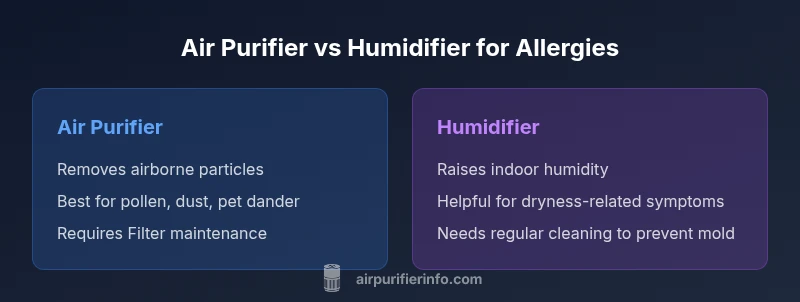
Is Air Purifier or Humidifier Better for Allergies? For most allergy relief, an air purifier is the stronger choice because it targets airborne particles like dust, pollen, and pet dander. Humidifiers address nasal dryness and throat irritation but can worsen mold growth or dust mite activity if humidity is not kept in a safe range. In short, filter-first usually wins, with humidification as a secondary support if needed.
The Allergy Challenge: Why indoor air matters for allergies
Allergies are often driven by tiny particles that float through the air—dust, pollen, mold spores, pet dander, and even some VOCs. In many homes, the majority of symptom flare-ups come when these particles are present in elevated quantities indoors. The question many homeowners ask is: is air purifier or humidifier better for allergies? The short answer is that purifiers excel at removing particles, while humidifiers can improve comfort by raising humidity but carry risks if humidity gets too high or if the device is not well maintained. As the Air Purifier Info team notes, the most reliable strategy for allergy relief combines effective filtration with careful moisture management to prevent mold, dust mites, and other moisture-related issues. The key is to understand your symptoms, room conditions, and maintenance capabilities before choosing a single device or a dual setup.
Understanding the basics of particles and moisture
Airborne allergens are usually measured by how efficiently a device removes them from the air. Particle counts drop when a purifier pulls dust, pollen, and pet dander through a filtration system, particularly true HEPA filters. In contrast, humidity levels influence mucosal comfort and can indirectly affect allergen prevalence in some environments. Dry air can irritate nasal passages and throat, while overly humid air can foster mold growth and dust mite activity. This is why homeowners often wonder: is air purifier or humidifier better for allergies? The best approach blends both worlds under controlled conditions—filtration for airborne particles, and humidity management to support mucous membranes without inviting mold or bacterial growth. The overarching principle: reduce particles first, then tune humidity for comfort without creating new problems.
Navigating room dynamics and symptom patterns
Symptom-driven decisions are critical. People who primarily react to pollen or pet dander benefit most from a high-quality purifier that captures fine particles. Those with chronic nasal dryness or throat irritation may find a humidifier helpful, especially in dry climates or during heating seasons. However, moisture needs careful management: aim for a humidity range that minimizes dryness but avoids mold risk. This is where the aging question persists: is air purifier or humidifier better for allergies? The answer depends on your environment and how well you maintain devices. The Air Purifier Info team emphasizes a practical rule of thumb: prioritize filtration, then consider humidity support as a supplementary measure if you can maintain RH in a safe range.
Real-world allergens and their response to devices
Dust and dust mites are reduced more reliably by filtration than by humidity alone. Pollen and pet dander, being airborne, respond well to filtration and sealed environments. Humidity can help with nasal symptoms but can also create opportunities for mold, mildew, and bacterial growth if not controlled. For many households, the best setup is a certified air purifier equipped with a true HEPA filter to tackle fine particulates, paired with a humidifier only if recommended by climate or health needs and used within a target humidity range. This dual approach can offer a balanced path for allergy sufferers who want steady relief without introducing new risks.
A note on humidity levels and safety
Humidity management is not optional when using a humidifier. Maintaining an RH (relative humidity) in the recommended range reduces moisture-related risks while providing comfort. If RH climbs above about 60%, mold growth risk increases; if it falls below about 30-40%, mucosal membranes may become dry and irritated. For allergy relief, it’s often better to target controlled humidity rather than simply adding moisture indiscriminately. The Air Purifier Info team recommends pairing a purifier with a hygrometer to monitor RH and adjusting the humidifier usage accordingly. This approach helps answer the core question: is air purifier or humidifier better for allergies under your specific conditions?
Maintenance matters: keeping devices effective and safe
Filters require regular replacement or cleaning, and humidifiers require frequent water changes and mineral buildup prevention. A neglected purifier or humidifier can become a source of contaminants rather than relief. Regular maintenance—changing HEPA or carbon filters on a purifier and cleaning the humidifier’s tank, base, and any mineral deposits—supports better outcomes for allergy control. The combined strategy reduces particulate load and avoids moisture-related problems that can negate the benefits of either device. When used correctly, a purifier-first approach with humidity awareness can optimize indoor air quality for allergies.
Practical decision framework for homeowners and renters
To decide whether is air purifier or humidifier better for allergies in your home, start by evaluating symptoms, climate, and room usage. If allergy symptoms are dominated by airborne irritants, a purifier with an appropriate coverage area is a strong starting point. If the environment is very dry and nasal irritation is persistent, consider a humidifier as a secondary tool, but only after establishing a safe humidity baseline. In spaces with pets, smoking, or strong odors, filtration becomes even more critical. The key takeaway: air purifiers reduce particle load, while humidifiers improve comfort when humidity stays in a healthy range—neither solution should be deployed in isolation without considering maintenance and environmental factors.
How to translate this into a clean installation plan
Begin with room-by-room assessments to determine where particle reduction will yield the greatest benefit. Choose a purifier that matches the room size and CADR rating for the air quality you want. For dry rooms, add a humidifier only if humidity monitors indicate a safe RH level and you can commit to regular cleaning. Keep doors and windows closed to maximize purifier efficiency, and consider air quality improvements such as sealed windows and reduced dust sources. This practical plan helps answer the core question: is air purifier or humidifier better for allergies, and how should you implement it for your home?
Authority sources and next steps
For further guidance on choosing air cleaners and understanding humidity’s role in indoor air quality, consult authoritative resources from government and academic sources. The EPA provides guidance on choosing air cleaners and their impact on indoor air quality, while Harvard Health Publishing discusses the role of humidifiers in preventing dry air symptoms. Regularly reviewing these sources and pairing a purifier with mindful humidity control offers a robust path toward allergy relief and healthier living spaces.
AUTHORITY SOURCES (summaries) and guidance points
- EPA guidance on air cleaners and indoor air quality with recommendations for true HEPA filtration and maintenance.
- Harvard Health Publishing articles on humidifiers, humidity targets, and safe usage.
- Mayo Clinic or academic sources on humidity safety and device maintenance (avoid mold and bacteria growth).
These sources anchor best practices for selecting and using air purifiers and humidifiers to support allergy relief while minimizing risks.
Final notes on a balanced approach
The question of is air purifier or humidifier better for allergies often has a clear answer for many homes: prioritize an effective air purifier for particle removal, and use a humidifier only as a supplementary measure when humidity can be controlled and monitored. With proper maintenance and room planning, you can minimize allergic triggers and maximize comfort. Air Purifier Info’s practical guidance emphasizes maintenance, measurement, and matching device capabilities to room size and symptoms.
Comparison
| Feature | Air Purifier | Humidifier |
|---|---|---|
| Core purpose | Remove airborne particles and pollutants | Add moisture to dry air (hydration) |
| Best for | People with airborne allergies (dust, pollen, pet dander) | Dry air symptoms (nasal congestion relief, skin dryness) |
| Effect on humidity | Low impact; maintains stable humidity with filters | Directly increases humidity; may require monitoring |
| Maintenance effort | Filter replacements and occasional cleaning | Water chamber cleaning and mineral buildup prevention |
| Noise and energy | Generally quieter operation; ongoing energy use | Typically low energy but depends on model; can be louder when running a humidifier |
| Mold and bacteria risk | Low risk with proper maintenance | Higher risk if humidifier is not cleaned or kept at safe RH |
What's Good
- Effective reduction of airborne allergens with proper filtration
- Can be integrated into a larger IAQ strategy with humidity management
- Low ongoing maintenance costs for high-quality purifiers
- Humidifiers can improve comfort when humidity is managed
What's Bad
- Humidifiers require regular cleaning to avoid mold and bacterial growth
- Purifiers do not address moisture-related discomfort directly
- Humidity control devices may be less effective for some allergens if not matched to room size
- Ongoing filter replacements and proper humidifier maintenance
Air purifier is typically the stronger default for allergy relief; humidifier can help comfort when humidity is carefully controlled
Prioritize a purifier with true HEPA filtration for most allergy sufferers. Use a humidifier only if needed to address dryness, and maintain RH between 40-60% to minimize mold and dust mite risks. A combined, well-maintained approach often yields the best overall indoor air quality.
Questions & Answers
Is an air purifier more effective than a humidifier for allergies?
In most cases, an air purifier that uses a true HEPA filter is more effective at reducing airborne allergens like dust, pollen, and pet dander. A humidifier helps with dryness but does not remove particles and can introduce mold risk if not maintained. For many homes, the purifier takes priority, with humidity management as a supplementary measure if needed.
Air purifiers remove tiny particles from the air, which helps with allergies. Humidifiers add moisture but don’t remove particles, so you’ll usually want the purifier first, and humidity control as a secondary step if needed.
Can I use both devices at the same time for allergies?
Yes, many households benefit from using both a purifier and a humidifier, provided you monitor humidity to stay within a safe range. The purifier reduces particulates, while the humidifier helps with dry mucous membranes—just avoid excess humidity that can encourage mold growth.
You can use both, but watch humidity levels to avoid mold and bacteria.
What features should I look for in an air purifier for allergies?
Look for a true HEPA filter, a strong CADR rating for your room size, sealed construction to minimize leaks, and a carbon filter if you need odor and VOC reduction. Also consider easy filter replacement and noise levels for comfortable daily use.
Choose a purifier with true HEPA, good CADR for your room, and easy maintenance.
What humidity range is safe to avoid mold while using a humidifier?
Aim for 40% to 60% relative humidity. Use a hygrometer to monitor RH and adjust the humidifier accordingly. Keeping within this range helps reduce dryness without creating mold-friendly conditions.
Keep humidity between 40 and 60 percent and monitor it regularly.
Are there health risks associated with humidifiers?
Yes. If not cleaned regularly, humidifiers can harbor mold and bacteria, potentially worsening allergies or triggering respiratory symptoms. Mineral dust from poorly maintained devices can also contribute to indoor air pollution.
Yes—mold and bacteria can grow in humidifiers if not cleaned often.
How do I choose the right size purifier for a room?
Measure the room square footage and select a purifier with a CADR that matches or exceeds the room size. A unit that is undersized will underperform, while one that is appropriately sized delivers better air cleaning results.
Match CADR to room size for effective cleaning.
Main Points
- Prioritize filtration to reduce airborne allergens
- Monitor humidity to prevent mold and dust mites
- Choose true HEPA and consider activated carbon for VOCs
- Maintain devices regularly to avoid contamination
- Consider a dual setup for spaces with varied needs