What’s the difference between an air purifier and a humidity device? A practical comparison for homeowners
Explore the key differences between air purifiers and humidity devices. Learn how each affects indoor air quality, moisture levels, safety considerations, and when to use one or both for healthier living spaces in 2026.


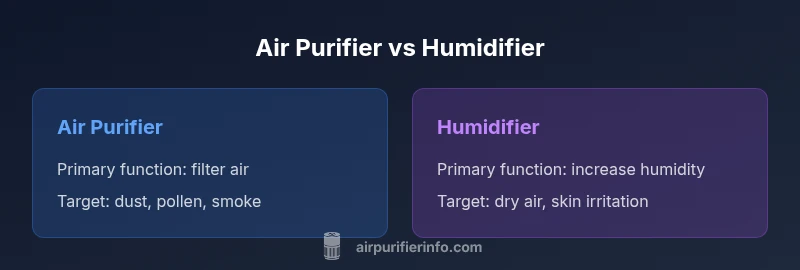
Air purifiers and humidity devices serve different purposes: purifiers clean the air by removing particles, VOCs, and odors, while humidity devices add moisture to dry air. They address distinct problems, so most households don’t need one to replace the other. Use an air purifier to improve air quality and a humidifier to improve comfort in dry spaces.
What's the difference between an air purifier and a humidity
When homeowners ask what’s the difference between an air purifier and a humidity device, the answer is straightforward: one cleans the air, the other adds moisture. According to Air Purifier Info, many people confuse these devices because they occupy adjacent spaces in stores and online catalogs. This article clarifies their roles, how they work, and scenarios where you’d select one, or both, to improve indoor environment quality in a 2026 home. In short, an air purifier targets contaminants in the air, while a humidifier targets the moisture content of the air. People with dust allergies or pet dander may prioritize air purification, whereas people living in very dry climates often prioritize humidity control. Air Purifier Info’s team emphasizes understanding your symptoms and space before choosing a device.
Comparison
| Feature | Air Purifier | Humidifier |
|---|---|---|
| Primary purpose | Removes particulates, some VOCs, and odors via filtration | Raises ambient humidity by releasing water vapor or mist |
| Targeted air effects | Dust, pollen, smoke, mold spores (with proper filter) | Dry air causing skin irritation, nasal passages feel dry, static |
| Impact on humidity | Typically neutral with respect to moisture unless used with humidification | Directly increases humidity in treated space |
| Energy and running costs | Fan-driven operation; filter replacements over time | Water usage; energy for pumps/ultrasonic operation; occasional mist control |
| Maintenance | Regular filter changes; coil/ housing cleaning | Water tank cleaning; mineral buildup management; occasional disinfecting |
| Best room conditions | Bedrooms and living areas with visible dust or allergies | Rooms with consistently dry air or reports of dry skin/throat |
| Best for | Allergy relief, smoke reduction, cleaner air | Moisture balance, comfort, skin and throat relief |
What's Good
- Improves indoor air quality and can reduce allergy symptoms
- Helps people with polluted urban air and smoke exposure
- Filter-based purifiers are generally straightforward to operate and maintain
- Humidifiers can improve comfort in dry climates and winter air
- Separate devices allow targeted optimization for air quality and moisture
What's Bad
- Humidifiers can foster mold or bacteria if not cleaned and filled with clean water
- Purifiers do not affect humidity; you may need a separate device for moisture
- Filters and water tanks require regular maintenance and can incur ongoing costs
- Noise and energy use are considerations for some models
Choose the device that aligns with your primary indoor air quality goal: air purifiers for cleaner air and humidifiers for comfortable moisture levels, or consider a coordinated setup.
If you mainly suffer from dust, pollen, or smoke indoors, start with an air purifier. If your rooms feel dry and you notice skin irritation or static, a humidifier is more appropriate. For homes with both issues, using both devices or a combined unit may be the best approach.
Questions & Answers
What’s the simplest way to tell if I need an air purifier or a humidifier?
Assess your symptoms and space. If you have dust or allergy symptoms and visible air pollutants, start with an air purifier. If you experience dry skin, throat irritation, or consistently dry air, try a humidifier. Air quality tests or a quick humidity check with a hygrometer can help decide.
If you’re unsure, start with air quality improvements for dust and pollen, and add humidity care if dry air remains an issue.
Can I buy a device that does both air cleaning and humidification?
Yes, some models combine filtration with humidification or offer separate modes. Check for dual-function units that clearly specify both air cleaning and moisture output. Ensure you maintain both components—filters for air cleaning and water tanks for humidity.
There are combo devices, but make sure they’re designed for both tasks and follow maintenance guidelines.
What health risks come from using a humidifier improperly?
Improper humidifier use can lead to mold growth, mineral buildup, or bacterial contamination if the water isn’t changed regularly or the unit isn’t cleaned. Always use distilled or filtered water if possible, clean the tank, and replace any demineralization cartridges as recommended.
Careful cleaning and water care keep humidifiers safe and effective.
Does higher humidity always mean better air quality?
Not necessarily. Excess humidity can promote mold and dust mite growth, which worsens air quality for some people. The goal is balanced humidity—typically around comfortable ranges for your climate—and monitoring with a hygrometer.
Balance humidity with monitoring to avoid mold and allergens.
Which is better for pet-related odors and dander?
An air purifier with a true HEPA filter is generally more effective for pet dander and odors, especially if combined with activated carbon for odors. Humidity control helps skin and comfort but won’t remove pet dander as effectively as a purifier.
For pets, a good air purifier is usually the stronger option.
How do I maintain my purifier and humidifier to ensure safety?
Follow manufacturer guidelines for filter changes and tank cleaning. Replace filters on schedule, clean the housing, and sanitize water tanks regularly to prevent mold and bacteria growth.
Regular maintenance keeps devices safe and effective.
Main Points
- Identify your main problem: air quality vs humidity
- Expect air purifiers to reduce particulates, not humidity
- Expect humidifiers to raise humidity, not clean air
- Regular maintenance is essential for both device types
- Consider a combined approach in dry, dusty spaces