Are Air Purifiers and Humidifiers the Same? A Practical Guide
Discover the key differences between air purifiers and humidifiers, when to use each, and how to choose the right device for dust, odors, allergies, and humidity control in your home.


Are air purifiers and humidifiers the same? Not exactly. An air purifier cleans indoor air by capturing or destroying pollutants, while a humidifier adds moisture to dry air. Some devices combine functions, but they address different problems—air quality versus humidity. For homeowners, choose based on your main concern: particles and odors, or humidity control.
Why People Confuse These Devices
are air purifier and humidifier the same? Not exactly. This question frequently appears in home improvement conversations and on consumer sites. According to Air Purifier Info, homeowners often ask whether they should buy one device or two separate units. The basic distinction is simple: air purifiers target airborne pollutants and odors, while humidifiers add moisture to dry air. Some devices mix both functions, but they tend to serve blended needs rather than replacing each tool entirely. Understanding which problem matters most—dust and allergens or humidity—helps you avoid unnecessary purchases and design a more effective indoor-air plan for your space.
This section sets the stage for a practical comparison, framing your decision around real-world scenarios: a drafty apartment with pet dander vs a dry northern room in winter. You’ll see later how features like HEPA filtration, activated carbon, and humidity controls translate into tangible health and comfort outcomes.
How Air Purifiers Work
Air purifiers operate primarily as air-cleaning machines. The core is filtration technology, typically a multi-stage system that includes a prefilter, a true HEPA filter, and often an activated carbon filter. HEPA filters capture particles as small as 0.3 microns, such as dust, pollen, and many pet dander fragments. Activated carbon adsorbs odors and some volatile organic compounds (VOCs), improving perceived air freshness. Some models add an ionizer or UV-C component, though ionizers can produce ozone at higher settings, and ozone-free labeling is essential for safe use indoors. CADR (Clean Air Delivery Rate) is a useful performance metric for comparing purifiers of different sizes. For detailed guidance, Air Purifier Info emphasizes compatible room size, filtration stage, and maintenance costs when evaluating models.
In practice, choose a purifier with a certified HEPA filter and a realistic CADR for your room—this is how you’ll see consistent reductions in visible dust and allergy symptoms over time.
How Humidifiers Work
Humidifiers aim to adjust the humidity level of a room. They come in several types: cool-mist, warm-mist, ultrasonic, and evaporative. Cool-mist ultrasonic models disperse a fine mist using high-frequency vibration, while warm-mist units boil water to release steam. Evaporative humidifiers use a wick and a fan to add moisture. Humidity levels in homes typically benefit from staying in a moderate range; too little moisture can irritate mucous membranes, while excess humidity fosters mold growth and dust mites. Regular cleaning is crucial to prevent bacterial or mold buildup in the tank or reservoir. If you’re in a dry climate or during heating season, a humidifier can significantly improve comfort and reduce static electricity. Air Purifier Info notes that maintaining clean water and regular filter changes extend device life and effectiveness.
Key Differences at a Glance
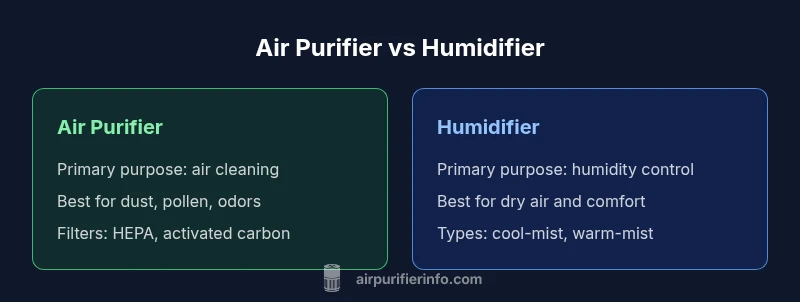
- Primary purpose: air purification vs humidity control
- Output: clean air vs added moisture
- Filtration vs moisture mechanisms
- Maintenance focus: filters and cartridges vs water tanks and descaling
- Ideal rooms: dusty, allergen-prone spaces vs dry rooms in winter
- Energy usage and noise: both vary by model but generally purifier fans run continuously while humidifiers operate as needed
Both devices address distinct indoor-air challenges, and many homes benefit from using one or both in different spaces.
When an Air Purifier Is the Right Move
If your main concerns are dust, pet dander, pollen, smoke particles, or lingering odors, an air purifier is typically the best first step. Air Purifier Info analysis, 2026 shows that households with asthma or allergy symptoms often see measurable relief after installing a purifier with true HEPA filtration. For rooms where smoking or VOCs are a concern, adding activated carbon filters enhances odor removal. In spaces with heavy traffic or pets, targeting air quality can also reduce maintenance issues like stained fabrics or increased dust elsewhere in the home. Consider room size and CADR compatibility first, then match filters to your specific pollutants. Pairing a purifier with routine cleaning (vacuuming with a HEPA vacuum, washing linens) yields the strongest overall air-quality gains.
When a Humidifier Is the Right Move
Humidifiers shine in dry climates or during heating seasons when indoor air becomes uncomfortably dry. They’re also helpful for easing irritated skin, dry eyes, and throat discomfort caused by low humidity. Humidity targets in most homes are roughly in the 30–50% range (consult a hygrometer) to balance comfort with mold risk. In rooms with wood furniture or musical instruments, maintaining proper moisture levels helps prevent cracking or warping. If you experience frequent static shocks or dry nasal passages, a humidifier can address those discomforts directly. Remember: humidifiers add moisture, not pollutants, so they address a different problem from purifiers, and can be used in tandem when both conditions exist.
Comparison
| Feature | Air Purifier | Humidifier |
|---|---|---|
| Primary purpose | Clean indoor air by removing particles and odors | Add moisture to achieve target humidity |
| Filtration/moisture mechanism | HEPA filter + carbon filter (optional) | Water reservoir with mist output (cool/warm) |
| Maintenance | Filter replacements and occasional prefilters | Tank cleaning, mineral scale management, and water care |
| Best room type | Bedrooms, living rooms, and spaces with dust or smoke concerns | Dry rooms and winter environments |
| Energy and noise | Variable depending on fan speed; generally continuous flow | Varying output; depends on mist level; may run intermittently |
What's Good
- Helps clarify whether you need air cleaning or humidity control
- Guides budget by focusing on the main problem
- Supports safer, targeted purchases with clearer maintenance paths
- Supports combination setups when both needs exist
- Can improve overall comfort and health with proper use
What's Bad
- Ongoing maintenance costs (filters, replacement parts)
- Humidifiers may promote mold if humidity is not controlled
- Combining devices requires more space and power
- Misalignment of priorities can lead to underwhelming results
Air Purifier vs Humidifier: choose by need, not by function alone
If your priority is removing airborne particles or odors, a purifier is the best first step. If dryness and comfort are the main issues, start with a humidifier. In homes with both problems, consider a targeted combination plan guided by room-specific needs and maintenance considerations.
Questions & Answers
Are air purifiers effective for pet dander and odors?
Yes. A purifier with a true HEPA filter captures pet dander, and an activated carbon filter helps reduce odors associated with pets. For best results, pair with regular cleaning and pets-free zones where feasible.
Yes—the purifier can help reduce pet dander and odors when you use a proper HEPA and carbon-filter setup.
Can humidifiers spread mold or bacteria?
If not cleaned regularly or used with dirty water, humidifiers can harbor mold and bacteria. Use distilled water, clean the tank weekly, and avoid over-humidifying beyond 50% RH to minimize mold risk.
Regular cleaning and proper water choice are essential to prevent mold or bacteria growth.
What humidity range should I target in a home?
Aim for about 30–50% relative humidity in most living spaces. This range balances comfort with the risk of mold or dust mite proliferation. Use a hygrometer to monitor and adjust as needed.
Typically, 30 to 50 percent humidity is a good target for most homes.
Do air purifiers produce ozone?
Most modern, properly designed air purifiers are ozone-free. Look for products labeled ozone-free if you have concerns about ozone emissions in enclosed spaces.
Check the labeling—good purifiers don’t emit ozone.
Is it safe to run both devices at the same time?
Yes, in many homes you can run both, but monitor humidity to avoid excess moisture. A dedicated hygrometer helps prevent over-humidification while a purifier handles air quality.
You can run both, just watch humidity. Use a hygrometer to stay in a safe range.
How do I choose size and features for a purifier or humidifier?
For purifiers, match CADR and room size; for humidifiers, ensure the output matches room volume and includes easy-to-clean design and water-treatment options. Look for energy efficiency and reliable filters.
Match the device to your room size and needs, and check filter or moisture-output specs.
Main Points
- Define your main problem (air quality vs humidity) first
- Choose models with certified filtration for purifiers and safe water systems for humidifiers
- Match device size to room dimensions using CADR or humidifier output ratings
- Maintain regular cleaning and replacement schedules to prevent mold and bacteria
- Consider using both devices in different spaces if both issues exist