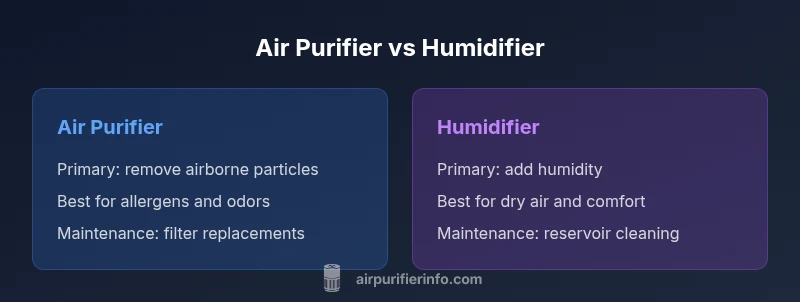
What to Buy: Air Purifier or Humidifier in 2026
Compare air purifiers and humidifiers to decide which device best supports your home's air quality and comfort. Learn how to choose, size, and use for optimal results.


For most homes, the decision comes down to your primary goal: air quality vs humidity. If dust, allergies, or odors are your concern, choose an air purifier; if dry air causes coughing or skin irritation, choose a humidifier. For mixed needs, consider a dual-function unit or using both.
Understanding the core difference between an air purifier and a humidifier
At its core, deciding what to buy air purifier or humidifier hinges on your primary IAQ goal. An air purifier targets airborne contaminants—dust, pollen, pet dander, smoke, and VOCs—while a humidifier adds moisture to the air to address dryness, throat irritation, and nose discomfort in dry environments. In many homes the goals overlap: a purifier can help remove damp odors that indicate mold spores, and a humidifier can make breathable air feel less dusty if humidity is too low for comfort. The decision is rarely a simple binary; in fact, many households benefit from using both devices, or a dual-function model if available. This guide maintains an analytical tone, focusing on room size, usage patterns, maintenance, and safety implications. According to Air Purifier Info Team, clarity about your primary goal remains the strongest predictor of long-term satisfaction and measurable gains in indoor air quality.
The data behind IAQ devices: how to evaluate performance
Performance metrics and testing methodologies shape what you get for your money. For air purifiers, consumer-grade metrics revolve around CADR (clean air delivery rate), filter efficiency, and coverage area. For humidifiers, the focus is humidity output, ability to maintain target humidity, and cleanliness features to prevent mineral buildup or microbial growth. A practical evaluation also weighs energy use and noise, because an efficient device that disrupts sleep defeats the purpose. When you read specifications, look for independent tests, such as those summarized by consumer reports and industry bodies. Air Purifier Info analysis shows that real-world performance often diverges from lab ratings due to room layout, leakage, and how quickly a device cycles air. Therefore, plan on verifying performance with your own measurements over a two-week trial and adjust placement if you notice stagnant corners, hot spots, or noisy operation. The objective is to match device capabilities with your space and your priorities, not chase the highest spec alone.
When air purification matters most: allergens, smoke, and pollutants
The cases where purification pays off most are when occupants wrestle with seasonal allergies, pet dander, cooking odors, wildfire smoke, or tobacco smoke. In such scenarios, an air purifier with a true HEPA filter and activated carbon stage can capture particles down to at least 0.3 microns and adsorb odor-causing compounds. The key is proper CADR relative to room size and a sealed environment—gaps around doors, windows, and vents can drastically reduce effectiveness. For renters or homeowners with sensitive occupants, a purifier that supports a higher air changes per hour helps maintain consistent air quality throughout the living space. A caution: some cheaper units advertise impressive CADR numbers but use subpar filters. Prioritize certified products with replaceable filters and verify filter replacement costs. In some environments, air purifiers can help reduce dust, pollen, and smoke-related irritants, contributing to improved sleep and fewer allergy symptoms.
When humidity matters most: dry air, condensation, comfort
Humidifiers address symptoms of dry air: dry skin, throat irritation, and congestion. However, adding moisture to the air can also encourage mold growth, mineral dust, and bacteria if not cleaned properly. The benefits show up in dry winters or in climates with low outdoor humidity, but the risks increase when humidity levels become too high or when water reservoirs become neglected. Look for units with automatic humidity control, sanitized filters, and easy cleaning routines. Distilled water reduces mineral dust; cleaning schedules reduce microbes. If you share your space with plants or wood furniture, stable humidity helps maintain material integrity. A humidifier is not a purifier; the two devices address different problems, and improper use can create new ones.
How to size and place your device
Sizing a purifier or humidifier starts with the room. For purifiers, choose a unit rated for at least the size of the space you want to treat, and consider placement away from walls and furniture to prevent dead spots. For humidifiers, match capacity to square footage and ensure the device can sustain comfortable humidity without overshooting. In small bedrooms, a compact purifier or a portable humidifier with a built-in humidistat can be enough; in larger living rooms, a higher-capacity unit or multiple units may be necessary. Placement matters: avoid corners where air stagnates and keep devices on stable, level surfaces. For best results, run the purifier or humidifier continuously on a schedule that aligns with occupancy patterns, typically during the hours when you’re home most of the day or sleeping.
Maintenance, safety, and operating costs
Regular maintenance is essential for both devices. Air purifiers require periodic filter replacements or cleanings, with costs rising as you scale to larger rooms or higher CADR units. Humidifiers need regular reservoir cleaning, mineral filter replacement (if applicable), and using distilled water to minimize mineral buildup and white dust. Safety considerations include avoiding over-humidification, which can promote mold or dust mite proliferation, and ensuring electrical safety and water protection for floors and furniture. When evaluating operating costs, add energy consumption, filter/filter replacements, and potential additional moisture-related cleanup. A prudent approach is to set up a maintenance calendar that tracks filter life and cleaning reminders, so operations remain efficient and clean.
Combining devices: is a dual-function unit worth it?
Dual-function air purifiers with built-in humidification are marketed as convenient, but they can involve trade-offs. While they save space and simplify control, they may compromise either filtration efficiency or humidity precision compared with dedicated devices. If you have a small apartment with limited space, a high-quality purifier with a separate, compact humidifier could be the best balance. In larger homes, or spaces with varying humidity, using two separate units or a separate dehumidifier in high humidity seasons can yield more consistent results. Consider your climate, occupancy patterns, and maintenance tolerance when deciding between dual-function devices and separate purifiers and humidifiers.
Practical decision framework: quick checks for your home
To decide what to buy air purifier or humidifier, start with your top priority: particle reduction or humidity control. Look at the room size, typical occupancy, and presence of pets or smokers. If you frequently wake up congested or wake with dry skin, you may benefit from humidity control; if you sneeze while cooking or notice persistent odors, purification is likely more impactful. Use trusted brands and look for independent testing and clear replacement schedules. Finally, test a trial period where you run the device on a moderate schedule and observe changes in comfort and air visibility. Your assessment should be based on subjective comfort and objective indicators like allergy symptom frequency and reported nasal dryness.
Quick-start checklist and next steps
- Define your primary IAQ goal: purification, humidity, or both.
- Measure room size and choose the appropriate device capacity.
- Check for true HEPA or certified filtration and humidity control features.
- Plan maintenance schedules for filters and cleaning.
- If budget allows, consider a paired setup or a high-quality dual-function unit and monitor results for 30 days.
Comparison
| Feature | Air purifier | Humidifier |
|---|---|---|
| Primary purpose | Remove airborne contaminants (dust, pollen, smoke, VOCs) | Add moisture to the air (humidification) |
| Ideal usage context | Polluted air, allergies, smoke, odors | Dry air in winter, skin/throat discomfort |
| Best for | Reducing allergens and odors; improving overall air quality | Improving comfort from dryness; preventing skin irritation |
| Maintenance frequency | Filter replacements and occasional cleaning | Reservoir cleaning and mineral management (if applicable) |
| Common safety concerns | Filter performance, regular replacement | Over-humidification and mold risk if misused |
| Noise level | Variable by model, often quiet on low | Variable, can be noticeable at higher humidity levels |
| Energy use | Moderate to high depending on CADR and room size | Moderate depending on output and reservoir size |
| Price range | Wide range from budget to premium | Wide range from budget to premium |
What's Good
- Air purifiers reduce dust, pollen, smoke, and odors for cleaner indoor air
- Humidifiers alleviate dry air symptoms like dry skin and throat irritation
- Both can improve sleep quality when used with sensible settings
- A broad range of sizes and features makes them accessible for most homes
- Some models offer built-in sensors and auto modes to simplify use
What's Bad
- Purifiers do not address humidity; humidifiers do not remove airborne pollutants
- Humidifiers can promote mold or bacteria if not cleaned regularly
- Both require ongoing maintenance and occasional filter or part replacements
- Overuse or incorrect placement can cause discomfort or property damage
- Upfront costs vary widely and may be difficult to justify without a clear need
Choose based on your primary IAQ goal: purifier for contaminants, humidifier for humidity; for mixed needs, pair devices or select a dual-function unit.
If you predominantly suffer from allergies or odors, start with a purifier. If dryness or comfort is the main issue, start with a humidifier. For both problems, consider combining devices or choosing a unit with dual capabilities, and monitor results over a few weeks.
Questions & Answers
What is the main difference between an air purifier and a humidifier?
An air purifier removes airborne particles to improve air quality, while a humidifier adds moisture to the air to improve comfort in dry environments. They serve distinct IAQ goals, though some homes benefit from using both.
An air purifier cleans the air; a humidifier adds moisture. They address different problems, and many homes use both.
Can I use both devices in the same room?
Yes, you can. Just monitor humidity levels to avoid over-humidification, which can foster mold and dust mites. Proper placement and maintenance help ensure both devices work harmoniously.
Yes, you can use both in the same room, but keep humidity in check and maintain devices.
How do I choose the right device for a small bedroom?
For small spaces, start with one compact purifier or humidifier sized for the room. If allergies are a concern, prioritize purification; if dryness is an issue, prioritize humidity control. Consider a model with auto modes and easy cleaning.
For a small bedroom, pick a compact purifier or humidifier suited to the room, with auto modes.
What features should I look for in a device?
Look for true HEPA filtration or certified filtration, appropriate room sizing, sensors for air quality or humidity, auto modes, and easy filter cleaning/replacement. For humidifiers, consider antimicrobial reservoirs and distilled water use.
Key features include HEPA filtration, appropriate room size, sensors, and easy maintenance.
Are there safety concerns with humidifiers?
Yes. Over-humidification can promote mold. Clean reservoirs regularly and use distilled water to minimize mineral deposits. Ultrasonic units may spread mist differently; follow manufacturer guidance.
Yes—clean regularly and avoid over-humidification to prevent mold.
Will a purifier help with odors, pets, or smoke?
Air purifiers with activated carbon filters can reduce odors and some smoke smells, but effectiveness depends on the level of pollution and room size. For strong odors, pair with good ventilation.
Purifiers help with odors and smoke if the unit has carbon filtration and is appropriately sized.
Is a dual-function unit worth it for a medium-sized living room?
It can be convenient, but dual-function units may compromise peak performance for either function. If your space is medium-sized and you have mixed needs, consider a dedicated purifier or humidifier with strong specs, or use two separate devices.
In a medium living room, a separate purifier and humidifier may outperform a dual-function unit.
How often should I replace filters or clean the devices?
Follow the manufacturer’s schedule for filter replacements and reservoir cleaning. In homes with pets or smokers, maintenance is more frequent. Set reminders and inspect units monthly.
Follow the owner’s manual for filter changes and cleaning; set reminders to stay on track.
Main Points
- Define your primary IAQ goal before buying
- Size devices to room and occupancy for effective results
- Regular maintenance is essential for safety and efficacy
- Consider sensors and auto modes to simplify control
- For mixed needs, explore dual-function devices or paired units