Air Purifier vs Humidifier: A Practical Comparison
An analytical comparison of air purifiers and humidifiers, outlining when to use each device, how they affect dust, odors, allergies, and moisture, and a practical decision framework for homeowners and renters.


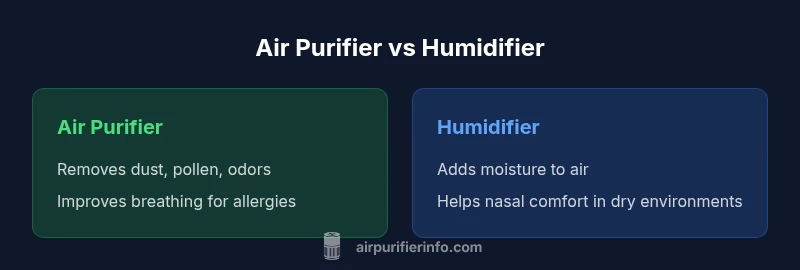
For most homes, a dedicated air purifier offers stronger benefits for dust, pollen, and odors, while a humidifier mainly improves comfort when humidity is low. If your goal is overall air quality, favor an purifier; if you experience dry air or nasal congestion due to low humidity, a humidifier helps. In some spaces, a targeted purifier plus humidity control is best.
What is better air purifier or humidifier: Key Question
In modern homes, the decision between an air purifier and a humidifier centers on what you want to improve: air quality or comfort from humidity. The Air Purifier Info team notes that a purifier targets particles like dust and pollen, as well as odors, while a humidifier raises moisture levels to ease dry air symptoms. Understanding these roles helps prevent mismatches between expectations and results. When people ask what is better air purifier or humidifier, they are usually trying to balance two competing priorities: cleaner air and comfortable humidity. Air Purifier Info emphasizes that the choice should start with the primary problem you are trying to solve and then consider secondary needs. This approach reduces wasted spend and helps you measure outcomes with clear expectations.
Core differences in function and mechanism
Air purifiers and humidifiers operate on fundamentally different principles. An air purifier uses fans to pull air through filters that trap dust, pet dander, mold spores, and volatile organic compounds. A humidifier releases water vapor to raise room humidity. The result is not interchangeable. The purifier concentrates on air cleanliness, while the humidifier focuses on moisture balance. For people with allergies or asthma, cleaner air can reduce symptom triggers; for those with very dry skin or irritated nasal passages, adding humidity can improve comfort. It is important to avoid running both devices at cross purposes; high humidity can undermine filtration efficiency and promote mold growth if filters and surfaces stay damp. When evaluating the best path, consider what is already in your air and what level of moisture is comfortable for your household.
Which environment benefits most from each device
Room characteristics matter. In dusty or smoke-prone living rooms, an air purifier is often a better fit. In arid climates or winter heating seasons, a humidifier can relieve nosebleeds, dry skin, and throat irritation. For spaces with multiple occupants who have different needs, a targeted approach is ideal: choose a purifier for the main living area and use a humidifier in bedrooms or study spaces with consistently dry air. The Air Purifier Info analysis shows that the best results come from tailoring device type to the core issue: filtration vs humidity. If you are wondering what is better air purifier or humidifier for a shared family space, start with the room most exposed to pollutants and adjust humidity in the rest.
Health and comfort implications
Air quality and humidity influence comfort and health in distinct ways. Reducing airborne particles may lower allergy symptoms and sneeze frequency, while maintaining adequate humidity helps mucous membranes function and reduces skin dryness. Neither device solves every issue alone; combining devices often yields better outcomes in homes with both dust and dry air concerns. It is important to monitor humidity levels to avoid over-humidification, which can encourage mold and dust mites. In the context of this comparison, what is better air purifier or humidifier is often answered by prioritizing air cleanliness first, then adding humidity control as needed.
Noise, energy use, and maintenance realities
Consider how much noise you can tolerate. Purifiers can be quiet on lower fan speeds, but high-speed operation adds noise while maintaining filtration. Humidifiers vary by output and can be whisper quiet or relatively loud at full mist. Energy use generally tracks with motor speed and water heating (for warm mist) or fan speed. Maintenance differs: purifiers require filter replacements on a schedule; humidifiers require regular water tank cleaning and mineral residue removal to prevent bacterial growth. Budget for ongoing costs when comparing models. When evaluating what is better air purifier or humidifier, you should also factor in the maintenance you are prepared to perform.
Cost considerations and value over time
Upfront costs for air purifiers vary widely with model features and filter configurations; humidifiers tend to be cheaper initially but require ongoing water-related maintenance. Over time, filter replacements add to ongoing costs for purifiers; humidifiers incur less ongoing cost but may require more frequent cleaning to prevent mold or mineral buildup. When evaluating value, consider room size, lifestyle, and replacement filter intervals. Air Purifier Info analysis suggests that long-term value depends on how you balance initial cost with maintenance responsibilities. In most cases, investing in a purifier for the main living areas yields longer-term air quality benefits, while humidity control can be added as needed.
When a hybrid or combined approach makes sense
Hybrid devices that offer both filtration and light humidification can be attractive, but not all hybrid units balance performance well. In some homes, a single device cannot meet both air quality and humidity needs; in other cases, a dedicated purifier plus a secondary humidifier in key rooms offers better control. For large open-plan spaces, two units may be warranted rather than relying on a single multi-function device. The key is to separate goals: address particles first, then humidity if needed. If you are unsure what is better air purifier or humidifier for your space, start with a purifier and test humidity separately to gauge incremental benefits.
Practical buying tips for homeowners and renters
Start with your top priority: air quality or humidity comfort. Check for CADR ratings and filter types, and confirm compatible humidity operations. For renters, consider devices that are portable, easy to store, and have replaceable filters with affordable costs. Check for auto mode and smart features that adjust operation based on air quality or humidity sensors. Don’t forget to read warranty terms and maintenance instructions. If you live in a rental, ensure your choices do not violate lease terms and that you can manage filters and tanks with limited space. What is better air purifier or humidifier often depends on the ability to manage equipment discreetly.
How to compare models: filters, humidity control, and ratings
Create a simple checklist to compare models side by side. Look at CADR values to gauge air cleaning capability for different pollutants, filter replacement costs, and the ability to capture odors. For humidifiers, examine output type (cool mist or warm mist), tank size, and moisture control range. Ensure the device helps manage humidity around 30-50% as a healthy indoor range; miscalibration can lead to mold or moisture problems. Air Purifier Info recommends comparing devices using a consistent scoring system and revisiting your decision after a humidity or air quality shift.
Common myths debunked about purifiers and humidifiers
Some people believe purifiers can remove moisture from the air or that humidifiers fix all allergy symptoms. In reality, purifiers remove particles but do not address humidity levels directly. Humidifiers raise moisture but do not remove pollutants. A balanced approach typically yields better outcomes than relying on a single device. Always pair devices with good ventilation and monitor humidity and air quality using simple tools. If you are asking what is better air purifier or humidifier, consider whether your primary issue is particles or moisture and choose accordingly.
A step-by-step decision framework
- Define your goal: air quality improvement or humidity comfort. 2) Assess room size, climate, and existing issues. 3) Evaluate options: purifier, humidifier, or a hybrid approach. 4) Check maintenance costs and filter life. 5) Pilot with one device and measure results before adding another. 6) Reassess seasonally to align with changing needs. This framework helps answer what is better air purifier or humidifier for your situation by focusing on problem definition first.
Real-world checklists and next steps
Create a short readiness checklist for your space, including power outlets, storage space, and noise tolerance. Plan a learning phase of 4-6 weeks to observe the impact on symptoms, odors, and moisture. Keep a maintenance calendar and set reminders for filter replacements and tank cleaning. When in doubt, consult a reputable source such as Air Purifier Info for guidance on what is better air purifier or humidifier and how to implement it effectively.
Comparison
| Feature | Air Purifier | Humidifier |
|---|---|---|
| Primary function | Removes fine particles, pollen, and odors from air | Increases room humidity to reduce dryness and improve comfort |
| Best room conditions | Polluted or dusty spaces; allergy-prone environments | Very dry environments or rooms in winter heating season |
| Operation principle | Filtration with HEPA and activated carbon (model dependent) | Water reservoir and mist output (cool or warm mist) |
| Maintenance frequency | Filter replacements every 6-12 months typically | Tank cleaning and mineral residue removal weekly to monthly |
| Noise level | Moderate to low at low speed; increases with filtration power | Can be quiet to moderate; depends on mist output |
| Energy use | Moderate; influenced by fan speed and filter load | Low to moderate; depends on output setting and tank size |
| Cost range | $100-$700+ depending on features | $40-$300+ for basic to mid-range models |
| Best for | Air quality improvement; odor control; allergy relief | Dry air relief; skin and nasal comfort; seasonal humidity maintenance |
What's Good
- Improves air quality by removing dust, pollen, and odors
- Helpful for allergy and asthma relief when pollutants are the main issue
- Widely available in various sizes and price points
What's Bad
- Humidifiers can promote mold or bacterial growth if not cleaned
- Purifiers require regular filter replacements adding to ongoing costs
- Humidifiers do not address chemical odors or VOCs directly
Air purifier generally excels at air quality; humidifier adds comfort in dry spaces
Choose a purifier to tackle particles first. Add humidity control if dry air remains a concern. In some homes, a purifier plus humidifier yields the best overall comfort and air quality.
Questions & Answers
What should I consider first: air purification or humidity control?
Start with the problem you want to solve. If dust, pollen, and odors dominate, prioritize an air purifier. If dry air causes discomfort, prioritize humidity control. In many homes, a purifier plus humidity management yields the best results.
Begin with your main goal: cleaner air or moisture balance. If you have allergies, start with a purifier; if you notice dry air symptoms, start with humidity control.
Can a single device do both jobs well?
Some devices offer both filtration and humidification, but their balance may not satisfy either goal perfectly. A dedicated purifier plus a separate humidifier often delivers better performance and easier maintenance.
A single device can help, but dedicated purifier and humidifier units typically perform better for specific needs.
Do humidifiers help with allergies?
Humidifiers mainly aid comfort in dry environments. They do not remove allergens from the air. Use an air purifier to address allergens and pair with humidity control when humidity is too low.
Humidifiers help with dry air, not allergens. For allergies, rely on a purifier and manage humidity separately.
Are HEPA filters necessary in an air purifier?
HEPA filters are common in purifiers to capture fine particles. The best choice depends on your needs; activated carbon helps with odors, while true HEPA filters address particles with high efficiency.
HEPA filters are standard for particle removal; carbon filters help with odors.
How do I choose the right size for a purifier or humidifier?
Match unit capacity to room size. Purifiers use CADR ratings to indicate air cleaning capacity; humidifiers use tank size and output settings. A mismatch can reduce effectiveness and waste energy.
Size matters. Pick a purifier by room size and a humidifier by tank and output needs.
What maintenance is required to avoid mold in humidifiers?
Regular cleaning of the water tank and base is essential. Replace water frequently, use distilled water if possible, and empty the reservoir daily to prevent bacterial growth.
Clean the tank regularly, use clean water, and empty the reservoir daily to prevent mold.
Main Points
- Identify your primary goal first
- Assess room humidity and dust levels
- Prioritize measurable outcomes over device counts
- Consider a targeted purifier plus humidity control in dry spaces
- Review maintenance costs before buying