Humidifier vs Air Purifier: A Practical, Data-Driven Guide
Compare humidifiers and air purifiers to decide which device fits your home. Learn when to use each, maintenance tips, and how to optimize indoor air quality with a data-driven approach.


Humidifiers and air purifiers serve different purposes: humidity versus particle removal. A humidifier air purifier combination can offer convenience, but single-function devices often perform better for their primary job. For most homes, prioritize an air purifier for dust, pollen, and smoke, and add a separate humidifier only if indoor moisture is too low.
Understanding the Scope: humidifier air purifier in a home environment
In the home, the terms humidifier and air purifier describe two distinct goals: humidity management and air cleanliness. The phrase humidifier air purifier is sometimes used to describe a device that attempts to do both, but most units specialize in one core function. For homeowners and renters aiming to improve overall indoor air quality, the best approach is to separate tasks: use a dedicated air purifier to reduce airborne particles and odors, and add a humidifier only when relative humidity consistently falls below recommended ranges. This separation helps you achieve reliable performance for each function and reduces the risk of compromising either task. According to Air Purifier Info, understanding your indoor climate is the first step toward targeted, effective choices.
Core functions explained: how moisture and filtration differ
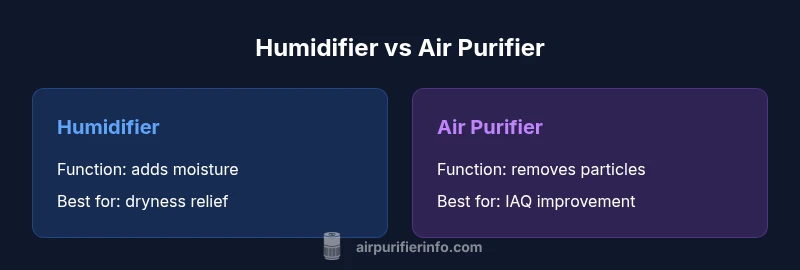
At a high level, humidity control (humidifier) and air cleaning (air purifier) address two different problems. Humidifiers increase moisture in the air to relieve dryness, protect wooden furnishings, and support skin and respiratory comfort. Air purifiers remove particles such as dust, pollen, pet dander, smoke, and some microorganisms depending on the filtration stage. The key difference is that humidifiers move water vapor into the space, while air purifiers move air through filters that trap contaminants. If your priority is reducing household dust or allergy triggers, an air purifier is typically the most effective starting point. If you live in a climate with dry air, a humidifier can be essential for comfort and health, especially in bedrooms and living areas. Air Purifier Info emphasizes balancing moisture with air quality for optimal comfort.
How to assess your room’s needs: humidity levels and IAQ indicators
Begin with a baseline check of both humidity and air quality. Use a reliable hygrometer to monitor relative humidity (RH); aim for roughly 30–50% RH in most homes, adjusting for comfort. For IAQ indicators, track visible dust, cough or throat irritation, and seasonal allergens. If RH drops below 30%, dry air may irritate mucous membranes; if it rises above 60–65%, you risk mold and dust mites. A dedicated air purifier works best when your main issue is airborne particles, while a humidifier is more appropriate when humidity is consistently low. Air Purifier Info’s approach is to measure, then match device choice to the dominant problem rather than buying a single device to cover multiple tasks.
Types of humidifiers and what they mean for performance
Humidifiers come in several types, including evaporative, ultrasonic, and steam (warm-mist). Evaporative units use a wick or filter and a fan to add moisture; ultrasonic units use high-frequency vibrations to create a fine mist. Steam humidifiers boil water for moisture, which can kill some microbes but requires more energy. Each type has trade-offs: evaporative and steam models can be easier to maintain but may require regular filter changes or mineral management; ultrasonic models are quieter but can spew mineral dust if not properly treated. For most homes, choosing a reputable model with a built-in humidistat helps maintain safe, consistent humidity.
Types of air purifiers and how they work
Air purifiers vary in filtration technology. True HEPA purifiers capture 99.97% of particles as small as 0.3 microns, including dust, pollen, and many smoke particles. Activated carbon filters help with odors and some volatile organic compounds (VOCs). Some purifiers include pre-filters to capture large particles and UV-C or ionization features, though these may come with additional considerations. When selecting an air purifier, look for CADR (clean air delivery rate) ratings that match your room size, and choose models with certified filters and replaceable parts. The goal is consistent, effective air cleaning without excessive noise or energy use.
Maintenance and safety: keeping devices effective and safe
Maintenance is a core determinant of both humidifiers and air purifiers’ effectiveness. Humidifiers require regular cleaning to prevent mold and bacterial growth, especially in the water tank and internal tubes. Mineral buildup from hard water can create white dust and needs filtration or regular descaling. Air purifiers require filter replacements on a schedule aligned with usage and air quality; a clogged filter reduces performance and increases energy use. Always follow manufacturer instructions, use distilled water in humidifiers if possible, and monitor humidity levels to prevent mold growth. Safety considerations include avoiding over-humidification and ensuring filters installed correctly for optimal performance.
Practical sizing: matching devices to room dimensions
Room size is a critical factor. An air purifier that’s underpowered for the space will fail to improve IAQ, while an oversized unit may be noisy and costly. Look at the manufacturer’s recommended room size and CADR numbers to ensure adequate cleaning capacity. For humidifiers, consider the ceiling height, air exchange rate, and whether the space experiences rapid humidity loss. In small bedrooms, a compact humidifier with a built-in humidistat is often sufficient; larger living rooms benefit from air purifiers with higher CADR across multiple zones. The right combination depends on climate, occupancy, and the presence of pets or smokers in the home.
Practical scenarios: when to add a dedicated humidifier or purifier
If you live in a dry winter climate, a humidifier is essential to maintain comfort, reduce nasal irritation, and protect wooden furniture. If you suffer from seasonal allergies or frequent coughing due to dust or pollen, a dedicated air purifier is usually the best first purchase. In households with both concerns, a balanced approach — a dedicated air purifier for primary IAQ improvement and a humidifier for humidity control — tends to yield the most consistent results. Dual-function units may seem appealing, but research and field experience show they rarely outperform purpose-built devices for each task. Air Purifier Info notes that reliability and ease of maintenance often favor separate devices.
Dual-function devices: should you buy one?
Dual-function humidifier air purifier units are convenient but often compromise on strength in at least one function. If you live in a compact apartment with budget constraints, a dual-function unit might be worth testing, provided you confirm independent performance claims for both moisture and filtration. However, if you are managing moderate to high pollution or extreme dryness, invest in a dedicated purifier and a separate humidifier. This strategy improves monitoring and maintenance, reduces the risk of cross-contamination, and yields better, measurable outcomes in air quality and comfort.
Implementation plan: a step-by-step setup for most homes
- Measure RH and IAQ with a reliable hygrometer and, if possible, a basic particle counter or air-quality monitor. 2) Decide on primary need: humidity control or particle reduction. 3) Choose a dedicated air purifier sized for the room and with a true HEPA filter. 4) If humidity is low, select a humidifier with a built-in humidistat and auto shutoff. 5) Place devices to optimize performance: keep air purifiers away from walls but not in direct airflow, and position humidifiers away from heat sources and outlets. 6) Monitor humidity and IAQ weekly and adjust as needed. 7) Schedule regular maintenance: replace filters on time, clean tanks as recommended, and use distilled water to reduce mineral buildup.
Quick-start checklist for new buyers
- Confirm the main problem: dryness or airborne particles. - Pick a dedicated purifier sized for the room. - If humidity is an issue, add a humidifier with a humidistat. - Check filters annually and replace as recommended. - Keep the room well-ventilated to avoid stale air. - Maintain a regular cleaning routine for both devices. - Consider a dehumidifier in areas with high humidity or dampness (if needed).
Final considerations before purchase: quality, warranty, and support
When evaluating humidifier air purifier options, prioritize build quality, safe materials, and a reasonable warranty. Look for units with certifications or independent testing where available. A longer warranty often reflects confidence in component durability and filter performance. Also consider the availability of replacement parts and filters in your region, as ongoing maintenance is a key driver of long-term value. Air Purifier Info suggests that buyers should scrutinize both initial costs and ongoing maintenance when choosing between single-function and dual-function devices.
Comparison
| Feature | Humidifier | Air Purifier |
|---|---|---|
| Primary purpose | Add moisture to indoor air | Remove airborne particles and odors |
| Targeted benefits | Relief for dry skin, throat, and nasal passages; reduced static | Lower dust levels; reduced pollen, pet dander, smoke odors |
| Filtration vs moisture control | N/A or moisture-focused (may include microfilters in some models) | HEPA filtration + activated carbon (often true HEPA is used) |
| Maintenance | Tank cleaning, mineral scale management, occasional filter changes (depending on model) | Filter replacements, occasional pre-filters cleaning |
| Noise level | Low to moderate (varies by model and usage) | Low to high (depends on fan speed and filter design) |
| Energy use | Low to moderate (depends on water evaporation rate) | Low to moderate or higher with high CADR models |
| Best room size guidance | Effective across a range, depending on tank size | Best matched to room size via CADR and room coverage |
| Best for | Dry air relief, comfort in bedrooms and living spaces | Allergen reduction, smoke and odor control, overall IAQ |
What's Good
- Clarifies whether the dominant issue is humidity or particle contamination
- Helps avoid overpaying for combined devices with limited performance
- Encourages targeted maintenance for each function
- Supports better troubleshooting when problems persist
- Facilitates room-by-room customization for IAQ
What's Bad
- Requires managing two devices in some homes
- Increases upfront and ongoing maintenance costs
- Requires more space and more setup considerations
- Potential confusion if humidity and IAQ worsen simultaneously
Separate devices typically outperform dual-function units for reliable humidity and air purification
For most homes, prioritize a dedicated air purifier for particle removal and a separate humidifier if humidity control is needed. Dual-function units can be convenient but often compromise performance in one area. The Air Purifier Info team recommends evaluating room-specific needs and choosing specialized devices when possible.
Questions & Answers
What is the main difference between a humidifier and an air purifier?
A humidifier adds moisture to indoor air to alleviate dryness, while an air purifier filters particles to improve air cleanliness. They target different problems and are typically most effective when used separately.
A humidifier adds moisture while an air purifier cleans the air. They solve different problems, so they usually work best as separate devices.
Can I buy a single unit that both humidifies and purifies the air?
Yes, some models combine both functions, but verify that each function has proven performance for your space. Many dual-function units trade some effectiveness for convenience, so check reviews and specifications carefully.
Yes, you can find dual-function units, but check their performance claims and read reviews to ensure they meet your needs.
How do I decide which device to buy first?
Start with the primary issue: if IAQ is the main concern (dust, pollen, smoke), choose a purifier. If humidity is consistently low, add a humidifier. In many homes, a purifier first and a humidifier second gives the best outcomes.
Start with the most pressing problem: air quality or humidity. Purify first if particles are the issue; humidify if air is dry.
What size should the purifier be for my room?
Choose a purifier rated for the room size using CADR appropriate to that space. An underpowered purifier won’t improve IAQ, while an oversized unit can be noisy and costly.
Pick a purifier with enough CADR for your room size; bigger isn’t always better if it’s noisy.
What maintenance should I expect for a humidifier?
Regular cleaning of the tank and surfaces is essential to prevent mold and bacteria. Use distilled water if possible, and descalers for mineral buildup. Replace any filters per the manufacturer’s schedule.
Clean the humidifier often, use distilled water, and replace filters as advised.
Are there safety risks with dual-function devices?
Dual-function devices can be convenient but may have trade-offs, including less effective filtration or humidity control. Always verify safety features, water quality guidance, and maintenance requirements before purchase.
Dual-function units can save space but check safety features and maintenance so they don’t underperform.
Main Points
- Prioritize air purifiers for IAQ improvement in dusty or allergy-prone homes
- Add a humidifier only when humidity routinely falls below 30-40% RH
- Match device capacity to room size with CADR and humidifier output in mind
- Maintain both devices regularly to preserve efficacy
- Consider separate devices first; only opt for dual-function units if space or budget is extremely limited