Air purifier or humidifier for dust: which is best for indoor air quality in 2026
A data-driven comparison of air purifiers and humidifiers for dust control, with practical buying guidance, maintenance tips, and decision frameworks for homeowners and renters.


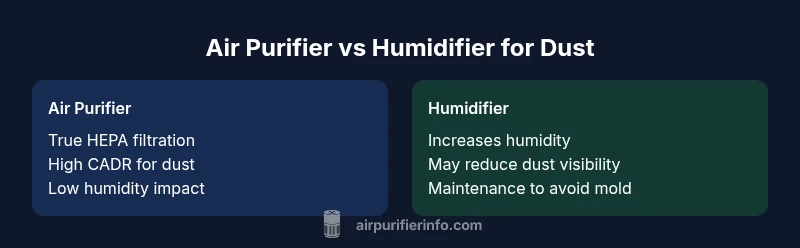
Air purifiers excel at reducing dust in most homes, while humidifiers primarily address moisture and comfort. For dust control, an air purifier with a true HEPA filter and proper CADR outperforms a humidifier in capturing fine dust particles. If your goal is to minimize airborne dust, start with an air purifier and use a humidifier only to manage humidity when needed.
Understanding the air purifier vs. humidifier question for dust
The central question many homeowners ask is the practical one: should I rely on an air purifier or a humidifier to tackle dust in my living space? The phrase air purifier or humidifier for dust captures a spectrum of needs—from actively removing dust particles to creating a comfortable humidity level that reduces dust resuspension. In practice, most homes benefit from prioritizing a high-quality air purifier for dust control and using a humidifier only when humidity levels are too low for comfort and health. According to Air Purifier Info, the distinction is not just about clearing visible dust; it is about managing the airborne particles that trigger allergies, asthma symptoms, and general indoor air irritation. When you start from this premise, you’ll see why a purifier-backed approach often yields more noticeable improvements in air quality, especially in spaces that are prone to dust from outside, pet dander, and indoor activity.
First, identify your main dust sources: outdoor particulate matter carried in by windows and shoes, indoor activities like cooking and cleaning, and pet-related debris that becomes airborne. The dust you seek to reduce includes not only visible particles but also microscopic irritants such as pollen, molds, and skin cells. An air purifier with a true HEPA filter steps in as the primary solution because it is designed to capture a broad spectrum of particles down to submicron sizes. Humidifiers, by contrast, influence air quality by adjusting moisture. When humidity is too low, static and dust become more noticeable; conversely, excessive humidity can encourage mold growth and dust mites. The Air Purifier Info team emphasizes that while humidity management is important for comfort, it should not replace a dedicated dust-removal device in spaces with elevated dust levels.
In sum, if you want clean air and fewer trapped particles, prioritize an air purifier for dust reduction and reserve the humidifier for balancing comfort. This pragmatic order aligns with consumer needs across both homeowners and renters.”,
Comparison
| Feature | Air purifier | Humidifier |
|---|---|---|
| Dust removal effectiveness | High: true HEPA filtration captures most fine particles | Low to moderate: dust is reduced mainly by humidity changes and surface deposition |
| Impact on humidity | Neutral to slight drying effect depending on model | Increases humidity; must be controlled to avoid mold and dust mites |
| Maintenance requirement | Regular filter replacement and occasional cleaning | Regular cleaning and wick/element maintenance; some models require filter changes |
| Noise level | Moderate to low with common models | Low to high depending on the size and function (humidifiers can be quiet to loud) |
| Power usage | Low to moderate (depends on fan speed) | Low to moderate when operating as a humidifier, higher if combined features |
| Price range | $100-$500 range for midrange purifiers | $50-$150 for basic humidifiers (or higher for premium models) |
| Best for | Dust control in living spaces, allergy-prone rooms | Humidity balance and comfort in dry indoor environments |
| Key caveat | Purifier does not address humidity-related comfort; keep humidity in check | Humidifier alone does not remove dust efficiently; risk of mold without cleaning |
What's Good
- Significant dust reduction with sealed HEPA purifiers
- Maintains cooler, drier air while filtering dust particles
- Wide availability and maintenance options across budgets
- Supports allergy and asthma symptom relief in dust-prone spaces
- Offers reliable, measurable air-cleaning performance
What's Bad
- Humidifiers can worsen dust under poor cleaning or high mineral content
- Humidity control alone cannot substitute for dedicated dust removal
- Noise and filter replacement costs can add up over time
- Humidifiers require regular cleaning to avoid mold and bacteria growth
Air purifiers are the primary tool for dust reduction; humidifiers are best for humidity balance when dust is not the main concern
For dust-focused air quality, prioritize an air purifier with true HEPA filtration and appropriate CADR. Use a humidifier only to correct humidity when needed. In spaces with mixed needs, a purifier plus careful humidity management offers the most reliable outcome.
Questions & Answers
Can a humidifier reduce dust on its own?
A humidifier can indirectly affect perceived dust by increasing humidity, which helps particles settle or stick to surfaces. It does not actively remove dust from the air like a purifier. Use a humidifier mainly for comfort, and rely on an air purifier for actual dust reduction.
A humidifier makes the air more humid, which can help dust settle, but it doesn't remove dust from the air like a purifier does.
Will a purifier remove pet dander as dust?
Yes. A high-quality air purifier with a true HEPA filter captures most pet dander particles in the air, reducing itchiness and nasal irritation for many people. Maintenance and proper placement matter for best results.
A true HEPA purifier can pull pet dander out of the air, especially when placed in key living spaces and kept clean.
Are there devices that combine purifying and humidifying functions?
There are hybrid devices on the market that combine purification and humidity features. If you choose one, verify that the purifier component is effective for dust, and ensure the humidification feature can be controlled to avoid over-humidity.
Yes, there are combo units, but check that the dust-removal part is strong and humidity is easy to control.
What size purifier do I need for a small apartment?
For a small apartment, select a purifier with an adequate CADR for the room size and a sealed unit to prevent leaks. Round up your room size by 20-30% to ensure efficient air cleaning.
Know your room size, pick a purifier with enough CADR for that space, and aim for a sealed unit.
How often should I replace filters?
Filter replacement depends on usage and air quality, but many purifiers require a filter change every 6-12 months. Check the manufacturer’s recommendations and monitor filter color and airflow.
Most purifiers need a filter swap every 6 to 12 months, depending on use and air quality.
Can these devices affect energy bills?
Yes. Purifiers use electricity, with higher fan speeds consuming more power. Humidifiers vary in energy use depending on the model and features. Look for ENERGY STAR-rated purifiers for efficiency.
They do use some electricity, especially at higher fan speeds, so check energy ratings.
Main Points
- Prioritize a true HEPA purifier for dust reduction
- Balance humidity with a controlled humidifier only when necessary
- Monitor humidity to prevent mold and dust mite growth
- Regularly replace filters and clean devices to maintain performance
- Use a humidifier as a secondary tool, not the primary dust solution