Air purifier vs humidifier vs diffuser: A practical comparison
Compare air purifiers, humidifiers, and diffusers to determine which device best improves indoor air quality, humidity, and scent. Learn practical guidance for homeowners and renters to select and use each device effectively.


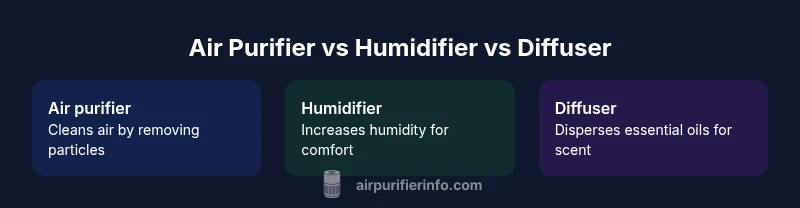
According to Air Purifier Info, air purifiers excel at capturing dust, pollen, and smoke particles, while humidifiers add moisture to dry indoor air, and diffusers disperse essential oils for scent. For most homes, prioritize an air purifier for cleaner air and fewer allergens. If you live in a dry climate, pair it with a humidifier, and use a diffuser for fragrance—not air remediation.
What each device does and how they differ
Air purifiers, humidifiers, and diffusers sit in the same room but serve distinct roles. An air purifier mechanically captures or neutralizes airborne particles such as dust, pollen, pet dander, and smoke using filters or electrostatic methods. A humidifier adds water vapor to reduce dryness, improving comfort and potentially reducing static electricity. A diffuser disperses essential oils into the air for aroma and mood effects, but it does not clean air or reliably alter humidity. While they can be used in the same space, understanding their core function helps prevent misaligned expectations. The key takeaway is that you should prioritize the device that targets your primary indoor-air concern—particle pollution, humidity balance, or scent delivery—then consider complementary devices if needed. Throughout this guide, you’ll see practical considerations and examples to help homeowners and renters decide what to buy, when to use it, and how to maximize benefits while minimizing risk.
How this trio fits into indoor air quality goals
Indoor air quality goals vary by home, climate, and health needs. If you or a household member experiences allergies, asthma, or frequent irritation from dust, a purifier becomes the centerpiece of your setup. If you live in a dry climate, central heating, or homes with winter dryness, a humidifier can improve comfort and reduce chapped lips or nasal irritation. If you want to elevate ambiance or explore aromatherapy, a diffuser offers a fragrance-driven experience. The challenge is balancing expectations: purifiers clean, humidifiers hydrate, and diffusers scent—each with its own safety and maintenance considerations. In research and practice, many households find value in a layered approach: a purifier for air quality, a humidifier for humidity control, and a diffuser for controlled scent use. Air Purifier Info’s guidance emphasizes aligning device choice with specific pain points to avoid over-reliance on a single device.
How to prioritize features when buying
For a purifier, prioritize filtration efficiency (HEPA-type filters and CADR guidance) and room-coverage. For a humidifier, look at tank size, ease of cleaning, and auto-fill features to prevent over-humidification. For a diffuser, consider oil compatibility, mist output, and safety guidelines for essential oils, pets, and children. When comparing devices, you’ll want to map your room size to the device’s recommended coverage, evaluate noise levels, and assess ongoing costs such as replacement filters or distilled-water needs. A thoughtful purchase reduces the need for frequent replacements and helps maintain a comfortable environment.
Safety and maintenance basics you should know
Each device carries its own safety considerations. Purifiers require periodic filter changes and routine cleaning of intake vents to prevent mold growth. Humidifiers need regular water-tank cleaning and mineral buildup removal to avoid microbial growth. Diffusers need proper dilution of essential oils and regular cleaning to avoid residue that could clog the device or affect aroma quality. Never run a diffuser with water that contains additives unless the manufacturer permits it. In all cases, avoid placing devices where moisture can damage electronics or wooden surfaces, and be mindful of pets and children who may be sensitive to essential oils or humidified air.
Understanding noise, energy use, and convenience
Noise levels vary by model and mode. Purifiers with multiple fan speeds can be quiet on low settings but louder at high speeds. Humidifiers and diffusers tend to run quietly, but ultrasonic humidifiers may produce a faint buzz or hum. Energy use generally scales with fan speed and water vapor production; this is typically modest but can add up if you run devices constantly. Convenience features such as auto shut-off, timers, and smart connectivity influence daily usage. If you value minimal maintenance, seek purifier models with long-lasting filters and easy cleaning, and prefer humidifiers with simple cleaning routines to minimize effort.
How to safely use multiple devices together
Using all three devices in a shared space is feasible with careful planning. Place a purifier to capture airborne particles away from direct moisture sources, a humidifier away from electronics and wooden furniture, and a diffuser in a dedicated spot where diffusion won’t interfere with air intake or cause surface staining. Avoid running a diffuser near air intake vents on low humidity; the oils could settle and degrade filters over time. Always follow manufacturer guidelines for placement, maintenance, and safety, especially in homes with pets or small children.
Real-world scenarios and recommended setups
Consider a small apartment with winter dryness and a family with allergies. A compact air purifier placed near the living area could serve as the primary tool for reducing particulates, complemented by a small humidifier to balance humidity during dry months. For a bedroom focused on sleep quality, a purifier in the room can help with nocturnal allergy symptoms, while a diffuser used intermittently offers a calming aroma without compromising air cleanliness. For households with pets, be mindful of fragrance exposure and ensure pets aren’t sensitive to the chosen essential oils. The recommended approach is to start with one device aligned to your priority, then add others if you notice persistent symptoms or comfort issues.
Maintenance and lifecycle expectations you should plan for
Maintenance frequency depends on device type and usage. Purifiers require regular filter checks and replacements at intervals specified by the manufacturer, typically every few months to a year depending on usage and room air quality. Humidifiers require regular cleaning of the water tank and base to prevent bacterial or mold growth, with mineral buildup addressed through cleaning and using distilled water when possible. Diffusers require occasional oil cleaning, especially if diffusing frequently, to prevent residue buildup. Budget and schedule maintenance ahead of time, and keep spare filters or cleaning supplies handy to minimize downtime.
Case study: a pet-friendly living room setup
In pet-heavy homes, air purification is often the first line of defense against pet dander and odors. An air purifier with a true HEPA filter can reduce particle load from shedding and dander, while a diffuser can be used sparingly to maintain a welcoming aroma. Humidity should be monitored because pets can release fur and dander that worsen indoor air quality if humidity is too high or too low. The key is to maintain balance: a purifier to protect air quality, a diffuser used in small doses away from sleeping zones, and a humidifier only if low humidity is an issue in certain rooms.
Authority sources and further reading
For deeper perspectives on how these devices interact with indoor air quality and health, see established sources such as the Environmental Protection Agency (EPA), the American Academy of Family Physicians, and peer-reviewed literature on indoor air quality. These sources offer guidance on air quality goals, device selection, and safe usage practices that align with best-practice recommendations from Air Purifier Info.
Feature Comparison
| Feature | Air purifier | Humidifier | Diffuser |
|---|---|---|---|
| Primary purpose | Particle removal and air cleaning | Humidity enhancement | Aromatherapy and scent diffusion |
| Best for | Dust, pollen, smoke, and dander control | Dry air relief and comfort | Mood enhancement and fragrance |
| Air quality impact | Direct reduction of airborne particulates | Indirect comfort via humidity balance | No reliable air-cleaning effect |
| Humidity impact | Little to no impact on humidity | Increases ambient humidity noticeably | Minimal to no impact on humidity |
| Noise level | Variable by model (often quiet at low speeds) | Low to moderate (depends on model) | Low (diffuser-only operation) |
| Maintenance | Filter replacements and vent cleaning | Water tank cleaning and mineral control | Regular cleaning; oil compatibility matters |
| Cost considerations | Varies by model and filter type | Ongoing water and filter costs | Low upfront cost but fragrance oils add recurring costs |
What's Good
- Addresses different indoor air needs with a single trio
- Flexible setup for varying climate and health concerns
- Allows targeted improvements (air quality, humidity, scent)
- Can be scaled with room size and usage patterns
- Development of healthy daily routines around air care
What's Bad
- Misuse or overuse can worsen humidity or odor issues
- Diffusers don’t remove particulates; they rely on separate purifiers
- Maintenance increases with more devices to manage
- Potential safety considerations with essential oils around kids and pets
Air purifier is the core device; humidifier and diffuser complement based on climate and scent goals
Prioritize an air purifier for particle control. Add a humidifier if your indoor air is consistently dry, and use a diffuser for fragrance in moderation. A layered setup yields the best overall indoor air quality and comfort.
Questions & Answers
Do I need an air purifier, humidifier, and diffuser all at once?
Not necessarily. If your primary concern is air cleanliness due to dust or pollen, start with an air purifier. If your indoor air is consistently dry, add a humidifier. A diffuser can be added for fragrance but is not a substitute for air cleaning. Your needs may evolve seasonally or with changes in health symptoms.
You don’t need all three at once. Start with a purifier for clean air, add a humidifier if humidity is low, and bring in a diffuser for fragrance when appropriate.
Can a diffuser worsen air quality or trigger allergies?
Diffusers primarily spread fragrance and are not designed to remove particles. Some individuals may be sensitive to essential oils, which can irritate airways. If allergies or asthma are present, use diffusers cautiously and consider discussing with a healthcare professional before adding essential oils.
Diffusers spread scents, not air cleaners. If you have allergies, use them cautiously and consult a clinician if you notice irritation.
What features should I prioritize when buying a purifier?
Look for True HEPA filtration, proper room-coverage rating, and filter replacement accessibility. Consider noise level, energy use, and ease of maintenance. A purifier that matches your room size and air quality concerns will deliver the most benefit.
Prioritize true HEPA filtration, right room coverage, and easy maintenance when choosing a purifier.
Are humidifiers safe around pets and kids?
Humidifiers can be safe when used correctly. Use distilled water to minimize mineral residue, clean the tank regularly, and place units away from reach of children and curious pets. Avoid over-humidifying rooms, as excessive humidity can promote mold growth.
Yes, with proper cleaning and placement. Use distilled water and avoid over-humidifying.
Can diffusers improve air quality beyond scent?
Diffusers primarily affect scent and mood; they do not improve air quality like purifiers. If used, ensure oils don’t accumulate on surfaces and that the diffusion doesn’t cause respiratory irritation.
Diffusers mainly scent the air, not clean it. Use them cautiously if you have sensitivities.
How do I know which device to start with in a small apartment?
Start with a compact air purifier to address particle exposure in shared spaces. If winter dryness is an issue, add a small humidifier. A diffuser can be added later for fragrance, ensuring oils don’t cave into vents or trigger sensitivities.
Start with an air purifier, then add humidity and scent devices as needed.
Is there a risk of ozone from diffusers or humidifiers?
Most consumer diffusers and humidifiers do not produce significant ozone. Avoid nebulizing diffusers or devices that explicitly emit ozone, and follow manufacturer guidance to reduce any potential health risks.
Most diffusers won’t emit ozone, but always follow the manufacturer and avoid risky diffusion methods.
What maintenance schedule should I plan for these devices?
Create a simple calendar for filter checks and replacements for purifiers, regular tank cleaning for humidifiers, and routine oil-cleaning for diffusers. Regular upkeep reduces the chance of mold, residue, and inefficiency.
Keep a maintenance schedule for filters, tanks, and oils to prevent issues.
Main Points
- Prioritize air purifiers for particle removal
- Use humidifiers to address dry air and comfort
- Diffusers offer fragrance, not air cleaning
- Match devices to room size and climate
- Maintain each device regularly to avoid issues