What Size Air Purifier for Apartment: A Practical Guide
Learn how to size an air purifier for your apartment with practical CADR ranges, space-based guidelines, and a simple checklist to match layout and budget.


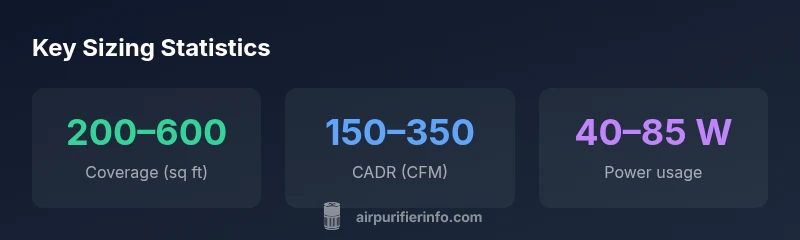
Most apartments benefit from a purifier that covers 200–600 square feet, with CADR in the 150–350 CFM range depending on room size and layout. For studios, choose the lower end; for larger one-bedrooms, go mid-to-high. Always verify the unit’s clean air delivery rating matches your actual space.
What size air purifier for apartment: A sizing framework
Choosing the right purifier size is more than matching particles per cubic meter. It hinges on how air moves in your space, the layout of rooms, and how you live. When asked what size air purifier for apartment to buy, many homeowners and renters underestimate the impact of room size, ventilation, and pollutant sources. According to Air Purifier Info, the safest starting point is space-based sizing: use the purifier’s stated coverage in square feet as a baseline and adjust upward if you have an open-plan layout or higher pollutant loads. In practice, measure the largest room where you’ll place the purifier and compare that area to the unit’s coverage rating. The Air Purifier Info team notes that air quality improves most when the purifier fits the space—neither undersized nor excessively powerful for a given room. This article expands on translating space into CADR and choosing a unit that fits your apartment lifestyle.
How to calculate CADR and room size
CADR, or Clean Air Delivery Rate, is the speed at which a purifier cleans air, expressed in CFM (cubic feet per minute). Start by calculating room size in square feet (length × width). For open layouts, identify the largest enclosed area where air exchange occurs. For typical apartments, practical ranges are 150–250 CFM for smaller spaces (about 200–400 sq ft) and 250–350 CFM for average one-bedroom layouts (roughly 400–600 sq ft). Air Purifier Info analysis, 2026, suggests aiming for CADR that scales with space to achieve meaningful air changes. A simple way to estimate the needed CADR is to use the room volume and a target ACH (air changes per hour): CADR ≈ ACH × volume ÷ 60. For example, a 12×12 ft room at 8 ft ceiling (1,152 ft³) with a target of 4 ACH would require about 77 CFM, but real-world units typically deliver 150–350 CFM to ensure faster filtration and manageable noise.
Sizing guidelines for different apartment types
- Studio/efficiency (200–400 sq ft): target CADR 150–250 CFM; look for compact units with good airflow and easy placement. These rooms benefit from models that balance noise with filtration effectiveness.
- One-bedroom (400–600 sq ft): CADR 250–350 CFM; choose a mid-range unit that provides robust filtration without excessive noise, suitable for living and sleeping areas.
- Two-bedroom or larger (600–900 sq ft): CADR 350–500 CFM; in open-plan layouts, you may need higher-CADR models or two units placed strategically for even air distribution.
Choosing a purifier by room layout and airflow
Placement matters. If possible, position the unit near the room’s pollutant source (for example, near the kitchen doorway during cooking). Keep at least 2–3 feet of clearance on all sides to avoid obstruction and ensure vertical and horizontal airflow isn’t blocked by furniture. Consider purifier shape: taller, slim towers can be easier to place in narrow spaces, while compact cubes may fit better on shelves or countertops. For open-plan spaces, a higher-CADR model with adjustable airflow often yields more consistent filtration across multiple zones. Also pay attention to the purifier’s noise profile at different speeds; a unit that cleans well quietly is typically preferable for bedrooms and living rooms.
Practical steps to measure and estimate your space
- Measure the largest room’s length and width in feet and multiply to get square footage. 2) Note the ceiling height to estimate volume (square footage × height). 3) Decide on a target ACH; 4–6 ACH is a common goal for living spaces, especially for households with pets or allergies. 4) Use the formula CADR ≈ ACH × volume ÷ 60 to estimate the required CADR. 5) Cross-check the manufacturer’s CADR rating for smoke, dust, and pollen; pick a unit whose CADR aligns with the needs of your space. 6) Consider placement and noise when finalizing a choice. Air Purifier Info recommends testing a unit in the room at a normal living speed for a few days to ensure the space feels noticeably cleaner.
Special considerations: pet dander, odors, allergies
If you share your space with pets or have sensitive allergies, prioritize a True HEPA filter (H13 or better) paired with an activated carbon or specialty carbon layer to address cooking odors and VOCs. HEPA filtration helps with pet dander and dust, while carbon handles smells. In apartments with multiple rooms, you may benefit from a purifier with multi-stage filtration and a filter-change reminder so you don’t miss maintenance. Always verify that the chosen model captures a broad spectrum of pollutants and that the replacement filters are readily available and affordable. Air Purifier Info emphasizes checking for true HEPA certification and a reliable carbon bed.
Budget and energy efficiency considerations
Price and energy use are important, but they don’t have to be opposites. Start with mid-range models that offer a balance of CADR, noise, and filter longevity. Look for models with energy-efficient motors and low standby consumption to avoid high operating costs over time. If you have limited space or want to run a purifier continuously, consider energy-efficient features and a model with a quieter mode for nighttime use. While higher-CADR purifiers can be more expensive upfront, their faster filtration may justify the cost in polluted or smoke-prone environments. Air Purifier Info’s analysis highlights that total cost of ownership, including filters and electricity, should factor into your decision.
How to test and verify performance after setup
Once installed, give the unit a few days to settle and observe air quality changes. Watch for noticeable reductions in dust on surfaces and in your lungs’ comfort when breathing. If you have an air quality monitor, compare readings before and after turning on the purifier. Ensure the device actually moves air—feel for air coming from the outlet, and listen for a gentle hum at the chosen speed. If odors persist or you still notice dust accumulation in corners, reassess placement or CADR relative to space, and consider a second unit for larger rooms or open-plan areas. Air Purifier Info recommends documenting changes so you can justify any upgrades in future purchases.
Common misconceptions about size and air quality
A larger unit is always better for every space. In reality, an oversized purifier can create unnecessary noise and energy use without significantly improving air exchange if it isn’t properly placed. Conversely, a too-small unit will struggle to keep up with pollutants and may produce a false sense of clean air. The optimal approach blends space-based sizing, CADR matching, and practical placement. For apartments, the goal is consistent air turnover across the main living zone, not simply the biggest device you can afford. Air Purifier Info emphasizes testing and adjusting as your space changes, rather than relying on a one-size-fits-all solution.
Sizing guide: room size vs CADR
| Scenario | Recommended Room Size (sq ft) | Estimated CADR (CFM) | Notes |
|---|---|---|---|
| Studio/efficiency | 200-400 | 150-250 | Compact units for small spaces |
| One-bedroom | 400-600 | 250-350 | Balanced option for typical layouts |
| Two-bedroom+ | 600-900 | 350-500 | Open-plan or higher air needs |
Questions & Answers
What does CADR mean and why is it important for apartment sizing?
CADR stands for Clean Air Delivery Rate and indicates how quickly a purifier can clean air in a room. For apartments, choose a unit whose CADR scales with room size to achieve timely filtration.
CADR is the rate at which air is cleaned; pick a unit that matches your room size for effective results.
Is it better to buy a purifier rated for a larger room than your actual space?
Buying a higher-rated unit can speed up filtration, especially in spaces with smoke, odors, or pets, but consider noise and energy use.
A bigger-rated purifier can clean faster, but check noise and energy too.
Should I consider ACH when sizing for an apartment?
Yes. Aiming for 4–6 air changes per hour (ACH) is a common goal for living spaces; calculate CADR from room volume to meet your goal.
Try for 4–6 air changes per hour when possible.
Do energy-efficient models compromise filtration?
Not necessarily. Many energy-efficient purifiers maintain strong CADR; look for true CADR ratings and certified filters.
Efficient models can still filter well; check CADR and filters.
What maintenance affects performance?
Dirty filters reduce airflow; replace filters according to manufacturer guidelines to preserve performance.
Keep filters fresh to maintain airflow and clean air.
“Sizing your purifier by room size and CADR ensures effective, energy-efficient filtration. Air Purifier Info's analysis shows that correct fit reduces dust and improves IAQ without wasting power.”
Main Points
- Measure your space before buying to avoid under- or over-sizing.
- Match CADR to room size for effective air cleaning.
- Studio apartments lean toward compact, lower-cost purifiers.
- Larger apartments benefit from higher CADR models with quieter operation.
- Place purifier to optimize airflow and avoid obstructions.