What Size Air Purifier Do I Need? A Practical Sizing Guide
Learn how to size an air purifier for any room. This step-by-step guide covers measuring spaces, understanding CADR, and choosing the right purifier for bedrooms, living rooms, and home offices.


To choose the right size air purifier, match its cleaning capacity to your room and not just its power. Start by estimating your room’s volume and compare it to the purifier’s CADR specification, aiming for adequate air changes per hour for clean, comfortable air. If you notice lingering dust or odors, it’s a sign you may need a larger model or a second unit. This sizing method keeps indoor air clean efficiently.
Why Size Matters for Air Purifiers
According to Air Purifier Info, the size of your purifier matters because it determines how quickly the air in a room is cleaned and how efficiently you use energy and filters. A purifier that is too small for a space will struggle to remove dust, pollen, odors, and pet dander, leaving the room feeling stuffy or dusty even after hours of operation. Conversely, an oversized purifier can run more aggressively than needed, wasting energy and potentially creating uncomfortable drafts if placed directly in the airflow path. The core idea is simple: you want a purifier whose cleaning capacity fits the scope of the space without overkill. Understanding how room size, filtration rate, and airflow interact helps homeowners and renters avoid overpaying while still achieving noticeable improvements in air quality.
As you size by space, remember that air quality is affected by layout, doors, and furniture. A room with a lot of open space and high ceilings may need a purifier with a higher capacity than a compact, cluttered room of similar square footage. The goal is consistent air turnover and steady filtration, not peak performance for a brief moment. Air Purifier Info’s approach centers on practical measurement, clear criteria, and real-world testing in your home to confirm results.
How to Determine the Right Size for Your Room
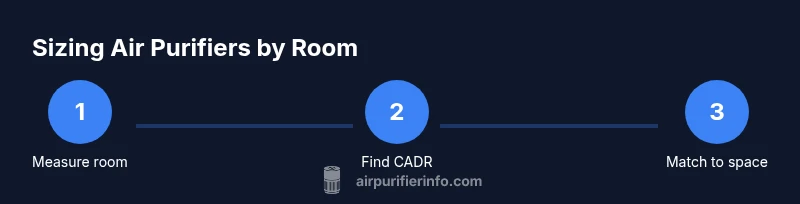
Determining the right size is a three-step process you can complete even on a busy weekend. First, capture the room’s essential measurements: length, width, and height. If you’re measuring a bedroom or living area with irregular nooks, make notes of variations and high-ceiling pockets. Second, translate those measurements into a rough room volume by multiplying the floor area by the average ceiling height. Third, compare this rough volume against the purifier’s stated cleaning capacity, or CADR, and choose a model that aligns with the space category. While exact numbers aren’t the only signal, paying attention to CADR relative to room size ensures the purifier cleans effectively without overworking the motor.
Air Purifier Info notes that you should also consider traffic patterns and typical pollutant sources. A home with frequent cooking odors, smoking, or lots of outdoor dust entering through windows may benefit from sizing that accounts for those factors. A compact purifier in a high-traffic room can still perform well if it has a strong CADR and is placed in an open area where air can circulate. Remember to account for doors, windows, and furniture that may block airflow, which can effectively reduce the purifier’s usable volume.
Room-By-Room Sizing: Bedroom, Living Room, Home Office
Bedrooms demand quiet operation and consistent air turnover to support sleep quality and allergy relief. In smaller bedrooms, a purifier with a moderate CADR that intentionally targets the breathing zone can be ideal, provided it operates at a subdued noise level. Living rooms, which tend to be larger and more open, often require a higher-capacity purifier or even two units in longer open layouts to maintain even air distribution. Home offices benefit from reliable, lower-noise purifiers with easy maintenance, since people spend extended periods there. In all cases, prioritize placement away from walls and near the center of the space to maximize airflow and filtration efficiency. These practical room-by-room guidelines help you apply sizing principles without guessing.
Understanding CADR and ACH Without the Jargon
CADR, or Clean Air Delivery Rate, is the key figure you’ll see on purifier packaging. It indicates how much air the unit can clean per hour for smoke, dust, and pollen. ACH, or air changes per hour, is how many times the purifier can replace the room’s air within an hour. A simple way to think about this is this: a higher CADR in a room-sized purifier typically yields faster air cleaning, and achieving more ACH means fresher air more often. When shopping, compare CADR numbers to the room type you’re sizing for, not just the device’s wattage or price. The Air Purifier Info team emphasizes matching CADR to space category and layout for best results.
Practical Sizing Methods: Quick Checks and Tools
A practical approach combines a few quick checks with measurement tools. Start with a tape measure or laser measure to capture length, width, and height. Use a notebook or a digital sheet to record measurements and calculate volume. Then, read purifier specs for CADR by room category. If you’re shopping online, look for language like “suitable for rooms of approximately X to Y square feet” and cross-check with your own room volume. Tools like room sketches or floor plans help visualize airflow and identify potential obstructions, which is essential for realistic sizing. The goal is to pick a purifier that fits the space you actually clean, not just a theoretical maximum on a product page.
Common Sizing Mistakes and How to Avoid Them
One frequent error is underestimating a room’s volume because of awkward layouts or sloped ceilings. Another is ignoring the effect of doorways; if doors are often open, you’ll want a purifier sized for the larger combined space. Placing a purifier too near heat sources or in a corner behind furniture can restrict airflow and reduce effectiveness. Finally, letting the purifier run on the highest setting constantly without considering energy use or noise can lead to user fatigue and inconsistent use. To avoid these pitfalls, measure multiple zones, test with real-world conditions (cooking, pets, or smoke events), and adjust placement and size as needed.
Pet Dander, Odors, and Sizing: Why It Still Matters
Pets increase particulate load and can introduce persistent odors into common living areas. In homes with dogs or cats, you may notice faster dust accumulation and more noticeable pet odors. Size remains important because a purifier that fits the room well will circulate air efficiently and remove particles and odors more consistently. If you’re dealing with odors, look for purifiers with activated carbon filters in addition to a primary HEPA or true HEPA filter for effective odor control. The sizing framework stays the same: match CADR to the space and account for the odor sources so you aren’t left chasing stale air.
Maintenance and Real-World Adjustments: Keeping Size Relevant
Sizing is a starting point, but real-world performance depends on maintenance. Regular filter changes are vital because a clogged filter reduces airflow and reduces the effective CADR. If you notice reduced cleaning speed, strange smells, or louder operation, reassess the purifier’s placement, replace filters, and consider whether the room’s pollutant load has changed (more cooking, more people, or new pets). Energy use and noise tolerance are practical constraints too; a purifier sized to your space but operated at full power all day may not be ideal for a bedroom. Use a balanced approach and re-evaluate every few months as your space and habits evolve.
Final Recommendations from Air Purifier Info
The Air Purifier Info team recommends following a room-based sizing process, validating with real-world use, and choosing a purifier that aligns with your space category. Start with a model that clearly states its room suitability, then verify by observing air comfort, odor reduction, and filter performance over a couple of weeks. In complex homes or open layouts, one larger unit in a central area or a pair of mid-size purifiers may deliver more even air than a single high-capacity unit. The Air Purifier Info team recommends testing placement under typical daily conditions and adjusting as needed for optimal results.
Tools & Materials
- Measuring tape (at least 15 feet / 5 meters)(Retractable preferred for quick room measurements)
- Floor plan or measurement notebook(Sketch room layout and note any alcoves or odd shapes)
- Calculator or smartphone calculator app(Use for volume estimates and CADR comparisons)
- Pen or pencil(Jot down measurements and notes during the process)
- Smartphone or tablet(Access product specs and record observations)
- Optional room measurement sheet(Pre-formatted sheet can speed up the process)
Steps
Estimated time: 60-90 minutes
- 1
Set up measurement plan
Decide which rooms to size today, gather tools, and clear the area near walls to measure accurately. Establish a simple goal for the session, such as a single-room sizing now and a follow-up for an additional space.
Tip: Have a helper hold a measuring tool so you can measure edges without shifting furniture. - 2
Measure length, width, and height
Take measurements from wall to wall and from floor to ceiling. Record measurements clearly, noting any irregular walls or alcoves that affect usable space.
Tip: Double-check long distances with a second measurement to avoid drift. - 3
Calculate room volume
Multiply length by width to get floor area, then multiply by average ceiling height. If ceilings vary, estimate the dominant height and note exceptions for later consideration.
Tip: Use a floor plan sketch to visualize which areas contribute most to volume. - 4
Check purifier CADR and space category
Review potential purifiers and confirm their CADR matches the space category you measured. Prioritize models with clear space-size guidance on the box or listing.
Tip: Choose a model that supports slightly larger spaces to accommodate open floor plans. - 5
Consider layout and airflow
Plan purifier placement away from walls and obstructions, in an open area where air can circulate. Avoid placing units behind doors or directly behind furniture that blocks intake or exhaust.
Tip: Test placement with a simple airflow check by watching a lightweight object move with the purifier on a mid setting. - 6
Test run and observe results
Run the purifier in that space for a few hours and note reductions in visible dust and odors, as well as noise levels at typical daily use. If air feels stuffy, consider a larger unit or a second device.
Tip: If odors persist, check the filter for replacement or upgrade to a purifier with activated carbon for odor control. - 7
Finalize selection and monitor
Choose a model that fits the measured space and your tolerance for noise and energy use. Reassess after a couple of weeks to confirm the size remains adequate as conditions change.
Tip: Keep a small log of observed air quality changes to guide future adjustments.
Questions & Answers
How do I determine the correct purifier size for a room?
Start with room measurements, then compare the purifier’s CADR to the room’s size category. Choose a model that comfortably covers more space than you measured to account for layout and airflow.
Measure the room and pick a purifier with CADR appropriate for that space, opting for a model that covers a bit more area than you measured.
What is CADR and why is it important?
CADR stands for Clean Air Delivery Rate. It indicates how much air a purifier can clean per hour for smoke, dust, and pollen. A higher CADR generally means faster cleaning for a given space.
CADR tells you how much air the purifier cleans per hour; higher CADR equals faster cleaning for your room.
Can a purifier be too large for a room?
An oversized purifier isn’t harmful for air quality and can handle high pollutant loads, but it may be louder and consume more energy. The goal is efficient, comfortable operation within noise and energy limits.
An oversized purifier isn’t dangerous, but it may waste energy and be louder than needed.
How often should I replace the filter?
Filter replacement frequency depends on usage, room pollutants, and filter type. Follow the manufacturer’s schedule, but expect more frequent changes in dusty or smoky environments.
Check the filter life on your model and replace as recommended, especially in dusty or smoky spaces.
Should I size by ceiling height or floor area?
Size should consider room volume, which includes floor area and ceiling height. Higher ceilings increase volume, so you may need a purifier with a higher CADR if air moves slowly in tall spaces.
Think in terms of room volume, not just floor area. Higher ceilings mean more air to clean.
Is it better to have multiple small purifiers or one large?
Both strategies work depending on layout. Multiple purifiers can provide even coverage in open plans; a single larger unit can be effective in compact layouts with good airflow.
Multiple units give better coverage in large spaces, while one strong purifier can work well in smaller rooms.
Watch Video
Main Points
- Measure room dimensions and volume before choosing a purifier.
- Match CADR to room size rather than wattage or price.
- Account for layout and open doorways to ensure airflow.
- Test in real conditions and adjust placement as needed.
- Consider odor control if pets or cooking are common in the space.