How to Determine Air Purifier Size for Your Space
Learn how to determine the right air purifier size for your space with clear steps, CADR guidance, and practical tips. A comprehensive, air-quality-driven approach from Air Purifier Info.


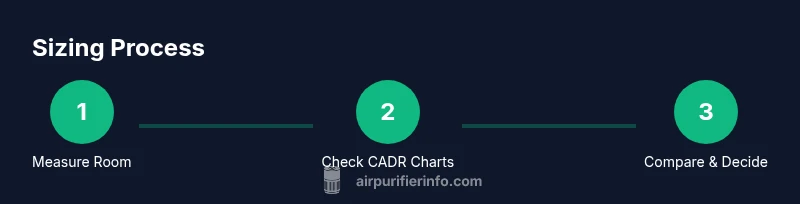
To determine air purifier size, start by measuring your room’s length, width, and height, then calculate its volume. Use the manufacturer’s CADR charts to pick a model whose clean air delivery rate matches your room’s volume and typical usage. For better coverage, choose a purifier designed for slightly larger spaces. According to Air Purifier Info, always check real-world performance for your needs.
Why Size Matters for Indoor Air Quality
Room size directly influences how effectively an air purifier can remove dust, odors, and allergens. A purifier that’s too small will struggle to clean the air in a busy living room, while one that’s too large may operate with more noise and energy use than you need. The Air Purifier Info team emphasizes sizing as the first practical step toward meaningful air-quality improvements. By aligning a purifier’s airflow with the room’s volume, you create a foundation for consistent air cleaning, reduced irritation, and improved comfort for occupants.
In homes, the goal is to achieve noticeable air turnover without constant noise or hot air buildup. Sizing correctly also helps with multi-room scenarios where you open doors, walk through living spaces, or run purifiers in adjacent areas. A properly sized purifier not only cleans more efficiently but also tends to maintain a steadier indoor climate, which helps with dust control, odor reduction, and overall allergen management.
The Air Purifier Info team notes that proper sizing improves user satisfaction and long-term performance across various room layouts.
Tools & Materials
- Measuring tape(Long enough to measure room length, width, and height (at least 10 ft/3 m).)
- Notepad or digital note app(Record measurements, CADR values, and model comparisons.)
- Calculator or smartphone calculator(Compute room volume (L×W×H) and compare CADR figures.)
- Manufacturer CADR charts or product pages(Access the official CADR values for relevant models.)
- Pen or marker for notes(Mark models on your comparison shortlist.)
Steps
Estimated time: 45-60 minutes
- 1
Measure room dimensions
Accurately measure length, width, and height of the space where the purifier will operate. Write down the numbers in feet or meters, and ensure the room is clear of obstacles that could distort your measurements. This step creates the foundation for estimating room volume and subsequent CADR alignment.
Tip: Measure from walls, not from furniture edges; use a level to ensure you’re measuring perpendicular corners. - 2
Calculate room volume
Compute volume by multiplying length × width × height. This gives you a sense of the airspace the purifier must clean. While this doesn’t replace CADR data, it helps you filter models that are within a practical range for your space.
Tip: If your space has an irregular shape, break it into simpler rectangular sections and sum their volumes. - 3
Find CADR charts on product specs
CADR (Clean Air Delivery Rate) indicates how much clean air a purifier delivers per hour for smoke, dust, and pollen. Open the product page or manual and locate the CADR values. These charts relate room volume to a recommended purifier size.
Tip: Look for CADR values that cover all three pollutants (smoke, dust, pollen) relevant to your needs. - 4
Match CADR to room size
Choose models whose CADR aligns with your room volume according to the manufacturer’s guidance. Prefer models that can handle a slightly larger space if you expect occupancy changes or future room use adjustments.
Tip: Don’t rely on a single CADR figure; compare smoke, dust, and pollen ratings to ensure well-rounded performance. - 5
Consider layout and airflow
Place the purifier so its intake isn’t blocked by furniture or walls. Leave some space around the unit for unrestricted airflow, typically at least a foot. Proper placement enhances the effective size alignment.
Tip: Avoid corners or behind large furniture which can trap dust and impede airflow. - 6
Assess noise and energy use
Review the purifier’s noise levels (dB) at typical operation and its energy consumption. A properly sized unit will balance effective cleaning with acceptable noise and daily energy cost.
Tip: Check for energy-star certifications or user reviews noting real-world energy use. - 7
Test performance and adjust if needed
Run the purifier for several hours in the chosen space and observe air freshness, odor levels, and any residual dust. If outcomes are not meeting expectations, re-evaluate size choice or placement and consider a slightly larger model.
Tip: Keep a simple log of odors, dust visibility, and air feel to compare before/after results.
Questions & Answers
What is CADR and why does it matter for sizing an air purifier?
CADR stands for Clean Air Delivery Rate and reflects how quickly a purifier cleans air of specific pollutants. Higher CADR values typically indicate faster air cleaning for a given room size, so you’ll want models whose CADR aligns with your room’s volume. Always compare CADR across smoke, dust, and pollen to ensure balanced performance.
CADR tells you how fast a purifier cleans the air. Look for models with CADR values that match your room size across smoke, dust, and pollen to ensure effective cleaning.
Is it better to oversize or undersize a purifier?
Oversizing a purifier generally improves air cleaning speed and reduces how often you see dust or odors, but can increase noise and energy use. Undersizing may leave rooms with visible air quality issues. Prefer models that cover your space and a bit more to allow for changes in room usage.
Going a bit bigger usually helps more, but watch for noise and energy. Choose a unit that covers your space and then some.
How do I measure my room accurately for sizing?
Take precise measurements of length, width, and height. Use a measuring tape and record dimensions in the same units. If the room has irregular shapes, approximate by breaking it into simpler sections and sum their volumes before checking CADR charts.
Measure length, width, and height carefully, then use simple math or split the space to estimate volume for CADR matching.
Can one purifier size work for multiple rooms?
If rooms are used together or open-concept, size for the largest common area or consider multiple purifiers to cover distinct zones. This helps maintain consistent air quality as you move between spaces.
In open layouts, size for the biggest space or use more than one purifier for different areas.
What placement considerations affect sizing impact?
Place purifiers away from walls and furniture, with at least 1 foot of clearance for intake and exhaust. Poor placement can bottleneck airflow and reduce effective size, making the purifier seem underpowered.
Good airflow needs space—don’t crowd the unit against walls or doors.
Watch Video
Main Points
- Measure accurately to define your room’s airspace
- Use CADR charts to narrow down model options
- Aim for a purifier that covers a slightly larger space for real-world use
- Place the purifier for optimal airflow and minimal noise
- Verify ongoing filter availability and energy use for long-term ownership