What Size Air Purifier for Living Room: A Practical Guide
Learn how to size an air purifier for your living room using CADR, room size, and layout. Practical steps, quick math, and buying tips to improve indoor air quality.


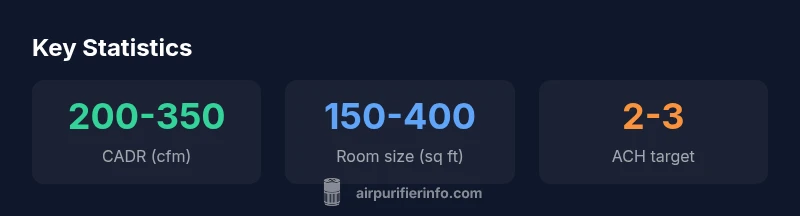
For a typical living room (150–400 sq ft), target a CADR of about 200–350 cfm to achieve roughly 2–3 air changes per hour. This translates to units that cover 250–600 sq ft depending on ceiling height and layout. According to Air Purifier Info, choose a model sized for your room size and balance noise and energy use.
Why size matters for living room air quality
The living room is often the largest, most frequently used space in a home, and it acts as the central hub for family life. Getting the size right means you reclaim clean air faster and keep pollutants, dust, odors, and pet dander from accumulating. In sizing terms, we talk about CADR (clean air delivery rate) and ACH (air changes per hour). A purifier with an appropriate CADR can move enough air to clean the room in a reasonable time, while keeping noise and energy use manageable. According to Air Purifier Info, the goal is to match the purifier’s airflow to the room’s volume so you achieve at least 2 air changes per hour without pushing the unit into a loud, ineffective run.
Understanding CADR, ACH, and room volume
CADR measures how much clean air a purifier can deliver per minute, while ACH tells you how many times the entire room’s air is replaced in an hour. The relationship is straightforward: ACH ≈ (CADR × 60) / RoomVolumeInCubicFeet. For a 250 sq ft living room with an 8 ft ceiling, the room volume is about 2,000 cubic feet. A purifier with a CADR around 160–200 cfm yields roughly 5–6 ACH in that space, but most living rooms perform best with CADR in the 200–350 cfm range to target 2–3 ACH, balancing performance and noise.
Measuring your living room accurately
Begin by calculating floor area: measure length and width in feet, then multiply to get square feet. Convert to volume by multiplying by ceiling height (in feet). If the space is irregular or features alcoves, estimate the main living zone and add a fudge factor (roughly 10–20%) for gaps. For open-plan layouts that flow into dining or kitchen areas, treat the largest contiguous area as your sizing anchor and adjust CADR accordingly. Finally, consider furniture layout, curtains, and pets, which can affect air paths and filtration efficiency.
Translating room size into purifier capacity
A practical rule of thumb: for standard ceilings (8 ft) in a 150–250 sq ft space, aim for a CADR of roughly 200–250 cfm. For 250–400 sq ft, target about 300–350 cfm. If your living room exceeds 400 sq ft or has high ceilings, you’ll want a higher CADR (450–650 cfm) or use two mid-range purifiers placed strategically. Always confirm that the purifier’s rating matches the actual square footage of the space you intend to clean, not just the advertised max room size.
Special cases: open floor plans and tall ceilings
Open-plan spaces humanize air flow in a way that single-room calculations can’t capture. In open layouts, contaminants may travel across zones, reducing effective cleaning speed. For these spaces, you might choose a single high-CADR purifier or deploy two units in opposite corners to create more uniform air movement. Tall ceilings increase the room volume, which lowers ACH unless CADR is increased proportionally. If you have ceilings taller than 9 feet, expect to need 15–40% higher CADR than the base recommendation.
Practical buying tips: noise, energy, and filters
Always check the decibel rating at the desired airflow. The quiet operation mode may significantly reduce the CADR you get per minute. Consider energy consumption—look for Energy Star or similar efficiency marks if you’ll run the purifier long hours. Filter replacement costs and cadence matter as well; HEPA filters typically last 6–12 months depending on use, with pre-filters needing more frequent changes in dusty homes. If you’re sizing for a living room with pets, odors, or kids with allergies, prioritize purifiers with true HEPA filtration and sealed designs to maximize performance.
A quick sizing workflow you can follow
- Measure your living space to determine square footage. 2) Estimate room volume (square footage × ceiling height). 3) Look up CADR ratings and pick a model that covers the measured square footage with a cushion (±10–20%). 4) Check noise at the expected CADR, and confirm energy use aligns with your budget. 5) If you have pets or strong odors, prefer purifiers with odor control and true HEPA filtration. 6) Plan for maintenance, including filter replacement frequency and costs.
Air purifier sizing pitfalls to avoid
Avoid assuming that a larger room always requires a single larger purifier; misjudging space can lead to underperforming airflow or excessive noise. Don’t rely solely on square footage—ceiling height, furniture, and air flow paths matter. Finally, resist the temptation to overbuy: a purifier with a much higher CADR than needed may not provide meaningful additional benefit and can waste energy while creating more noise.
CADR guidance by living room size
| Living Room Size (sq ft) | Recommended CADR (cfm) | Notes |
|---|---|---|
| 150-250 | 200-250 | Small space with standard ceilings |
| 250-400 | 300-450 | Open-plan or medium layout |
| 400-600 | 450-650 | Large room or high ceilings |
Questions & Answers
How do I calculate my living room size for purifier sizing?
Start by measuring length and width to get square footage. Multiply by the ceiling height to get room volume. For irregular shapes, estimate the main area and add a 10–20% margin. Use this volume to guide CADR selection.
Measure the room’s length and width to get square footage, then multiply by ceiling height to estimate volume. Use that to pick a CADR range.
What CADR is best for a small living room?
For 150–250 sq ft, aim for CADR around 200–250 cfm. If ceilings are higher, you may need toward the upper end of that range. Check real-room performance in reviews for your layout.
For a small living room, look for about 200 to 250 CADR; higher ceilings may push you toward the top of that range.
Do ceilings height affect purifier size?
Yes. Higher ceilings increase room volume, reducing ACH unless CADR is increased. Expect to adjust CADR upward by roughly 15–40% in rooms with tall ceilings.
Yes. Higher ceilings mean more air to move, so you’ll want a purifier with higher CADR.
Can I use a single purifier for an open-plan living space?
You can, but you’ll usually need a higher CADR to cover the connected zones, or place purifiers strategically in key areas to improve air movement.
Yes, but pick a higher CADR or use two purifiers to cover the space effectively.
How loud are purifiers at recommended settings?
Noise levels vary by model and speed. Look for decibel ratings at your target CADR and choose a unit with a quiet mode if you’ll run it around people and TVs.
Check the noise rating and use a quiet mode if you’ll be nearby.
“Sizing is about air movement and room volume, not just square footage. A purifier must move enough air to achieve the target ACH without becoming a loud constant.”
Main Points
- Measure your living room size accurately.
- Match CADR to room size and layout.
- Aim for 2-3 air changes per hour.
- Account for ceiling height and open-plan spaces.
- Balance CADR with noise and energy use.