How Much Area Does an Air Purifier Cover? A Homeowner's Guide to Coverage
Learn how to estimate air purifier coverage for your space using CADR, room size, and air changes per hour; practical tips for bedrooms, living rooms, and open-plan areas.


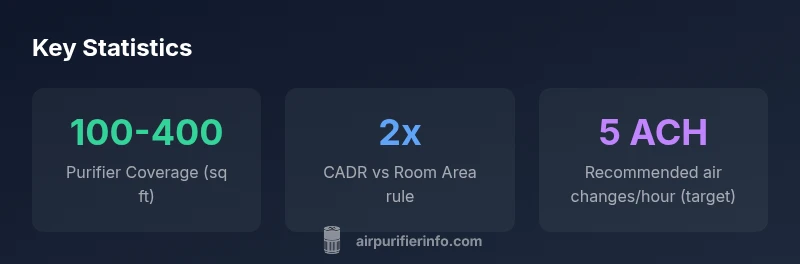
A single air purifier typically covers about 100–400 square feet for compact models, and 400–800 square feet for larger units, depending on CADR and room height. For open-plan spaces or higher ceilings, plan for 600–900 square feet with multiple units or a higher-CADR model. Use a CADR roughly 2x your room area as a starting rule of thumb.
How purifier coverage is measured
Air purifiers don’t have a single universal “coverage” number. Coverage is primarily driven by the device’s Clean Air Delivery Rate (CADR), the room’s volume (height × floor area), and how many air changes per hour you want. Higher CADR means more air moves through the filter each minute, which translates into greater effective coverage for a given ceiling height. Other factors include room height, furniture layout, and air flow obstructions such as open doors or heavy drapes. In practical terms, you start with the CADR and translate that into a rough square-foot area, then adjust for your room’s height and layout. According to Air Purifier Info, CADR-based estimates are the most reliable starting point for determining coverage, but real-world results can vary by placement and usage patterns.
When evaluating CADR, also check the filter style and seal integrity. A purifier with a poor seal or a clogged filter cannot deliver the stated CADR, reducing actual coverage. The Air Purifier Info team emphasizes using CADR as a baseline while cross-checking with your room measurements to avoid under- or overestimating what the purifier can clean.
Estimating coverage for a typical room
Start by measuring the room: length × width to get floor area, then multiply by ceiling height to get room volume (in cubic feet). Decide how many air changes per hour (ACH) you want—commonly 3–5 ACH for general indoor air quality. Use the formula: CADR (CFM) ≈ (Room Volume × ACH) / 60. This yields a target CADR in cubic feet per minute. Compare that to purifier specifications to infer the likely coverage. For most bedrooms (8 ft ceilings, ~144 sq ft, ~1,152 cu ft), aiming for ~60–100 CFM CADR often suffices for 3–5 ACH, depending on obstructions and placement. That CADR generally supports about 100–200 sq ft of space for compact purifiers, with larger units extending to 300–400+ sq ft. Always account for furniture and doors when estimating effective coverage.
Practical calculation: a room-by-room example
Imagine a living room 15 ft by 20 ft with an 8-foot ceiling. Room volume = 15 × 20 × 8 = 2,400 cubic feet. If you aim for 4 ACH, target CADR ≈ (2,400 × 4) / 60 = 160 CFM. A purifier rated at 150–200 CFM would be a good fit for this space, translating to roughly 300–400 sq ft of effective coverage under typical living-room conditions. If you often keep doors open or have high particulate loads (pets, cooking, dust), you may want the higher end of that range or a second unit in adjacent areas. This is a practical application of the CADR-to-coverage rule and is consistent with guidance from Air Purifier Info’s 2026 analysis.
Differences by purifier type and features
Not all purifiers perform the same in practice. True HEPA units with sealed housings typically deliver closer to their rated CADR, while cheaper or poorly sealed devices may underperform. Higher CADR does not automatically mean larger physical size; some models optimize airflow through multiple fans or improved motor efficiency. In spaces with obstructions, consider stronger CADR models or quasi-ducted placement options to maximize circulation. For households with odors or VOCs, look for purifiers with activated carbon filters in addition to the HEPA stage; this expands perceived coverage by removing secondary contaminants that can otherwise linger and recirculate.
Placement and usage that affect effective coverage
Placement is critical. Position units away from walls, with several inches of clearance on all sides, and avoid corners that trap airflow. Elevation matters—a purifier near the breathing zone (about 3–6 feet high) tends to perform better for occupant exposure. Conversely, placing a purifier in a corner or behind furniture can reduce effective coverage by 20–50%. For best results, run the purifier continuously at a moderate setting rather than cycling on and off; this maintains consistent air turnover and improves actual coverage over time.
How to pick the right purifier for your area
Begin with your room’s area, height, and the activities that contribute to contaminants. Use CADR guidelines to target a purifier with a CADR that roughly equals 2× your room area for standard ceilings (8 ft). If you have high ceilings, plan for a CADR that matches your volume rather than your floor area alone. For open-plan spaces, you’ll likely need multiple units or a higher-CADR model to achieve uniform air exchange across zones. Finally, consider energy use and filter replacement costs; a purifier with a slightly higher CADR but reasonable running costs can offer better long-term coverage.
Common myths about area coverage
Myth 1: Higher CADR always means the purifier will cover every corner of a large room. Reality: placement and air flow paths matter more than pure CADR in many layouts. Myth 2: If a purifier is powerful, you don’t need to worry about room size. Reality: mis-sizing leads to noisy operation and inefficiency. Myth 3: Coverage is the same in all rooms. Reality: ceiling height and furniture dramatically influence actual effectiveness. Myth 4: In open-plan spaces, one purifier is enough. Reality: open plans often require multiple devices or a system approach to maintain even air quality.
Quick-start template: estimate coverage in 5 minutes
- Measure room dimensions and ceiling height to calculate volume. 2) Choose a target ACH (3–5 for daily air quality). 3) Compute target CADR using CADR ≈ (Volume × ACH) / 60. 4) Check manufacturer specs and pick a unit with CADR near that target. 5) Place the purifier in a central location with clearances. 6) Test for satisfactory air changes over several days and adjust as needed.
Estimated CADR and coverage across common room types
| Scenario | Room Size (ft²) | Estimated CADR (CFM) | Estimated Coverage (sq ft) |
|---|---|---|---|
| Small bedroom | 120-180 | 60-100 | 100-200 |
| Medium living room | 250-400 | 100-150 | 200-400 |
| Open-plan area | 600-900 | 180-250 | 400-800 |
Questions & Answers
What does CADR stand for and why does it matter for coverage?
CADR stands for Clean Air Delivery Rate. It measures how much clean air a purifier can deliver per minute. It matters because higher CADR generally equates to greater possible coverage for a space, assuming proper placement and a sealed system.
CADR is the purifier’s clean air delivery rate; higher CADR usually means bigger coverage, when placed properly and with clean filters.
Can one purifier cover multiple rooms?
One purifier can impact adjacent spaces if doors are open and air can circulate, but effectiveness drops with distance and obstructions. For even coverage across disparate rooms, consider multiple units or a larger CADR model.
One purifier can help nearby spaces, but for even coverage, you’ll likely need more than one or a bigger unit.
Is square footage the best way to choose a purifier?
Square footage is a good starting point, but consider room height, airflow patterns, and activities. Use CADR and ACH targets to refine your choice rather than relying on area alone.
Square footage is a starting point, but factor in height and airflow to choose the right purifier.
How do I handle high ceilings or open spaces?
For high ceilings, calculate using volume (area × height) and target CADR based on volume. Open spaces may require higher CADR or more units to maintain consistent air turnover.
Use volume-based CADR targets for tall spaces or open areas, and consider multiple purifiers if needed.
Do air purifiers remove odors and VOCs too?
Many purifiers include activated carbon or specialty filters to reduce odors and VOCs. Combine with proper ventilation for best results, especially in kitchens and rooms with strong smells.
Yes, many purifiers reduce odors and VOCs with carbon filters, alongside HEPA filtration.
How often should I replace filters to maintain coverage?
Follow the manufacturer’s schedule, typically every 6–12 months depending on use and air quality. A clogged filter can reduce CADR and effective coverage.
Replace filters per the maker’s schedule to keep CADR and coverage up.
“"Coverage estimates are a starting point; verify CADR against your space and adjust for placement and usage. Real-world results depend on layout and maintenance."”
Main Points
- Start with CADR to estimate coverage, not just room size
- Use 2x room area as a baseline CADR guideline for standard ceilings
- Account for height, obstructions, and placement to translate CADR into real coverage
- Open plans often require higher CADR or multiple purifiers
- Regular maintenance helps ensure your estimated coverage remains accurate