What Is Similar to an Air Purifier? A Thorough Comparison
Explore practical alternatives and complements to air purifiers—ventilation upgrades, carbon filtration, and hybrid devices. An analytical, evidence-based comparison helps homeowners improve indoor air quality for dust, odors, allergies, and pet dander.


If you’re wondering what is similar to an air.purifier, several viable options exist: portable filtration units, ventilation-focused upgrades (ERV/HRV), and carbon-based odor control devices. Each approach targets different aspects of indoor air quality, from particle removal to odor adsorption. This guide breaks down how these alternatives compare to a stand-alone air purifier and when each makes the most sense for homeowners and renters.
What what is similar to an air.purifier means in practical terms
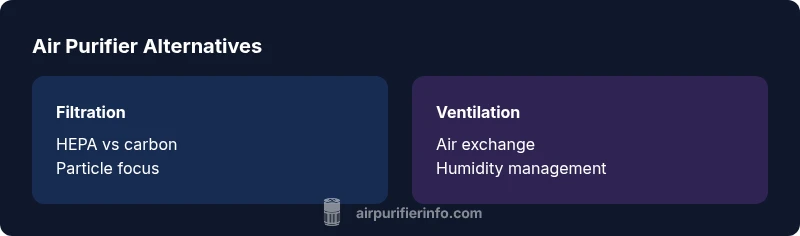
Understanding the phrase what is similar to an air.purifier helps homeowners connect direct filtration with broader strategies for indoor air quality. According to Air Purifier Info, similarities emerge in three broad categories: (1) devices that actively filter air in a defined space, (2) strategies that increase overall air exchange in a building, and (3) adsorbent solutions that capture odors and VOCs. This section maps the landscape and explains why each option matters for dust, pollen, pet dander, odors, and humidity-related concerns. The goal is not to replace a purifier with a singular alternative but to assemble a toolkit that covers different rooms, lifestyles, and budgets. The framing will emphasize trustable factors such as filtration efficiency, maintenance needs, energy use, and real-world performance.
Feature Comparison
| Feature | Traditional standalone air purifier | Ventilation upgrade (ERV/HRV) | Activated carbon air cleaner / carbon-based purifier |
|---|---|---|---|
| Filtration method | HEPA-based filtration for particulates | Enhanced air exchange and filtration via HVAC hardware | Adsorbent-based filtration primarily for odors and VOCs |
| Best For | Particles and allergens in specific rooms | Whole-home odor control and humidity management | Odor-heavy environments or spaces with strong VOC sources |
| Maintenance | Filter replacements and occasional cleaning | HVAC filter changes and system servicing | Carbon filter replacement and occasional fan cleaning |
| Energy use | Moderate to high depending on fan speed | Low to moderate; influences HVAC energy use | Low to moderate; typically passive when deployed in a room |
| Upfront cost | Moderate to high for high-capacity purifiers | High for full HVAC upgrades, installation, and ductwork | Low to moderate for portable carbon devices |
| Effectiveness | Strong for particles and some allergens | Broad influence on indoor air through exchange and filtration | High for odors and some VOCs, limited particle impact |
| Noise | Can be noticeable at higher speeds | Usually quiet if integrated; some systems add fan noise | Typically quiet for small portable units |
What's Good
- Direct, controllable filtration with replaceable parts
- Wide availability of portable options and configurable room coverage
- Can target odors with activated carbon or hybrid technologies
- Less invasive installation compared to full HVAC changes
What's Bad
- Ongoing filter and component replacement costs
- Effectiveness depends on room size and placement
- HVAC upgrades can be disruptive and expensive
- Carbon-based devices may require periodic replacement for odor control
Air purifier remains the most direct control, but ventilation upgrades offer scalable, whole-home benefits.
Choose a standalone purifier for targeted room-level control and quick wins. Consider ventilation improvements for long-term, whole-house air quality and when addressing multi-room or large spaces.
Questions & Answers
What is similar to an air purifier?
Options similar to an air purifier include portable HEPA units, whole-home ventilation upgrades, and carbon-based odor control devices. Each option targets different aspects of indoor air quality, from particle filtration to VOC adsorption.
Options similar to an air purifier include portable HEPA units, ventilation upgrades, and carbon odor-control devices. Each serves different air-quality needs.
When should I choose a ventilation upgrade over a purifier?
Choose a ventilation upgrade when you need broad, long-term air quality improvements across multiple rooms. Upgrades address air exchange and humidity, which can lessen pollutant buildup beyond what a single purifier can handle.
Ventilation upgrades work best for whole-home improvement, especially in larger homes.
Are carbon-based devices effective for odors?
Activated carbon devices excel at adsorbing odors and some VOCs but may not remove fine particulates as effectively as HEPA purifiers. They are often best used in a complementary role.
Carbon devices tackle odors well, but they aren't a complete stand-in for particle filters.
Is installation of a ventilation system a DIY project?
Some small changes, like upgrading filters or adding exhaust fans, can be DIY-friendly. Full ERV/HRV installations typically require a professional to ensure proper sealing, ducting, and energy efficiency.
Small upgrades may be DIY, but complete systems usually need a pro.
How do I compare energy costs between options?
Estimate by considering running hours, device efficiency (CADR/CFM), and the building's HVAC load. A whole-home upgrade can lower long-term energy use if it reduces pollutant buildup, while portable purifiers add ongoing electricity use in each room.
Check running hours and efficiency; big energy differences come from HVAC integration.
What’s a quick framework to decide?
Start with room size, pollutant type, and budget. Map options to needs: room-specific filtration, whole-home air exchange, or targeted odor removal.
Match room size and pollutant type to the right option, then factor in cost and maintenance.
Main Points
- Assess your space size before choosing a solution
- Pair filtration with ventilation where possible for best results
- Factor maintenance costs into the total cost of ownership
- Odor control often benefits most from carbon-based approaches
- In many homes, a hybrid approach yields the broadest protection