Is an air purifier the same as a diffuser? A practical comparison
Explore whether an air purifier is the same as a diffuser. Learn core differences, use cases, safety considerations, and practical guidance to choose based on indoor-air quality goals.


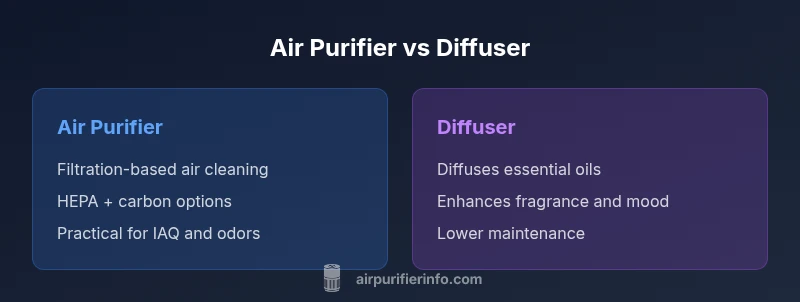
Is an air purifier the same as a diffuser? Not exactly. An air purifier filters particulates, allergens, and pollutants to improve indoor air quality, while a diffuser releases essential oils for scent or aromatherapy. While both can affect perceived air quality, their core functions, maintenance needs, and safety considerations are different, so choose based on your goals and space.
Is an air purifier the same as a diffuser? Core differences
The short answer is no—the two devices exist to solve different problems, even if both sit in the same room. According to Air Purifier Info, the underlying purpose is divergent: air purifiers target particle and gas contaminants to improve air quality, while diffusers introduce scented oils to alter aroma and mood. When homeowners or renters ask, “is an air purifier the same as a diffuser?” the best response is to map your primary goal: cleaner air versus a fragrance-enhanced environment. This first section lays the groundwork by defining each device, clarifying common misconceptions, and setting up the decision framework for rooms of varying sizes and activities.
In many households, the temptation is to treat both devices as interchangeable because they both touch the ambient air. The reality is more nuanced. An air purifier will not typically emit fragrance, and a diffuser will not remove fine particulates or volatile organic compounds (VOCs) with the same efficiency as a properly sized purifier. The Air Purifier Info team emphasizes that you should expect different performance metrics and maintenance demands from each device. If your goal is to reduce allergens or smoky odors, prioritize an air purifier. If your goal is mood enhancement or scent, choose a diffuser. Keep in mind safety considerations for oils around children and pets, discussed later in this guide.
From a consumer perspective, the cost of ownership and space requirements also diverge. Air purifiers tend to be bulkier, with ongoing filter costs, while diffusers are smaller, less expensive upfront, and require oil refills. For apartment dwellers, a compact diffuser might be a practical starting point for fragrance, while a purifier could be a better long-term investment for IAQ. The difference in maintenance routines means you’ll schedule filter changes for purifiers and oil refills for diffusers, not both on the same cadence. In short, the core difference hinges on air-cleaning versus aroma-delivery as the primary function.
This article uses a practical, evidence-based lens to compare both devices across use cases, safety, energy use, noise, and cost, so you can decide what fits your space. We’ll also provide a side-by-side table that highlights the differences and a verdict that aligns with your IAQ priorities.
How air purifiers work: filtration, CADR, and filters
Air purifiers are designed to reduce particulates and certain gases from the air. Most devices use mechanical filtration, with a primary HEPA-grade filter capable of capturing a broad range of particles, from dust to pollen. Some units incorporate activated carbon or other sorbents to adsorb odors and VOCs. The effectiveness of an air purifier is often described using a Clean Air Delivery Rate (CADR), which indicates how quickly the purifier can remove particles of different sizes in a given room. Importantly, CADR is influenced by room size, fan speed, and filter condition. Regular maintenance—such as timely filter replacement and occasional pre-filter cleaning—ensures the purifier maintains its performance curve over time. For homeowners dealing with dust, pet dander, and seasonal allergies, a purifier with a true HEPA filter and carbon stage is typically the most straightforward option.
However, not all purifiers are created equal. Some models emphasize silent operation and energy efficiency, while others push higher CADR numbers at the expense of noise. The choice should reflect room size, occupancy, and sensitivity to airborne irritants. The Air Purifier Info team notes that in many urban homes, successfully reducing IAQ problems means combining a robust filtration setup with practical daily habits such as keeping HVAC intake clean, using sealed storage for dusty items, and ensuring that the purifier isn’t placed behind furniture that blocks airflow. In short, purification is a process that depends on proper sizing, filter type, and room dynamics.
How diffusers work: diffusion methods and safety
Diffusers operate on a different principle: they disperse essential oils into the air to create a fragrant environment and, in some cases, potential aromatherapy benefits. Most diffusers use ultrasonic or nebulizing diffusion to release a fine mist of essential oil molecules. The mechanism is not about cleaning air; it’s about scent distribution, mood modulation, and sometimes perceived air freshness. The diffusion rate, oil concentration, and room air exchange (ventilation) will influence how strong the scent feels in a space.
Diffusers vary in capacity, duration, and ease of use. Ultrasonic diffusers are common for home use: they vibrate a water-oil blend to create a mist, requiring regular water and oil refills. Nebulizing diffusers don’t rely on water; they atomize pure oil, delivering more potent aroma with less dilution but often at a higher cost and louder operation. It’s important to only use oils that are safe for pets and people in your household. Some essential oils can irritate airways or trigger allergies in sensitive individuals, and certain animals—especially cats and birds—are more susceptible to oil exposure. Always start with small amounts and monitor occupants for any adverse reactions.
From a safety standpoint, diffusers should be used according to the manufacturer’s instructions, placed away from heat sources, and kept out of reach of children and pets to prevent accidental ingestion. If you have an asthma or allergy history, consult a clinician before relying heavily on diffusers as a fragrance strategy, and prefer low-odor alternatives or simply use them intermittently.
Use-case scenarios: when each device shines
Different rooms and activities call for different IAQ strategies. In bedrooms where dust and pollen infiltration contribute to morning congestion, an air purifier positioned near the bed can minimize particulate exposure during sleep. For living rooms with cooking smells, a purifier with a carbon filter can reduce odors and capture grease particulates from air rain, while a diffuser might be used sparingly to set a calm mood with a light fragrance, never as a sole method for odor control.
In offices or home studios with higher particulate load from printers or craft activities, a purifier becomes a practical core device. On the other hand, for a spa-like setting or a room meant for relaxation and mindfulness, a diffuser can enhance ambiance. The key is clear boundaries: do not expect a diffuser to replace a purifier for IAQ, and do not rely on a purifier to deliver fragrance. The two tools complement each other when used with a clear plan and proper maintenance schedules.
Design and maintenance: placement, care, and longevity
Placement matters for both devices. An air purifier should have unobstructed intake and exhaust, ideally elevated off the floor and away from walls or large furniture that disrupts airflow. If you’re sharing space with multiple devices, ensure there’s adequate clearance around the purifier to maintain efficient operation. Maintenance for purifiers revolves around filter replacement intervals and occasional pre-filter cleaning. Align these tasks with monthly checks and a seasonal reminder to ensure the purifier remains effective when outdoor air quality worsens.
Diffusers require regular cleaning to prevent oil buildup on the device and to maintain fragrance quality. Oils can degrade plastic components or produce residue if left unchecked. For households with pets or children, consider the volatility of oils used and how frequently you diffuse them. Keeping a dedicated, well-ventilated diffusion area away from sleeping or nursing areas helps minimize potential exposure. The Air Purifier Info team recommends following manufacturer guidelines for cleaning and using only high-quality, fragrance-grade oils that are free from adulterants and avoid known irritants.
Health considerations and pet safety: navigating risks
Air purifiers can reduce airborne irritants and odors but do not replace need-based medical strategies for asthma or allergy management. If you have respiratory sensitivities, pairing an accredited purifier with an air-quality-monitoring plan can provide a practical baseline for improvement. When diffusing essential oils, safety becomes critical for households with pets and young children. Some essential oils can cause liver or neurological issues in animals or trigger respiratory problems in sensitive individuals. Always diffuse in well-ventilated spaces and consider using pet-safe oils or alternating diffusion schedules to avoid continuous exposure. If any occupant experiences coughing, chest tightness, or eye irritation, reduce or stop diffusion and consult a professional.
Energy use and noise are practical health considerations as well. Air purifiers typically operate with fans at several speeds; higher settings improve air cleaning but may raise noise levels. Diffusers are generally low-energy devices, but some nebulizing units can introduce light noise. Balancing energy consumption with comfort is part of a holistic IAQ strategy.
Getting started: a quick decision guide
If your primary objective is cleaner air, start with a purifier that fits the space and has a true HEPA filter with an activated-carbon stage for odors. If you want fragrance or aromatherapy, add a diffuser as a supplementary device, being mindful of oil safety and room occupancy. For mixed needs, consider a two-device plan: a purifier for IAQ and a diffuser for mood and scent—not a single device attempting to do both. Establish a simple evaluation framework: room size vs purifier CADR, fragrance intensity vs diffuser output, maintenance cadence, and safety considerations for pets and children. The key is to align device selection with the specific indoor-air quality goals you want to achieve and to monitor IAQ over time using simple indicators like air freshness, dust visibility, and resident comfort.
In practice, a balanced approach often yields the best results. Keep a log of when you replace filters and when you diffuse oils; adjust placement and diffusion frequency based on observed comfort and odor levels. The goal is a sustainable, safe, and effective setup that clearly supports your IAQ objectives over the long term.
Integrating both devices for layered indoor air quality
For many households, a layered approach works best. Use an air purifier as the primary tool to reduce particulate matter and odors, then employ a diffuser sparingly to improve ambiance. The synergistic effect comes not from relying on one device for everything but from realizing distinct roles: filtration and fragrance. If you diffuse, choose a well-ventilated area, or diffuse for short durations while air exchange remains active. Remember that diffusers do not remove contaminants; they add fragrance and may influence the perception of air freshness. By combining both tools thoughtfully, you create an environment that supports both respiratory comfort and a pleasant atmosphere.
The Air Purifier Info team emphasizes that consumer decisions should be grounded in space, occupancy, and the presence of pets or children. In spaces with strict IAQ requirements, prioritizing an air purifier with tested filtration is essential, while diffusion can be used as a supplementary sensory enhancement rather than a primary solution.
Comparison
| Feature | Air purifier | Diffuser |
|---|---|---|
| Core purpose | Clean air by filtering particles and gases | Disperse essential oils for scent and mood |
| Primary mechanism | Filtration (HEPA/carbon) and airflow | Ultrasonic or nebulizing diffusion of oil |
| Ideal use cases | Dust/allergen reduction, IAQ improvement, odor control | Scent enhancement, aromatherapy, mood setting |
| Maintenance needs | Filter changes and occasional cleaning | Oil refills and regular cleaning |
| Safety considerations | Low risk with proper placement; avoid unfiltered exhaust | Oil sensitivity, pet safety, and potential irritation with some oils |
| Power consumption | Moderate to higher depending on CADR | Low to moderate, dependent on diffusion method |
| Noise level | Can be noticeable at higher fan speeds | Typically quiet, varies by model |
| Space requirements | Requires space near intake/outlet for airflow | Small footprint; place away from reach of kids/pets |
What's Good
- Clarifies purpose: air cleaning vs fragrance delivery
- Provides a clear decision framework for room goals
- Encourages appropriate maintenance for each device
- Supports safer, tailored IAQ strategies
- Highlights compatibility considerations for mixed setups
What's Bad
- Two separate devices may take more space and upfront cost
- Maintenance schedules differ, which can lead to planning complexity
- Diffusers carry fragrance-safety considerations for pets/children
- Air purifiers cannot provide aromatherapy benefits
- Over-reliance on a diffuser for air freshness can mask poor IAQ
Air purifiers and diffusers fulfill different tasks and should not be treated as interchangeable.
Prioritize an air purifier for IAQ improvements and odor control when dust and allergens are concerns. Use a diffuser for mood enhancement and fragrance, not for air cleaning. The best approach is a deliberate, goal-driven setup with separate devices, optimized placement, and safe usage practices.
Questions & Answers
Is it safe to run a diffuser and air purifier at the same time?
Yes, you can operate both devices simultaneously if you manage placement, ventilation, and fragrance levels. Start with short diffusion sessions and observe occupants’ comfort. Monitor for any signs of irritation or scent overload, and adjust usage accordingly.
Yes—it's generally fine to run both, but keep diffusion light and ensure good room ventilation.
Do diffusers clean the air or improve IAQ?
Diffusers do not filter particles or improve IAQ in the way purifiers do. They add fragrance and can contribute to a sense of freshness, but they do not remove dust or pollutants. For IAQ improvements, rely on a purifier with an effective filtration system.
Diffusers don’t clean air; they diffuse oils for scent, while purifiers clean air.
Are air purifiers effective against odors?
Air purifiers with activated carbon or other adsorbents can reduce household odors by trapping volatile compounds. They won’t scent the room the way a diffuser does, but they help with odor removal when properly matched to the space.
Purifiers can reduce smells if they have carbon filters, but they don’t perfume the room.
What should I consider when choosing between them?
List your primary goal (clean air vs fragrance), room size, noise tolerance, and safety concerns (pets/children). This helps determine whether to prioritize a purifier, a diffuser, or both in a layered IAQ strategy.
Think about your main goal, room size, and safety when deciding.
Can essential oils harm pets or people?
Some essential oils can irritate or harm pets; use caution, and consult a vet for pet-specific guidance. Always diffuse in well-ventilated spaces and consider using pet-safe oils and shorter diffusion sessions.
Some oils can be unsafe for pets; check safety guidelines and use oils sparingly.
Should I buy a combined device that does both?
There isn’t a single device that does both effectively for most homes. Separate devices provide better specialization: filtration for air cleaning and diffusion for fragrance.
There isn’t a perfect single device for both tasks; use separate devices for best results.
Main Points
- Define your goal: clean air vs. aroma.
- Choose a purifier for IAQ and odors; use a diffuser for fragrance.
- Mind safety: pets, oils, and child-safe practices matter.
- Maintain each device with appropriate schedules; don’t mix maintenance tasks.
- A layered approach often yields the best overall indoor air quality.