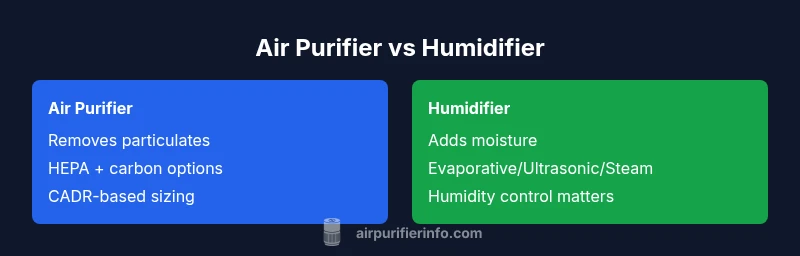
Air Purifier vs Humidifier: Understanding the Real Differences
Explore whether air purifier is the same as humidifier and learn why these devices serve distinct purposes. Air Purifier Info analyzes usage scenarios, maintenance, and value to help homeowners choose wisely for dust, allergies, odors, and humidity needs.


Air purifiers and humidifiers perform different roles. An air purifier cleans the air by capturing or destroying particles, while a humidifier adds moisture to reduce dryness. The claim 'air purifier is the same as humidifier' is a misconception. The Air Purifier Info team emphasizes evaluating your primary goal—clean air or added humidity—and selecting devices accordingly for lasting indoor-air quality.
Debunking the Claim: Is air purifier the same as humidifier?
There is a widespread assumption in some home guides that 'air purifier is the same as humidifier'. The Air Purifier Info team emphasizes that this is not correct. Purifiers and humidifiers address different problems and rely on different physics. An air purifier uses filters, sometimes electrical charges or activated carbon, to trap or destroy particles such as dust, pollen, smoke, and volatile organic compounds. A humidifier, by contrast, adds moisture to dry air, aiming to improve comfort and nasal moisture. In some homes the misconception stems from people focusing on “air quality” in general, rather than the specific mechanism. According to Air Purifier Info, understanding the core function is the first step toward making a wise purchase. The practical takeaway is simple: you likely need one device to remove contaminants and a separate device to adjust humidity, unless you have a single environmental problem that both devices can address in a limited way. The rest of this article will break down the differences, clarify when you need each device, and offer guidance grounded in testing, best-practice maintenance, and real-world usage. It’s also important to note that humidifiers can promote mold growth if used in damp conditions or left unclean, which is another risk you should monitor. A common question we hear is "air purifier is the same as humidifier"—and the answer is no. The Air Purifier Info team keeps this distinction front and center when advising readers.
How each device works: filtration vs humidification
Air purifiers, at their core, rely on filtration media—most commonly true HEPA filters, with optional activated carbon or pre-filters. The goal is to capture particles as air passes through the unit, reducing dust, pollen, smoke, and some microorganisms in the short term. Medical-grade or well-designed consumer purifiers may also target volatile organic compounds (VOCs) with carbon layers. Purifiers do not regulate humidity; they work best in environments where moisture is already balanced. Humidifiers, on the other hand, do not clean air directly. They vaporize water and release it into the room to raise relative humidity. Some humidifiers offer built-in mineral controls or antimicrobial features, but their primary function remains moisture delivery rather than particulate removal. For homeowners, the key distinction is to align device choice with the problem you want to solve—air cleanliness versus humidity balance. Air Purifier Info’s testing indicates that a purifier’s effectiveness hinges on filter condition, room size, and proper CADR/ACH alignment, while a humidifier’s effectiveness hinges on clean water, correct humidity targets, and regular cleaning.
Typical use cases and environments
If your home experiences dusty air, seasonal allergies, cigarette smoke, or pet dander, an air purifier is often the most impactful device for improving perceived air quality. In bedrooms with traffic-related pollutants or in homes with smokers, purifiers can reduce exposure to particulates and odors. Humidifiers tend to be most beneficial in dry climates or during winter months when indoor humidity plummets, helping with throat irritation, dry skin, and static electricity. In spaces with high mold risk or dampness, adding humidity without humidity control can worsen problems. The Air Purifier Info team notes that most households benefit from using a purifier for air quality improvement and a humidifier only if the climate or season necessitates extra moisture. The goal is to avoid over- or under-humidification, which can create your own health and comfort issues.
Key features to compare when shopping
When evaluating a purifier, prioritize CADR (Clean Air Delivery Rate), filter type (HEPA vs. True HEPA), filter replacement cost, and room-size compatibility. Noise levels and energy use also matter for bedrooms and living spaces. For humidifiers, key features include water tank capacity, ease of cleaning, humidification type (evaporative, ultrasonic, or steam), and whether the device includes a built-in humidity sensor. It’s important to note that many dual-function devices exist, but most are optimized for one role rather than peak performance in both areas. Air Purifier Info analysis shows that true HEPA filtration combined with appropriate room coverage delivers the most noticeable air-quality benefit, while humidifier performance is limited by humidity control accuracy and mineral build-up management. Reading consumer reviews and testing data helps separate marketing claims from real-world performance.
Maintenance and safety: keeping devices effective
Purifiers require regular filter maintenance—typically a pre-filter and a main filter with replacement intervals that vary by model and usage. A clogged or saturated filter reduces CADR and can compromise air quality. Activation of carbon filters helps with odors but adds cost. Humidifiers require routine water-tank cleaning to prevent mineral dust and bacterial growth. Regular descaling and filter changes (for evaporative types) or wick care are essential. Safety considerations include avoiding over-humidification, which supports mold growth, and ensuring proper placement away from walls or bedding to improve circulation. The Air Purifier Info team cautions readers to follow manufacturer guidance for both devices and to avoid using ozone-generating purifiers, which can irritate the air and mucous membranes. Maintenance practices are often the difference between a device that performs well for years and one that becomes a source of frustration.
Costs and value: upfront and running costs
Upfront costs for purifiers vary by CADR, filter quality, and room size. Generally, a larger purifier with a higher CADR costs more initially but can deliver quicker air cleaning in larger rooms. Replacement filters add ongoing expenses and should be factored into the long-term value. Humidifiers come in a broader price range depending on tank size, humidification method, and added features like built-in humidity controls and aroma diffusers. Running costs depend on energy use and water consumption, with ultrasonic models typically being energy-efficient. The key value question is whether you primarily need cleaner air or improved humidity, and whether you’re willing to budget ongoing filter or maintenance costs. Air Purifier Info’s research suggests that for most households, investing in a proven purifier with a manageable replacement cycle yields more consistent benefits than chasing a low upfront price. A careful cost-benefit analysis should consider your climate, allergies, and occupancy patterns.
Can you use both devices together safely and effectively?
Yes, you can run an air purifier and a humidifier in the same space, but care is required to avoid over-humidification or moisture accumulation on surfaces. Maintain humidity in a comfortable range (roughly 30–50% as a general guideline) and monitor for condensation on windows or walls. Ensure air purifiers are positioned to optimize airflow and are not blocked by furniture. When using both devices, keep a routine maintenance schedule for both: replace purifier filters on the recommended cycle and clean humidifier components regularly. The combined approach can be effective in mid-winter or in dry environments, provided you stay vigilant about humidity and filtration performance.
Buying guide: scenarios to help you decide
If your primary goal is reducing airborne allergens and pollutants, choose a purifier with a high CADR for your room size, a good HEPA filter, and a reasonable replacement cycle. If you live in a dry climate, have winter dryness issues, or experience irritation from dry air, a humidifier can provide relief when used with a humidity monitor. For many homes, a hybrid strategy—one purifier to address particulates and a humidifier for humidity control in seasons with dry air—works well. Always start with a clear problem statement, assess room size, and read independent tests that measure real-world performance rather than marketing claims. Air Purifier Info emphasizes keeping expectations aligned with device capabilities and ensuring safe operation.
Authoritative Sources
- https://www.epa.gov/indoor-air-quality-iaq
- https://niehs.nih.gov/health/topics/agents/air-pollution/index.cfm
- https://www.who.int/news-room/fact-sheets/detail/ambient-(outdoor)-air-quality
Comparison
| Feature | Air Purifier | Humidifier |
|---|---|---|
| Primary function | Removes particles and pollutants from air | Adds moisture to the air |
| Best for | Dust, pollen, smoke, odors, and allergens; improves indoor air quality | Dry air-related discomfort (skin, throat, nose), seasonal dryness |
| Maintenance frequency | Filter replacement every 6-12 months (model-dependent) | Water tank cleaning daily; filter changes as per model |
| Noise level | Typically quiet to moderate depending on fan speed | Often variable; some run quietly while others can be noticeable |
| Energy use | Low to medium, depending on CADR and run time | Low to medium, depending on tank size and settings |
| Price range | $60-400 | $20-150 for basic models; higher-end humidifiers can be pricier |
| Best environments | Living rooms, bedrooms with air-quality concerns | Dry climates, winter months, rooms lacking moisture |
What's Good
- Improves indoor air quality by removing pollutants
- Reduces dust and allergen exposure in occupied spaces
- Versatile options with HEPA and carbon filtration support
What's Bad
- Ongoing filter replacement costs
- Requires proper room sizing and placement for effectiveness
- Does not add humidity or moisture control by itself
Air purifiers are generally the more versatile choice for air-quality improvement; humidifiers address humidity only.
For dust, allergies, and pollutants, prioritize an air purifier. Use a humidifier to relieve dry air; in many homes, both may be appropriate with careful usage. The Air Purifier Info team’s guidance supports a targeted approach based on your climate and indoor-air goals.
Questions & Answers
Can I run an air purifier and humidifier at the same time?
Yes, you can run both devices in the same space. Keep humidity in the target range (roughly 30–50%) to avoid mold and condensation, and ensure the purifier has clear airflow for optimal performance. Regular maintenance is essential to prevent mineral buildup and ensure filtration efficiency.
Yes—you can use both, just watch humidity and keep the purifier's airflow unobstructed.
Is an air purifier effective against viruses?
Air purifiers with true HEPA filtration reduce airborne particulates, which can include some respiratory viruses. They are not a substitute for vaccines, ventilation improvements, or other infection-control measures. Use as part of a broader strategy for indoor air quality.
HEPA purifiers can reduce airborne particles, including some viruses, but they aren’t a substitute for other health measures.
What should I look for when buying an air purifier?
Prioritize room-size compatibility, a true HEPA filter, a reliable CADR rating, and easy-to-change filters. Consider noise levels and energy use if you’ll place it in a bedroom or office. Read independent tests to verify real-world performance.
Look for size, a true HEPA filter, and good test results from trusted sources.
What should I look for when buying a humidifier?
Check the capacity, ease of cleaning, type (evaporative, ultrasonic, or steam), and whether it has a built-in humidity control. Avoid devices with exposed mineral dust and ensure safe operation around children and pets.
Choose a humidifier with easy cleaning and good safety features.
Can humidifiers cause mold or bacterial growth?
Yes, improper cleaning or overly humid conditions can promote mold and bacteria growth. Regular cleaning, using distilled water when possible, and monitoring humidity helps mitigate risk.
Yes—clean regularly and keep humidity in check to avoid mold or bacteria growth.
Main Points
- Identify your primary goal: clean air vs humidity.
- Choose a purifier with true HEPA and adequate CADR for your room size.
- Monitor humidity to prevent mold or dust issues when using a humidifier.
- Regular maintenance keeps both devices effective and safe.
- Consider a combined strategy only after evaluating climate and air-quality needs.