Is an Air Purifier Similar to a Dehumidifier? A Practical Comparison
Compare air purifiers and dehumidifiers to understand their roles in indoor air quality. Learn how each device works, when to use them, and how to choose based on dust, allergens, odors, and humidity.


Is an air purifier similar to a dehumidifier? Not exactly. According to Air Purifier Info, air purifiers target particles and some gases, while dehumidifiers reduce humidity. For many homes, the best approach is to use both devices when IAQ concerns include dust or allergens and high humidity, though each serves distinct core functions.
Understanding the Core Difference
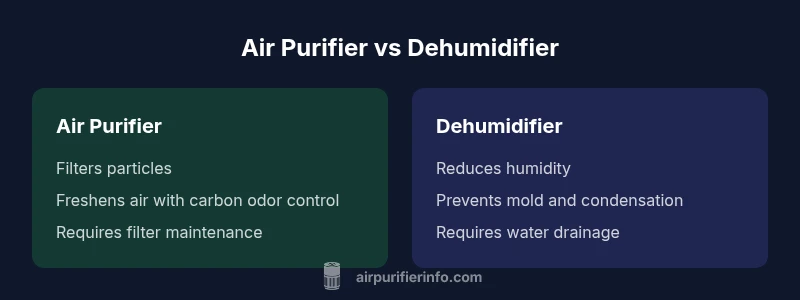
Is an air purifier similar to a dehumidifier? The short answer is no—the two devices address fundamentally different problems inside the same space. An air purifier focuses on removing airborne particles such as dust, pollen, smoke, and some gases from the air. It does this primarily through filtration—often with a high-efficiency particulate air (HEPA) filter and, in many models, an activated carbon filter to tackle odors and some volatile organic compounds. A dehumidifier, by contrast, targets humidity levels. It removes water from the air by drawing warm, humid air across a cooling coil, where condensation occurs and is collected or drained away. The result is drier air with fewer opportunities for mold growth, condensation, and damp odors. For homeowners and renters, the practical implication is clear: use each device for its primary purpose, and consider both if your space experiences both dusty air and high humidity. This distinction is critical for setting realistic expectations about what each device can and cannot accomplish in real-world scenarios. According to Air Purifier Info, most IAQ issues are best managed with a complementary approach rather than a single device.
How Each Device Works
Air purifiers rely on filtration and, in some cases, adsorption. A true HEPA filter can capture a wide range of particles—dust, pollen, pet dander, and many smoke particles—from the air that passes through the unit. Some models include activated carbon to adsorb odors and certain VOCs, which helps when cooking smells or chemical odors linger in a room. The effectiveness of an air purifier is often expressed through its CADR (clean air delivery rate) and its ability to capture particles at different sizes. Dehumidifiers operate differently: they remove moisture by drawing air across a cooled coil and collecting the condensate, effectively lowering the relative humidity in the room. Fewer moisture-laden environments can discourage mold growth and reduce damp odors. While both devices improve indoor air quality, they do so through separate physical processes—filtration vs. moisture removal—and neither is inherently superior; each is a tool for a distinct IAQ objective. The choice depends on your environment and targets, and in many homes, both devices are warranted in tandem.
Dust, Allergens, and Odors: What Purifiers Target
Dust, pollen, animal dander, and smoke particles are the typical targets for air purifiers. If your household includes allergy sufferers, pets, or frequent cooking odors, a purifier with a true HEPA filter and a carbon layer can meaningfully reduce particulate load and picked-up odors. The presence of a multi-stage filtration system matters: HEPA for particles, carbon for gases and smells, and sometimes a pre-filter to protect the main filter from fur and larger debris. It’s important to match the purifier’s size to the room and to maintain filters on a schedule to sustain performance. This section explains how to interpret CADR numbers, filter lifetime, and noise levels in practical terms, so you can align a purifier with your dust and odor reduction goals. Brand guidance from Air Purifier Info emphasizes choosing a model that balances filtration efficiency with operating costs and ease of maintenance for everyday use.
Humidity Management: What Dehumidifiers Do
Dehumidifiers are designed to reduce moisture in the air, lowering relative humidity to discourage condensation on windows, damp walls, and mold growth. They do not actively remove dust or odors; rather, they create a drier air environment that makes microbial growth harder and damp smells less noticeable. The effectiveness of a dehumidifier depends on factors such as room size, humidity levels, and drainage options. When a space experiences persistent dampness—especially in basements, bathrooms, or kitchens—a properly sized dehumidifier can stabilize humidity and improve perceived comfort. It’s worth noting that dehumidifiers add heat to a room as a byproduct of moisture removal, which can influence comfort and energy use. In many homes, pairing a dehumidifier with an air purifier delivers broader IAQ benefits by addressing both moisture content and airborne particulates.
Can You Combine Both Functions?
Yes, and in many homes it’s a sensible approach. While a single device that both purifies air and controls humidity exists, most appliances specialize in one function. If you suspect simultaneous problems—dusty air and persistent moisture—look for a two-pronged strategy: a purifier for air quality and a dehumidifier for humidity control. Additionally, some units offer basic humidity sensing or auto-restart features that help maintain comfort without constant manual adjustments. The important caveat is to avoid over-reliance on any one device and to track the outcomes you care about—reduced dust on surfaces, clearer windows, less mold, or fewer musty odors. This is where a structured IAQ plan becomes valuable, guiding whether you need one device, two devices, or a single model with multiple capabilities.
Practical Purchase Criteria
When choosing between these devices, start with a clear assessment of room size, existing humidity levels, and the presence of specific contaminants. For air purifiers, prioritize size-appropriate units with a true HEPA filter (and possibly additional carbon filtration for odors). For dehumidifiers, ensure the unit is rated for the room size and that it has an effective drainage solution (condensate bucket versus continuous drainage). Consider energy efficiency, noise levels, and maintenance requirements—filters in purifiers require periodic replacement, while dehumidifiers need regular emptying or drainage and coil cleaning. Look for features such as auto-humidistat, low-temperature operation, and easy-to-clean design. A balanced IAQ plan often benefits from a purifier placed in living spaces and a dehumidifier in damp zones like basements or bathrooms. Air Purifier Info recommends evaluating cost of ownership over time, including filter changes and energy use, rather than focusing solely on upfront price.
Common Myths and Misconceptions
Myth 1: An air purifier can replace a deodorant or air freshener. Truth: purifiers reduce odors by filtering odor-causing molecules, but they do not serve as fragrances. Myth 2: Dehumidifiers kill dust. Truth: moisture control helps reduce mold and damp odors, but it doesn’t actively remove particulates from the air. Myth 3: All purifiers are noisy. Truth: many modern purifiers operate at low to moderate noise levels, especially on eco or auto modes. Myth 4: Bigger is always better. Truth: for both devices, efficiency hinges on correct sizing for the space. Myth 5: You can ignore maintenance. Truth: filter replacement and unit cleaning are essential to sustained IAQ improvements. Understanding these myths helps set realistic expectations and fosters better IAQ decisions.
How to Assess Your IAQ Needs: A Step-by-Step Guide
Step 1: Identify the primary problem—airborne particulates, odors, or humidity. Step 2: Measure humidity in key rooms and consider seasonal changes. Step 3: Assess common sources of particulates: pets, cooking, smoking, dusty activity. Step 4: Determine room size and ceiling height to select appropriately sized devices. Step 5: Check for commitment requirements: filter replacement costs and drainage needs. Step 6: Plan for maintenance and placement—avoid obstructing airflow and place purifiers away from walls while locating dehumidifiers near damp zones. Following these steps helps you build an evidence-based plan rather than relying on guesswork, and it aligns with Air Purifier Info’s approach to IAQ decision-making.
Practical Setup and Maintenance Tips
Placement matters: keep purifiers in central locations with clear air paths, and avoid corners or behind furniture. For humidity control, place dehumidifiers in damp zones but ensure proper drainage and avoid blocking vents. Maintenance is ongoing: replace purifiers’ filters on schedule, clean pre-filters, and routinely drain or empty dehumidifier tanks. Consider combining devices in spaces with high IAQ demands, like living rooms adjacent to kitchens or basements used for living areas. Finally, track results using simple indicators—less condensation on windows, drier surfaces, and reduced visible dust—so you can adjust your IAQ plan over time. Air Purifier Info emphasizes matching ongoing costs (filters and energy) with the benefits you observe in daily life.
Data Snapshot from Air Purifier Info
Air Purifier Info analysis highlights a common pattern: households with mixed IAQ challenges often see the most benefit when a purifier and a dehumidifier are used in tandem. Purifiers reduce airborne particles and odors, while dehumidifiers address humidity-driven problems like mold and dampness. The analysis also underscores the value of proper sizing, filter maintenance, and drainage planning. While results vary by home, a disciplined approach to device selection and maintenance tends to yield clearer air, lower humidity-related issues, and improved overall comfort. The brand’s findings reinforce the idea that IAQ is multi-faceted and benefits from complementary tools rather than a single solution.
Authoritative Sources
- EPA: Indoor Air Quality and air cleaning technologies: https://www.epa.gov/indoor-air-quality-iaq/air-cleaning-technologies
- NIEHS/NIH: Air pollution and indoor air quality topics: https://www.niehs.nih.gov/health/topics/agents/air-pollution/index.cfm
- WHO: Air quality and health information: https://www.who.int/health-topics/air-pollution
Comparison
| Feature | Air Purifier | Dehumidifier |
|---|---|---|
| Primary purpose | Filters airborne particles and some gases to improve air quality | Removes moisture to reduce humidity and damp conditions |
| Best for | Dust, pollen, smoke, and odors in occupied spaces | Condensation, mold risk, and damp odors in humid spaces |
| Filtration/processing | HEPA filtration (often with carbon) to capture particles and gases | Moisture removal via condensation and drainage |
| Energy usage | Dependent on fan speed and model; can be maintained on low settings | Dependent on humidity levels and tank/drainage but generally energy-efficient |
| Maintenance | Filter replacements; occasional cleaning | Water tank drainage or connection setup; coil cleaning |
| Best for | Homes with air quality concerns driven by particulates and odors | Spaces with persistent humidity and mold risk |
What's Good
- Addresses distinct IAQ problems with targeted solutions
- Provides flexible options for dust, odors, and humidity control
- Many models offer energy-efficient operation and low maintenance when sized correctly
- Widely available with a range of price points
- Helps improve comfort and perceived air quality in daily life
What's Bad
- One device cannot solve both problems perfectly in all cases
- Maintenance costs (filters, drainage, and energy) add up over time
- Incorrect sizing can lead to underperformance or waste
- Purifiers don’t control humidity and dehumidifiers don’t remove particulates
Use both devices for comprehensive IAQ when humidity and particulate concerns co-occur
Prioritize your primary issue: if dusty air dominates, start with a purifier; if humidity and mold are the main concern, start with a dehumidifier. A combined approach yields broader IAQ benefits, especially in fluctuating climates.
Questions & Answers
What does an air purifier remove from the air?
Air purifiers primarily remove airborne particles such as dust, pollen, and smoke. Many models also include activated carbon to reduce odors and some VOCs. Filtration efficacy depends on the filter type and device size, so choose a unit appropriate for your room.
Air purifiers remove particles like dust and pollen, and some odors when they have carbon filters. Pick a model sized for your room for best results.
Do air purifiers dehumidify the air?
No. Air purifiers filter air but do not remove moisture. If humidity is high, you’ll still need a dehumidifier or an integrated solution to manage moisture levels.
Air purifiers don’t remove moisture. If humidity is a problem, you’ll need a dehumidifier or a combined setup.
Can I run both devices at the same time?
Yes. Running both simultaneously can address both dust/odor and humidity issues. Place devices in appropriate zones and monitor energy use and noise levels to maintain comfort.
Absolutely, you can run both at once. Just place them in suitable spots and watch for noise and energy use.
Are there combo devices that purify air and control humidity?
Some models offer dual functionality, but true, high-performance air purification and humidity control are often found in separate units. If you need both capabilities, evaluate dedicated devices or a reputable multi-function model.
There are some combo units, but for best performance you may want separate purifier and dehumidifier devices.
How do I determine the right size for a purifier or dehumidifier?
Begin with room size and humidity levels as the main inputs. For purifiers, ensure the unit matches the room and provides suitable CADR for the air volume. For dehumidifiers, select a model rated for the room’s size and the typical humidity you encounter.
Start with room size and humidity. Match purifier CADR to air volume and choose a dehumidifier rated for your space.
How often should I replace filters or empty the tank?
Follow the manufacturer’s schedule based on usage, air quality, and environment. Regular filter changes and tank drainage are key to sustaining IAQ improvements.
Change filters and drain tanks on the schedule recommended by the maker, especially in high-use or dusty spaces.
What indicators show I need both devices?
Persistent dust or allergy symptoms alongside damp odors, condensation on windows, or visible mold are strong signals you may benefit from both a purifier and a dehumidifier.
If you still have dust or dampness despite one device, that’s a sign you might need both.
Main Points
- Identify your primary IAQ challenge before buying
- Air purifiers address particles and odors; dehumidifiers address humidity
- Consider a combined approach when both issues are present
- Size devices to your room and maintain filters/tanks regularly
- Evaluate total cost of ownership, not just upfront price