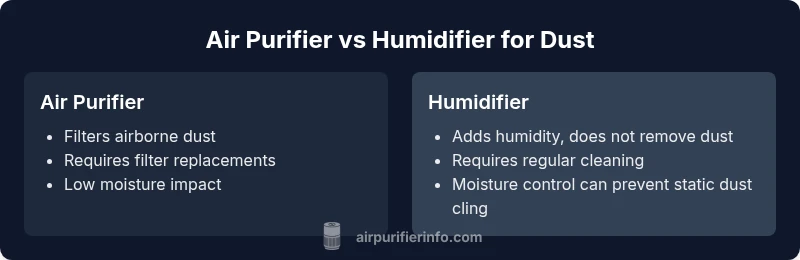
Is air purifier or humidifier better for dust? A comprehensive comparison
Is an air purifier or humidifier better for dust? A data-driven comparison of dust removal, humidity effects, maintenance, and cost to help homeowners choose the right device for cleaner, healthier indoor air.


TL;DR: For most homes, an air purifier is the stronger choice for dust control because filtration targets airborne particles, while humidifiers mainly adjust moisture. If dust is your main concern, prioritize a purifier with a true HEPA filter and regular maintenance; add a humidifier only if humidity is consistently low and mold risk is controlled.
Dust, dust particles, and indoor air quality
Dust is a pervasive indoor pollutant that travels on air currents, clings to surfaces, and triggers irritation for sensitive occupants. When people ask about is air purifier or humidifier better for dust, the practical answer hinges on what you hope to achieve: reduce airborne particles or improve comfort through humidity. In most homes, airborne dust is best tackled with filtration, because filters physically capture particles as air passes through the device. Humidity, by itself, does not remove dust and can even alter dust behavior by changing how particles settle or float. According to Air Purifier Info, effective dust control starts with a purpose-built purifier in the main living spaces, paired with an appropriate humidity level to avoid mold and other moisture-related issues. The goal is to strike a balance: minimize nuisance dust while maintaining safe humidity (roughly 30–50% relative humidity in many homes). The rest of this article examines the mechanisms, pros and cons, and practical guidance to help you decide whether to use a purifier, a humidifier, or both in concert.
Dust behavior and how devices affect it
Dust in indoor spaces consists of tiny particles from skin flakes, fibers, pollen, and outdoor soil that hitchhike on the air. In many homes, a significant portion of this dust remains suspended until acted upon by airflow, gravity, or filtration. Moisture affects dust in a different way: when humidity rises, dust particles can clump and settle more readily, which might seem like less airborne dust but increases surface deposition and can feed mold if surfaces stay damp. The question is not simply larger vs smaller particles; it is where those particles reside—on surfaces, in the air, or both. When considering the factor is air purifier or humidifier better for dust, the core idea is that devices designed to remove or redistribute moisture influence dust dynamics differently. Air Purifier Info notes that focusing on airflow patterns, filtration quality, and room occupancy patterns often yields the biggest improvements in perceived dust levels.
How air purifiers work for dust
This section explains the mechanism of a purifier. The core concept is capturing particles rather than simply circulating air. True HEPA filtration captures a wide range of microscopic particles, including many dust particles, allergens, and pollen. A purifier's effectiveness depends on room size, air changes per hour, and the proximity of the device to where you spend most of your time. In practice, a purifier should be placed in rooms with the highest dust activity, such as living rooms or bedrooms near windows. Pre-filters capture larger debris and protect the main filter; activated carbon can reduce odors and VOCs that accompany dusty environments. Regular filter replacements are essential to maintain performance. When evaluating a purifier, consider CADR ratings as a general guide, but ensure that the device can deliver clean air for the specific square footage of your space. In addition to the main filter, consider a model with a sealed system to minimize bypass leakage and maximize dust capture.
How humidifiers impact dust and mold risk
Humidifiers add moisture to the air, which can soften dryness that irritates the nose and throat and reduces static electricity that can attract dust to surfaces. However, humidifiers do not remove dust from the air; they may influence how dust behaves by changing humidity levels. In rooms that run very dry, a humidifier can improve comfort and feel of air quality, but at higher humidity dust may settle on surfaces more readily and mold and dust mite growth can become a concern if humidity stays near the high end of the recommended range. This block discusses two major risks: mold and bacterial growth in the humidifier reservoir and damp surfaces. To minimize risk, clean the device regularly, use distilled water if possible, and maintain humidity in the recommended range for your climate and season. In sum, a humidifier addresses moisture rather than dust, so it should not be regarded as a primary dust-control device.
Room size, placement, and airflow decisions
Effectiveness of any device depends on room characteristics. An air purifier with an appropriate size for the room will process air more efficiently; placed near sources of dust can capture particles before they spread. For dust control, aim for a purifier capable of delivering clean air to the main living spaces, with doors closed to minimize air leakage. A humidifier's impact is more pronounced in rooms that are consistently dry, where it should be used to maintain a target humidity rather than chase dust reduction. Consider layout: avoid placing air purifiers where air might short-cycle behind furniture, and avoid humidifier placement near sleeping areas where excess moisture could encourage mold. Both devices benefit from proper sealing and minimal clutter; keep carpets, textiles, and upholstery clean, and vacuum regularly to reduce dust reservoirs.
Maintenance, costs, and long-term value
Upfront price is only part of the total cost. An air purifier requires initial investment plus ongoing filter replacements. Filters vary by design, and some models prize themselves on low energy use. A humidifier adds ongoing costs for water and maintenance and may require more frequent cleaning, especially in homes with pets or a high dust load. In the long run, a purifier's maintenance cost will depend on filter life and replacement price, while humidifier costs depend on water treatment and cleaning supplies. If you have allergies, the dust removal benefits of a purifier often justify ongoing filter expenses.
Practical guidance: one device or both
Decide in three steps: first assess whether dust is the primary issue or whether low humidity is causing discomfort; second, evaluate room size and common usage patterns; third, consider a layered approach. If dust is dominant, start with a purifier sized for your main living areas and add a humidifier only if humidity routinely falls below 30–40% in winter. If you experience dryness but not dust, a humidifier may suffice. For households with both dusty air and dry conditions, using both devices in a controlled manner—such as a purifier in key rooms and a humidity monitor to keep RH in the 30–50% range—offers balanced benefits.
Comparison
| Feature | Air Purifier | Humidifier |
|---|---|---|
| Dust removal capability | High (filters airborne particles) | Low (does not filter air; primarily adds moisture) |
| Effect on humidity | Maintains or improves air cleanliness without raising humidity by itself | Increases humidity, no particle filtration |
| Maintenance effort | Moderate (filter replacements as needed) | Moderate to high (regular cleaning to prevent mold; water changes) |
| Best for | Dust reduction and allergy relief in occupied rooms | Comfort and dryness relief in dry climates |
| Typical room size guidance | Effective across a range of room sizes when appropriately rated | Best for small to medium spaces where dryness is a concern |
| Energy use | Low to moderate depending on model | Low to moderate; humidifiers generally use less power |
| Safety considerations | Ensure proper filter sealing to prevent bypass and maintain air quality | Maintain clean reservoirs to prevent mold and bacteria growth |
What's Good
- Highly effective at reducing airborne dust and allergens
- Humidifiers improve comfort in dry environments and can reduce static dust cling
- Both devices support better overall indoor air quality when used appropriately
- Regular maintenance keeps operating costs predictable
What's Bad
- Humidifiers can become mold/bacteria sources if not cleaned and maintained
- Air purifiers require ongoing filter replacements and may be noisy at higher speeds
- Using humidity in excess of recommended levels can worsen mold risk or dust deposition
- Filters and devices may have a higher upfront cost compared with single-purpose tools
Air purifier wins for dust control; humidifier is useful for comfort when humidity is low
Prioritize a purifier for primary dust reduction, especially in living spaces. Add a humidifier only if the air is consistently dry, and maintain humidity to avoid mold risk. A balanced, monitored combination can be ideal in some homes.
Questions & Answers
How effective is an air purifier at reducing dust compared with a humidifier?
Air purifiers actively remove dust from the air through filtration, which generally makes them more effective for dust reduction than humidifiers. Humidifiers do not remove particles but can influence how dust behaves by changing humidity levels. For best results, use a purifier for dust control and reserve humidity adjustments for comfort if needed.
Air purifiers remove most airborne dust, while humidifiers mainly adjust moisture. Use a purifier when dust is the main issue.
Can I use both a purifier and a humidifier at the same time?
Yes. Using both devices can address both dust and dryness, but you should manage humidity to stay within the recommended range (roughly 30–50%). Monitor air quality and clean devices regularly to prevent mold growth.
Yes, you can use both, just keep an eye on humidity and clean the humidifier often.
What should I look for in an air purifier for dust?
Look for a true HEPA filter, a suitable CADR for your room size, a sealed housing, and replaceable pre-filters. Consider noise level, energy use, and the availability of indicator lights for filter life. A model sized for your room will perform best over time.
Choose a purifier with a true HEPA filter and the right size for your room.
What maintenance does a humidifier require to prevent dust-related problems?
Regular cleaning of the reservoir and components is essential to prevent mold and bacteria. Use distilled water when possible and follow the manufacturer’s cleaning schedule. Empty and dry the unit when not in use to avoid standing moisture.
Keep it clean, use distilled water, and dry it when not in use.
Will increasing humidity help with dust in all homes?
Increasing humidity can reduce static and improve comfort, but it does not remove dust. Dust particles can still be present in the air, and excessive humidity can promote mold or dust mite growth. Humidity should be kept within a healthy range for your climate.
Humidity helps comfort but doesn’t remove dust; don’t overdo it.
Is dust reduction the same as allergen reduction?
Dust reduction often lowers allergen exposure but is not identical to allergen reduction. Some allergens are attached to dust particles, so a good purifier helps, but other allergens may require different strategies. Combining filtration with cleaning routines yields the best results.
Dust reduction helps with allergens but isn’t the same as complete allergen control.
Main Points
- Prioritize dust control with an air purifier first
- Use humidifier only when humidity is consistently low
- Maintain filters and monitor humidity to maximize benefits
- Place purifiers strategically for maximum airflow in living areas
- Consider a layered setup for homes with both dust and dry air