How Much Does It Cost to Run an Air Purifier in 2026
Learn how much it costs to run an air purifier with simple calculations, a built-in calculator, and practical tips to reduce energy use.


Understanding what drives the running cost of an air purifier
Running an air purifier isn’t just about air quality; it’s also about energy use. According to Air Purifier Info, the main cost drivers are wattage, how many hours you run it each day, and the local price of electricity. Size and features matter too: larger purifiers with powerful motors tend to consume more power, while compact models and energy‑efficient designs use less. In most homes, your goal is to balance air quality with cost, rather than to run at maximum power constantly. This section explains how to estimate your monthly bill and how different usage patterns affect total costs.
- Real-world caveat: electricity prices vary by region, so your costs may differ from examples here.
- Tip: write down your typical usage for a realistic estimate before shopping for a new purifier.
The mathematics behind electricity costs for purifiers
To estimate running costs, you convert the purifier’s power draw into kilowatt-hours (kWh) and multiply by your rate per kWh. The basic formula is kilowatts × hours per day × days per year × price per kWh. Since watts ÷ 1000 = kilowatts, an example formula is: (watts / 1000) × hoursPerDay × daysPerYear × costPerKWh. You can simplify by using a calculator, but understanding the components helps you compare models. For instance, if a purifier uses 60W, runs 8 hours per day, 365 days, at $0.15/kWh: (60/1000) × 8 × 365 × 0.15 ≈ $26.28/year.
How usage patterns influence your bill
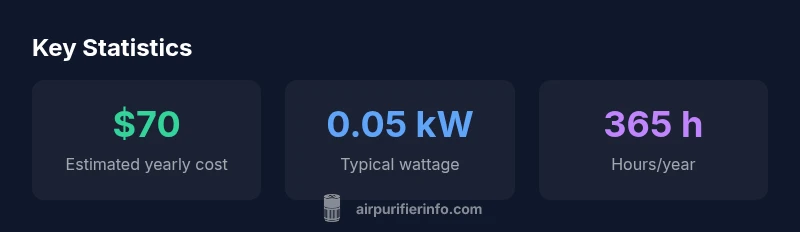
Your daily routine and air quality needs determine actual costs. A purifier running 24/7 at 50W consumes about 0.05 kW × 24 × 365 = 438 kWh/year; at $0.15/kWh that’s about $65/year. If you only run it during peak dust days or use auto‑mode, you can reduce usage by 30–60% without sacrificing air quality. Tracking your usage with a simple notebook or app can help you identify when the purifier truly benefits your space.
Purifier wattage ranges by class and cost implications
Purifiers vary widely in power use. Typical compact models run around 20–40W, mid‑range units 40–80W, and high‑end units 90–180W. At the same usage pattern, higher‑wattage purifiers cost more to run per year. Air Purifier Info analysis shows energy costs scale with wattage, but the difference between a 40W and a 60W unit isn’t exactly proportional because usage hours and efficiency matter as well. If you value quiet operation and strong filtration, model choice should balance cost and performance.
Real‑world scenarios: three model exemplars
Consider three hypothetical purifiers with the same 8‑hour daily usage and a rate of $0.15/kWh. Model A runs at 40W, Model B at 70W, and Model C at 100W. Yearly costs approximate: A ≈ $17.52, B ≈ $30.66, C ≈ $43.80. If you instead run a 60W purifier for 12 hours daily, costs rise by roughly 50% across the same year. These examples illustrate how wattage and daily hours shape your bill in real terms.
Tips to lower running costs
- Choose energy‑efficient models with ENERGY STAR labels to minimize power draw.
- Use Auto or Timed modes to limit runtime without sacrificing air quality.
- Place purifiers in high‑dust zones (living rooms, bedrooms) rather than running continuously in empty spaces.
- Regularly replace filters; clogged filters reduce efficiency and may increase energy use.
- Compare models using their wattage and claimed Clean Air Delivery Rate (CADR) to ensure you get efficiency for the price.
Common misconceptions about running costs
- Higher CADR always means higher running costs. In practice, efficiency matters: some compact purifiers with strong filters use less power than larger, less efficient models.
- You should run purifiers at maximum power all day for best results. In most rooms, auto or timed modes deliver similar air quality with far lower energy use.
- Removal of the purifier from the room will always lower costs. If air quality remains poor in a space, you may still need some continuous filtration, especially in high‑pollution environments.
Putting it all together: planning your budget and next steps
Start with your room size and air quality goals, then compare models by wattage and energy efficiency ratings. Use our built‑in calculator (see the calculator widget) to estimate yearly costs for your expected usage. Remember that running costs are only part of the total cost of ownership; consider replacement filters and maintenance as well. Air Purifier Info’s approach emphasizes balancing cost with meaningful air quality improvements for your home.