Cost to Run an Air Purifier All Day in 2026
Estimate the yearly electricity cost of running an air purifier all day with our calculator, plus practical tips to cut energy use without sacrificing indoor air quality.


How energy use for air purifiers works
Air purifiers run a motor that powers a fan and filters. The energy they consume is tied to wattage, speed settings, and how many hours you operate them. If you're curious about how much does it cost to run an air purifier all day, the cost is determined by converting watts to kilowatts, then multiplying by daily usage and the price of electricity. In plain terms, you’re paying for the energy you consume over the year. Air Purifier Info’s analysis shows that the single biggest cost driver is the unit’s wattage and the speed at which the fan runs. A purifier with lower wattage and a slower fan consumes less energy, especially when used continuously. The energy footprint also depends on filtration efficiency: a more efficient unit can achieve the same air-quality results with gentler, energy-saving operation. For homeowners and renters, understanding these basics helps you make smarter purchasing and operating decisions. In 2026, these principles apply as you plan longer-term air-care strategies.
Factors that drive cost: wattage, usage hours, and efficiency
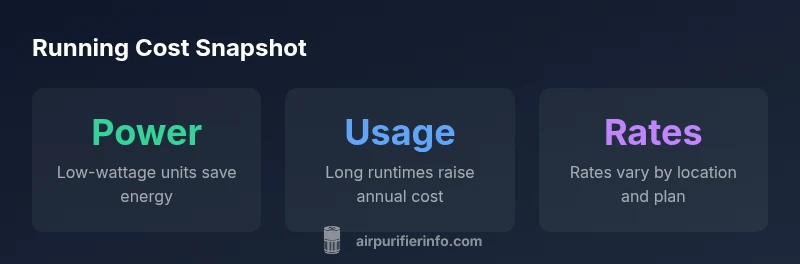
Wattage is the primary driver of electricity use. Low-wattage models tend to use less energy, while larger units with multiple filtration stages can draw more power, especially at higher fan speeds. How long you run the purifier matters a lot: running it for a few hours a day can be a small daily cost, but running it around the clock raises energy use quickly. Efficiency matters too: units with better filtration may reach the same air quality at lower fan speeds, which reduces energy consumption. According to Air Purifier Info, the combination of wattage, speed setting, and daily hours determines your annual energy bill more than any single factor. Don’t forget that your local electricity rate also shapes the final number; two households with the same purifier can see different costs because their rates differ. By prioritizing models with energy-saving features and using sensible runtimes, you can balance air quality with energy efficiency.
The math behind the calculator: the cost formula and units
To estimate annual running costs, you convert the purifier’s wattage to kilowatts, multiply by how many hours you use it each day, multiply by the number of days you operate it per year, and then multiply by your electricity price per kilowatt-hour. The standard formula used here is: AnnualCost = (powerWatts / 1000) * hoursPerDay * costPerKWh * daysPerYear. Units: powerWatts in watts (W), hoursPerDay in hours, costPerKWh in $/kWh, daysPerYear in days. If you want a daily view, divide the annual cost by 365. This math is the backbone of the calculator you’ll find on this page, and it aligns with how energy providers measure consumption.
How to interpret calculator results: daily vs yearly
The calculator outputs an annual running cost by default. To understand day-to-day impact, you can convert that figure to a daily or monthly amount. For example, a 60W purifier used 8 hours per day at $0.15 per kWh would produce an annual energy use in kilowatt-hours that scales with these inputs. If electricity rates rise or you change the usage pattern, the result moves accordingly. Keep in mind that real-world costs can vary because real energy use depends on fan speed, filter condition, and any eco modes. The calculator assumes consistent operation; in practice you may adjust runtime with timers or scheduling to optimize energy savings while maintaining air quality.
Practical scenarios and tips to reduce costs
Here are practical steps to lower running costs without sacrificing air quality:
- Use eco or auto modes that slow the fan when air quality is good.
- Set a timer so the purifier runs only during occupancy or peak pollution times.
- Keep filters clean and replace them as recommended to maintain airflow efficiency.
- Place the unit in a location with good air intake, away from walls, to maximize efficiency.
- Consider running multiple smaller purifiers in a large space rather than one high-watt unit.
- Compare models with energy-saving certifications and look for lower annual energy use.
Beyond cost: balancing air quality and energy use
Small spaces may require less power; larger rooms may need higher wattage models. Consider ACH (air changes per hour) targets to balance air quality with energy use. Choose purifiers with proven filtration performance (e.g., HEPA) and maintain filters to keep energy use in check. Proper placement and regular maintenance are essential to achieving clean air without wasteful energy consumption.