Air Purifier Energy Consumption: A Practical Guide for Homeowners
Explore how air purifier energy consumption varies by model, usage, and features. Learn practical steps to lower electricity use while maintaining clean indoor air.


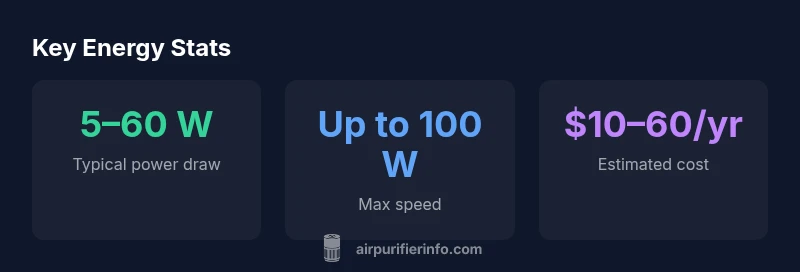
According to Air Purifier Info Team, air purifier energy consumption varies by model and use. Most residential purifiers run around 5–60 watts at normal operation, with higher speeds reaching up to about 100 watts. Based on local electricity rates and daily usage, yearly costs typically fall in the $10–60 range. Size, speed, and features shape real-world energy use.
Why energy consumption matters for air purifiers
Air purifier energy consumption is more than a nerdy number for tech enthusiasts; it translates directly to how much you pay monthly and how much electricity your home uses for clean air. The term air purifier energy consumption captures watts drawn by the fan, motors, sensors, and control circuitry during operation. For homeowners, this matters in two big ways: it affects operating costs and it interacts with room size and air quality goals. According to Air Purifier Info Team, the most efficient purifiers combine appropriately sized CADR with low-watt motors and intelligent controls to minimize waste while maintaining air quality. When you compare models, you’ll notice that energy use scales with the purifier’s fan speed and the presence of auto-sensing features. That means you can often reduce energy use by selecting the right mode for your room rather than always running at full blast.
How purifier design and features affect energy use
Purifier energy consumption hinges on several design choices. First, the motor and fan determine baseline wattage; more powerful fans move more air but use more energy. Second, sensors and smart controls (like PM, CO2, or humidity sensors) let a unit adjust fan speed automatically, potentially saving watts when air quality is good. Third, filtration type and seal quality influence how hard the fan must work; tighter seals and efficient filters reduce resistance, which can lower energy needs. Fourth, build quality and enclosure affect heat loss and airflow efficiency. In short, a model with a modest motor, efficient filtration, and good sensors often delivers clean air with less energy demand. Air Purifier Info recommends prioritizing energy-saving features that align with your room size and pollution levels.
How to estimate energy use for a specific model
To estimate energy use, start with the listed power draw (in watts) at the most common setting you’ll use. Multiply watts by hours of operation per day, then by days in a month or year, and divide by 1000 to convert to kilowatt-hours (
Practical steps to minimize energy use while maintaining clean air
- Size matters: choose a purifier rated for your room size. A unit undersized will run longer at high speeds, consuming more power overall.
- Use auto or Smart modes: sensors adjust fan speed to air quality, avoiding unnecessary energy use.
- Implement schedules: run purifiers during peak air pollution times or when people are present, and turn off when rooms are empty.
- Keep filters clean: clogged filters raise airflow resistance and increase energy draw, so schedule regular maintenance.
- Seal the space: close doors and seal leaks to improve efficiency and reduce the purifier’s workload.
- Consider energy-efficient models: look for certifications like ENERGY STAR and read independent reviews on long-term costs.
Energy use across model types: compact, mid-range, high-end
Compact purifiers are designed for desks or small bedrooms and typically consume less energy, around a handful of watts to a few dozen watts, depending on speed. Mid-range models balance airflow and energy use, with wattage commonly in the 20–60 W range at normal operation. High-end purifiers with auto modes and powerful sensors can draw more power at peak but often deliver more air changes per hour (ACH) and better filtration efficiency. When evaluating energy use, compare not just wattage but also CADR relative to room size to ensure you get the right performance per watt.
Real-world usage scenarios
In a small bedroom (about 120 square feet) with moderate pollution from dust and pet dander, a compact purifier running on auto mode might consume roughly 5–15 W most of the time, rising briefly during spikes in activity or odors. A mid-sized living room (300–400 square feet) may use a purifier in the 30–60 W band on average, with occasional higher consumption when air quality worsens or during cooking. For homes with heavy pollution sources like smokers or strong odors, larger models may be appropriate, and the energy use will reflect the higher air processing demands. These scenarios illustrate that energy consumption correlates with room size, pollution level, and chosen features, not merely with a device’s price.
Common myths about energy and air purification
- Myth: Bigger is always better for energy efficiency. Truth: A unit too large for the space may cycle air too quickly and waste energy; select a purifier sized to your room.
- Myth: Auto mode always saves energy. Truth: It can save energy, but depends on air quality dynamics and how often the sensor triggers higher speeds.
- Myth: ENERGY STAR guarantees the lowest operating cost. Truth: ENERGY STAR focuses on efficiency, but total cost depends on usage patterns and room conditions.
- Myth: Filters alone boost energy use. Truth: Clean filters reduce resistance and can lower energy draw when compared to clogged ones.
How to compare energy profiles when shopping
- Check the wattage at normal operation and at max speed.
- Look for models with auto-sensing features and energy-efficient fans.
- Review customer feedback on real-world energy use and maintenance requirements.
- Calculate annual costs using your local electricity rate and typical daily usage.
- Consider room size and CADR to ensure the unit’s energy per ACH aligns with your goals.
Energy profiles by purifier type
| Model Type | Typical Power (W) | Estimated Annual Cost | Notes |
|---|---|---|---|
| Compact purifier | 5–40 | $5–25/year | Good for small rooms |
| Mid-range purifier | 40–70 | $15–40/year | Balanced performance |
| Smart auto purifier | 60–100 | $25–60/year | Sensors optimize speed |
| Industrial/whole-home purifier | 100–200 | $50–100/year | High capacity, higher energy |
Questions & Answers
What is a typical power draw for a residential air purifier?
Most residential purifiers draw roughly 5–60 watts during normal operation, with higher speeds reaching near 100 watts. Actual use depends on model, speed settings, and sensors. Always check the product spec and verify in field reviews.
Most home purifiers use about 5 to 60 watts in normal use, and up to around 100 watts at high speed. Check the model specs for precise numbers.
How does auto mode affect energy consumption?
Auto mode uses air-quality sensors to adjust fan speed, which can save energy when pollutants are low. The savings depend on how often air quality varies and how aggressively the unit responds.
Auto mode adapts speed based on air quality, often saving energy when air quality is good.
Can I reduce energy consumption without sacrificing air quality?
Yes. Size the unit correctly, use auto mode, and run on schedules to align operation with occupancy. Regular filter maintenance reduces energy demand by lowering airflow resistance.
Yes. Properly sizing, using auto mode, and timely maintenance help you save energy without sacrificing air quality.
Is it worth buying an ENERGY STAR purifier?
ENERGY STAR models meet efficiency criteria and can lower energy use over time, but total cost depends on usage patterns and room conditions. Compare energy per air change across models with and without the label.
ENERGY STAR can help, but check usage patterns to see total savings.
How does local electricity cost affect running a purifier?
Electricity rates vary by region, so annual running costs can differ widely. Use your local rate to compute the expected cost from the purifier’s wattage and your daily usage.
Costs vary by where you live; multiply watts by hours used and your local rate to estimate annual costs.
What is CADR, and does it affect energy use?
CADR measures cleaned air per hour; a higher CADR often means higher energy use. The key is balancing CADR with room size and energy efficiency to meet air quality goals without excessive power draw.
Higher CADR can use more energy, so balance air cleaning needs with efficiency.
“Energy efficiency in air purifiers isn’t just about watts; it’s also about smart features that adapt to air quality without compromising filtration.”
Main Points
- Choose energy-efficient models with credible certifications.
- Match purifier size to room to avoid wasted energy.
- Use auto or scheduled modes to cut power use.
- Regularly maintain filters to minimize resistance.
- Compare energy per air change rather than just watts.