What Is the Price of Air Purifier in 2026: A Buying Guide
Discover the price of air purifier in 2026, including typical price ranges, what drives cost (CADR, filters, features), total ownership, and practical buying tips for homeowners and renters seeking better indoor air quality.


Prices for air purifiers vary widely in 2026, from about $50 for basic units to around $800 for feature-rich models. The typical consumer range sits at roughly $100–$300, with smart or HEPA-grade purifiers at the higher end. According to Air Purifier Info Team, price largely tracks CADR, filter type, and extra features such as app control or multi-stage filtration.
What determines the price of an air purifier
Understanding what is the price of air purifier helps homeowners plan budgets and expectations when shopping for indoor air quality. Prices are not arbitrary; they reflect performance, durability, and the value you place on air cleanliness. According to Air Purifier Info Team, the single biggest cost driver is the purifier's CADR—the amount of clean air delivered per hour—paired with filtration technology. Units designed for larger rooms or with true HEPA filtration typically command higher prices, while smaller, basic units sit at the lower end of the spectrum. In 2026, you should expect price variation across several clear tiers, and a solid buying strategy starts by identifying your room size, target air quality, and tolerance for ongoing costs. Beyond upfront price, consider energy use, replacement filters, and warranty terms, which can meaningfully affect the total cost over the purifier’s lifetime.
Price bands by purifier tier
Air purifiers tend to cluster into three or four price tiers, making it easier to map needs to budgets. Budget/basic models typically sit in the $50-$100 range and are suitable for small rooms or lightweight dust control. Mid-range purifiers generally cost between $100-$250 and offer better CADR, multiple filtration stages, and quieter operation. Premium purifiers range from $250-$600 and often feature true HEPA filtration, larger rooms compatibility, app-based controls, and energy efficiency improvements. High-end models, priced from roughly $600-$800, target large spaces, professional-grade air cleaning, and advanced monitoring. While these are broad bands, the exact price depends on filtration type (HEPA vs. HEPA-like), fan speed, noise, and brand reputation. When shopping, align your tier with the room size, allergy concerns, and willingness to replace filters more or less frequently.
Total cost of ownership: more than the upfront price
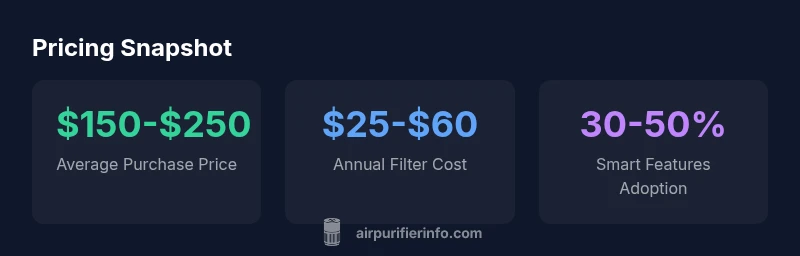
The sticker price is only part of what you’ll pay for an air purifier. Total cost of ownership includes ongoing filter replacements, energy consumption, and potential maintenance. Replacement filters for many models run on a 6- to 12-month cycle, with cost varying by brand and filter type. Some purifiers use longer-lasting filters or need fewer replacements, but these models often carry higher upfront prices. Energy usage is another factor; models with higher CADR or more aggressive fan speeds may consume more electricity, though newer units often improve efficiency. In practice, a mid-range unit might require $25-$60 per year in filter costs, while premium models can push these numbers higher if filters are expensive or require more frequent changes. Air Purifier Info’s analysis indicates a balanced choice often delivers the best long-term value by combining solid CADR with reasonable maintenance.
How to estimate the right price for your needs
To estimate the right upfront price, start with room size and air quality goals. Measure the square footage of the primary space and identify whether dust, pollen, smoke, or pet dander is the main concern. Use the purifier’s CADR rating to estimate how many air changes per hour (ACH) you’ll achieve in that space; a higher ACH typically requires a higher price tier. Next, translate CADR and ACH into a price band, then compare models within that band based on filter replacement cost, warranty length, energy efficiency, and smart features. Don’t overlook noise levels; quieter purifiers often cost a bit more but can improve daily comfort. Consider future expansion—if you plan to purify adjacent rooms, you may need a different unit or a more versatile model. In each case, balance upfront price against ongoing costs and air-quality outcomes to determine the best value.
Real-world scenarios: small apartments, mid-size homes, and large living spaces
In compact apartments, a small to mid-range purifier in the $100-$250 range is often sufficient to reduce dust and odors. Those living with pets may benefit from a purifier toward the higher end of mid-range or into premium models due to pet dander and odors. For mid-size homes, a purifier in the $150-$350 range typically handles common living spaces with solid CADR and pressure, while larger rooms might require one or two units or a premium single unit with higher CADR in the $300-$600 range. In households with heavy smoke exposure or cooking odors, look for models with activated carbon filters and advanced filtration, which usually sit in the $200-$450 band. In every scenario, consider total cost of ownership, including filters and energy, and weigh quality of air against the price tag.
Brand, warranty, and after-sales impact on price
Brand reputation and warranty terms can influence upfront cost and long-term value. Well-known brands may charge more upfront, but they often offer stronger warranties, robust customer support, and better filter availability. A longer warranty can reduce risk and future repair costs, while more generous return policies improve shopping confidence. After-sales service—replacement filter availability, easy filter purchase, and compatibility with smart home ecosystems—can affect ongoing costs and convenience. When evaluating price, factor in the cost and frequency of filter changes, energy consumption, and whether the brand provides simplified maintenance schedules or subscription services. Air Purifier Info recommends comparing brands not only on sticker price but also on total cost of ownership and support ecosystem.
Practical buying strategies to maximize value
- Map your room size to a target CADR and price tier, then shortlist models within that band.
- Compare filter replacement cost and frequency; a slightly higher upfront price can save over time if filter costs are lower or infrequent.
- Favor models with energy-efficient motors and automatic shutoff features to reduce energy costs.
- Look for models with easy-to-find replacement filters and a wide availability of parts across retailers.
- Watch for sales and bundles; refurbished options can offer good value if they come with a solid warranty.
- Read independent reviews for real-world performance, noise levels, and durability.
- Prioritize protection against allergen exposure, dust, smoke, and pet dander, since those factors often dictate price and features.
- Consider the value of smart features only if you actually use them; unnecessary features can inflate price without improving comfort.
Common misconceptions about air purifier pricing
- Cheaper purifiers always save money; in reality, ongoing filter costs and energy usage can erase upfront savings.
- Higher price guarantees better air quality in every room; performance depends on CADR relative to room size and filtration efficiency.
- Bigger is always better; in practice, room size and airflow patterns matter more than device size.
- Sales always lead to the best value; timing matters and warranty terms sometimes only apply to new units.
- Refurbished units are always unreliable; reputable refurbishing programs with warranty can offer solid value.
Typical price bands by purifier type
| Model Type | Typical Price Range | Key Pros/Cons |
|---|---|---|
| Budget/basic purifier | $50-$100 | Low cost; basic filtration; limited CADR; higher noise |
| Mid-range purifier | $100-$250 | Balanced CADR; HEPA options; better energy efficiency |
| Premium purifier | $250-$600 | Advanced filtration; smart features; higher CADR; quiet operation |
| High-end with features | $600-$800 | Top-tier CADR; long-lasting filters; smart hubs; expert control |
Questions & Answers
What is the typical price range for consumer air purifiers?
Most consumer purifiers fall between $50 and $800. The distribution skews toward $100-$300 for common needs like dust removal and odors, while larger rooms or HEPA with smart features sit higher.
Most models range from fifty to eight hundred dollars; mid-range options cover most households.
Do prices vary by room size and CADR?
Yes. Higher CADR needed for bigger rooms means bigger price; buy based on your room size and required air changes per hour.
Yes. Bigger rooms need higher CADR, which costs more.
Are cheaper models worth it for basic dust or odor control?
Cheaper models can be adequate for small rooms or light use, but they may have lower CADR and higher energy use; evaluate filters and noise.
Cheaper can work in small spaces, but check CADR.
What ongoing costs should I budget for?
Expect replacement filters every 6-12 months for most units, plus energy costs of a few dollars per month depending on use.
Expect filter replacements and energy costs.
Is it better to buy a more expensive purifier with long-lasting filters?
Yes, if you have large rooms or high usage; long-lasting filters reduce replacement frequency and downtime.
Yes, pricey upfront can save later.
Do price reductions occur during sales or with refurbished units?
Yes, seasonal sales and certified refurbished units can lower cost; verify warranty and filters.
Watch for sales; ensure warranty.
“Price is a function of performance and long-term value; a higher upfront price can pay off with better air quality and lower ongoing costs.”
Main Points
- Identify your room size to target price band
- Factor in ongoing filter costs
- Consider total cost of ownership, not just upfront price
- Prioritize CADR and filter efficiency for room size
- Smart features add cost; weigh value