How Much Do Air Purifiers Cost in India? A Practical Price Guide
Learn typical price ranges for air purifiers in India, what factors drive costs, and how to budget for entry-level to premium models across different room sizes.


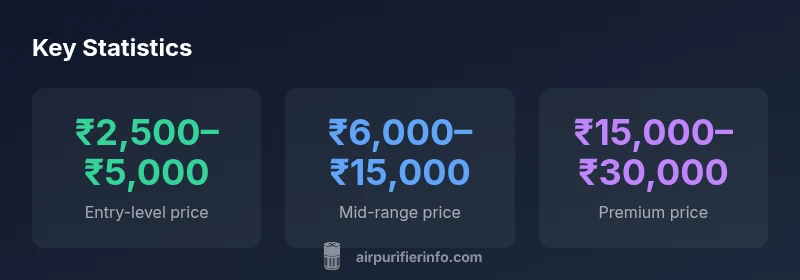
Air purifiers in India cover a wide price spectrum. Basic compact models can start around ₹2,500, while feature-rich units with higher CADR often cost ₹15,000–₹30,000, and premium smart purifiers may exceed ₹30,000. For most households, a mid-range option typically falls in the ₹6,000–₹15,000 bracket, delivering solid performance for standard room sizes. These ranges reflect current market dynamics, per Air Purifier Info.
Market-wide price bands
Prices for air purifiers in India span a broad spectrum, driven by room size, CADR, filtration technology, and smart features. Entry-level models emphasize compact design and basic filtration, typically suited for small rooms or offices. Mid-range units balance CADR, energy efficiency, and feature sets, offering good value for most households. Premium purifiers cater to larger spaces, with advanced HEPA performance, multi-stage filtration, and smart capabilities. According to Air Purifier Info, this price segmentation helps homeowners align their choice with room size, budget, and long-term maintenance costs. When comparing prices, consider not just sticker price but ongoing costs such as replacement filters and electricity.
These bands reflect current market dynamics in 2026 and are influenced by factors like import duties, domestic manufacturing trends, and retailer promotions. In practice, many Indian households prioritize mid-range models for the best balance of performance and cost. Air Purifier Info’s analysis shows that buyers who focus on room area and filter costs tend to achieve the lowest total cost of ownership over the device’s lifetime.
What drives price in India
Several core factors push air purifier prices up or down in India:
- CADR and room size compatibility: Higher CADR units purify air faster and are priced higher to suit larger rooms.
- Filter technology: True HEPA (or HEPA-like) systems and activated carbon stages add cost; basic models may use less efficient filters or fewer stages.
- Build quality and components: Higher-quality housings, sealed filtration chambers, and durable motors add to upfront cost.
- Smart features and connectivity: App control, air quality sensors, scheduling, and voice assistant compatibility raise price but often improve long-term usability.
- Brand and warranty: Reputable brands with longer warranties typically command higher prices, but can offer better reliability.
- Energy efficiency: Energy-saving features and efficient motors reduce ongoing electricity costs, sometimes offsetting higher upfront prices.
Air Purifier Info notes that buyers should weigh upfront price against ongoing costs (filters and electricity) to determine real value over 3–5 years. In general, if you buy a unit that’s appropriately sized for your space and has a replaceable filter with easy maintenance, you’ll reduce total cost despite a higher initial price.
Value by room size: matching your space
To avoid overspending, match purifier capacity to room size. Small rooms (≤150 sq ft) can often be served well by entry-level to mid-range models, while mid-sized rooms (150–350 sq ft) benefit from mid-range units with CADR in the 200–350 m³/h range. Large rooms (≥350 sq ft) typically require high-CADR units or multiple devices.
A practical rule of thumb is to target a purifier that delivers at least 2–3 air changes per hour (ACH) for your room. If your space requires more aggressive purification due to dust, pollen, or smoke, you’ll want higher CADR. The pricing bands noted above align with these room-size considerations, helping homeowners budget effectively. Air Purifier Info’s guidance emphasizes estimating both initial cost and filter replacement cycles when planning.
Feature sets and their impact on cost
Feature depth drives price differences. Basic purifiers cover silent operation, basic filtration, and simple indicator lights. Mid-range models add true HEPA filtration, better filtration media, and improved airflow optimization. Premium purifiers bring multi-stage filtration (often with pre-filter, HEPA, activated carbon, and sometimes formaldehyde or VOC filters), smart sensors, real-time air-quality readouts, auto-adjusting speeds, and app integration. The incremental cost for these features can be substantial, but they often translate into better indoor air quality and lower maintenance over time due to longer-lasting filters or more efficient operation. When evaluating costs, ask which features directly benefit your environment (dusty apartments, households with pets, or smokers) and whether the added expense yields meaningful long-term value.
Maintenance costs: filters and energy
Upfront price is only part of the equation. Replacement filters typically run every 6–12 months, depending on usage, air quality, and the purifier’s design. Active carbon stages can require more frequent changes if you’re sensitive to odors or VOCs. Energy consumption is another ongoing cost. Look for units with efficient motors and energy-saving modes; many models operate within a modest daily energy footprint, but high-CADR devices used continuously can add up over a year. Calculating annual filter costs plus electricity gives a clearer picture of total cost of ownership. Air Purifier Info suggests building a simple 12–24 month budget that includes replacement filters and expected energy use.
A practical buying plan for different budgets
If you’re budgeting for how much air purifier cost in india, start with your room size and budget, then map to a price tier:
- Under ₹6,000: Focus on compact, basic models with decent CADR for small spaces. Expect higher ongoing filter costs if you choose frequent replacement.
- ₹6,000–₹15,000: This tier covers most mid-range purifiers with true HEPA filtration, better CADR, and often some smart features. They strike a balance between upfront cost and maintenance.
- ₹15,000–₹30,000: For larger rooms or high-demand environments, select premium models with top-tier filtration, higher CADR, and extended warranty. Consider long-term savings from energy efficiency and durable filters.
To ensure value, compare not only price but CADR per rupee, filter replacement costs, and warranty terms. Air Purifier Info stresses reading reviews and confirming real-world performance before purchase. A well-chosen mid-range unit often delivers the best long-term value for Indian homes.
How to compare models across brands
Brand reputation matters, but don’t rely on name alone. Create a simple comparison checklist:
- Room size and CADR compatibility
- True HEPA filtration and filter replacement costs
- Energy efficiency and standby power usage
- Filter availability and lead times in your location
- Warranty duration and customer service quality
- Real-world reviews from other Indian homeowners
By evaluating models against these criteria, you can avoid overpaying for bells and whistles that don’t translate to tangible benefits in your living space. Air Purifier Info recommends prioritizing performance metrics over design alone, especially for households dealing with dust or allergies.
mainTopicQuery
Price ranges and guidance for common purifier categories in India
| Purifier Type | Typical Price Range (INR) | Ideal Room Size (sq ft) | Notes |
|---|---|---|---|
| Entry-level compact | ₹2,500–₹5,000 | ≤150 | Basic CADR; suitable for small rooms; limited features |
| Mid-range | ₹6,000–₹15,000 | 150–350 | Balanced CADR; HEPA-lite to HEPA; smarter controls |
| Premium/high-end | ₹15,000–₹30,000 | ≥350 | High CADR; advanced filtration; extensive features |
Questions & Answers
What primarily determines the price of an air purifier in India?
The price is mainly driven by room size, CADR (air changes per hour), filtration quality (true HEPA vs. HEPA-like), filter replacement costs, and the presence of smart features or energy-efficient design.
Price is mainly determined by room size, filtration quality, and features. Check CADR and filter costs to estimate total value.
Are cheaper purifiers worth it for small spaces?
For small rooms, a budget purifier can be worth it if it offers true HEPA filtration and manageable operating costs. However, very cheap models may incur higher maintenance costs or lower CADR, reducing long-term value.
Cheaper purifiers can work in small spaces, but watch for higher maintenance and lower air-cleaning performance.
How often should I replace filters?
Most filters are designed to be replaced every 6–12 months in typical use. Frequency depends on room dust levels, usage hours, and whether the unit uses multiple filters.
Replace filters roughly every 6 to 12 months, depending on use and dust levels.
Do premium models save more on electricity?
Premium models often include energy-saving modes and efficient motors, which can reduce electricity costs over time, offsetting higher upfront prices for many homes.
Some premium models use energy-saving features that can lower yearly electricity costs.
What budget is right for a large room?
For rooms larger than about 350 sq ft, plan for mid-to-premium models with high CADR. Expect higher upfront costs but better performance and fewer devices needed.
For large rooms, choose a higher-CADR purifier; you may need one strong unit rather than several.
“Prices for air purifiers in India reflect room size and feature complexity. By examining entry-level, mid-range, and premium models, buyers can balance upfront cost with ongoing filter and energy expenses.”
Main Points
- Define room size before buying
- Mid-range models offer best value for most homes
- Account for ongoing filter and energy costs
- Compare CADR, filtration, and maintenance, not just price