How Much Does a Good Air Purifier Cost?
Discover realistic price ranges for good air purifiers, factors that affect cost, and how to balance upfront price with long-term value. Air Purifier Info explains pricing.


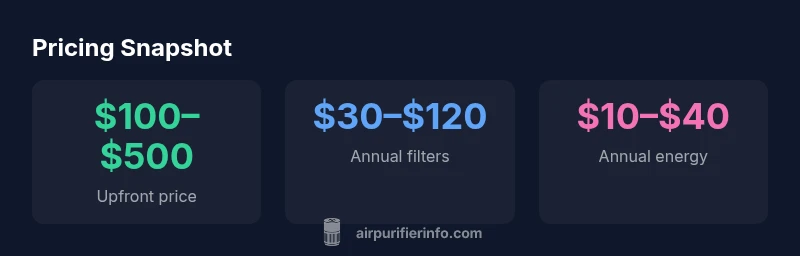
A solid air purifier typically costs between $100 and $500 upfront, with most homeowners spending around $150-$300 for models that balance filtration, noise, and energy use. According to Air Purifier Info, price is driven by filtration type (HEPA vs true HEPA), CADR, room size, and features like smart controls. Long-term value depends on filter replacement costs and efficiency.
What affects price in a good air purifier
In the consumer market, the sticker price is influenced by a cluster of factors. If you're trying to answer how much does a good air purifier cost, you should look beyond the label and examine what affects performance and running costs. According to Air Purifier Info, price ranges reflect room size, filtration quality, CADR, energy efficiency, and the durability of components. A true HEPA purifier with a high CADR for a large living space typically commands a premium, while compact, basic units for small rooms are cheaper but offer less air turnover. Beyond the core filter, manufacturers may add features that affect price: smart controls, humidity and air quality sensors, auto-mode algorithms, and design aesthetics. Heavier build quality and reliability testing also push up price but reduce the risk of filter leaks or motor wear over time. In practice, most households prioritize a model that balances three things: effective filtration (true HEPA), adequate air changes per hour, and reasonable ongoing costs. Air Purifier Info analysis shows that the largest price jumps occur when shoppers choose higher CADR, true HEPA certification, and advanced features, while basic models emphasize portability and lower upfront prices.
How to size a purifier for your space
Selecting the right purifier starts with your room size and air volume. A purifier that is too small won’t deliver the necessary clean air quickly, while one that is oversized can waste energy and money. The general rule is to pick a model whose CADR (clean air delivery rate) roughly matches your room size and desired air changes per hour. For small rooms under 150 square feet, compact units with modest CADR often suffice. For typical living spaces (about 150–400 sq ft), mid-range purifiers with higher CADR provide balanced performance and quiet operation. For larger rooms, you’ll want a high-CADR unit; pay attention to noise levels and filter availability. In practice, you’ll compare CADR ratings across three pollutants (smoke, dust, pollen) and ensure the device can circulate air multiple times per hour. If in doubt, use an online room calculator provided by many manufacturers or rely on independent reviews that benchmark CADR against room size. These rules help ensure you’re buying a purifier that actually improves indoor air without overpaying for features you don’t need.
Upfront cost vs running costs: a practical view
Upfront price is only part of the total cost of ownership. A low sticker price can be appealing, but the ongoing costs—especially filter replacements—often determine long-term value. Most mid-range purifiers require replacement filters every 6–12 months, depending on usage and indoor air quality. The cost per filter varies by brand and filter type, typically ranging from a modest to a substantial portion of annual running costs. In addition, energy use matters: higher fan speeds consume more electricity and can add to annual bills. A device with energy-efficient motors and smart sensors can help keep running costs in check, even if the upfront price is slightly higher. Air Purifier Info analysis suggests that buyers who evaluate both upfront and ongoing costs tend to achieve lower total cost of ownership over 3–5 years, compared with those who chase the lowest upfront price alone.
Features worth paying for and features to skip
Not all bells and whistles deliver meaningful improvements in air quality. The core must-have features include true HEPA filtration and a CADR that matches your room size. Look for a unit with a good seal, reliable pre-filters, and easy-to-replace filters. Sensors that measure real-time air quality can help you optimize operation without running the fan at full speed constantly. Energy-efficient motors, automatic modes, and timers can reduce running costs, especially in rooms used daily. Features to consider carefully include auto-mode, app connectivity, and advanced purification modes; unless you have a specific need for fragrance removal or VOC reduction, these extras may not justify a higher upfront price. A balanced approach is to prioritize durable construction, accessible maintenance, and documented performance rather than the latest fashion features. Air Purifier Info’s guidance is to align feature sets with your actual needs and cleaning priorities.
Price ranges by category: budget, mid-range, premium
For most households, price bands provide a pragmatic framework for decision making. Budget purifiers typically sit below $120 and emphasize portability and basic filtration; however, they may struggle with larger rooms or high dust loads. Mid-range models usually fall in the $120–$350 range and offer a graceful balance of CADR, filter availability, and quiet operation. Premium purifiers range from about $350 to $700 and deliver the strongest CADR, robust build quality, and feature-rich experiences such as smart home integration. When shopping, consider not just the upfront price but the cost of replacement filters over 2–3 years, which can significantly influence total cost of ownership. Air Purifier Info analysis shows that the mid-range tier often provides the best value for typical rooms, while the premium tier is worth it for larger spaces or allergy-prone households, provided you’re prepared for higher ongoing costs.
Shopping tips and buying checklist
- Define your room size and target CADR before browsing. - Prioritize true HEPA and energy efficiency. - Compare filter replacement costs and availability. - Check noise levels at typical speeds, not just maximums. - Look for warranties and after-sales support. - Read independent reviews to corroborate manufacturer claims. - Consider consumer protection features, such as carbon pre-filters for odors. - Verify the retailer’s return policy and verify ongoing maintenance costs. A simple checklist can help you avoid overpaying and ensure you pick a purifier that actually improves indoor air quality.
Common mistakes and how to avoid overpaying
One common mistake is focusing on price alone rather than performance. A very cheap unit may deliver subpar CADR for your space and require frequent filter changes. Another pitfall is buying a model with sensors or features you don’t need, adding upfront cost and potential maintenance headaches. Always confirm filter availability and price before purchase; if a brand uses proprietary formats, you may be locked into higher replacement costs. Finally, ignore energy usage claims; a high-powered unit running at full speed all day can negate initial savings. By sticking to genuine needs—adequate air turnover, reliable filters, and energy efficiency—you’ll maximize value and minimize surprises over time.
Price bands for air purifiers by category
| Category | Estimated upfront price | Key trade-offs |
|---|---|---|
| Budget | Under $120 | Limited CADR; basic filtration |
| Mid-range | $120–$350 | Balanced performance; good value |
| Premium | $350–$700 | Best CADR; advanced features |
| Ultra-premium | $700+ | Top-tier performance; premium features |
Questions & Answers
What is a typical price range for a reliable air purifier?
For reliability and consistent performance, expect to spend $120–$350 for most households. Budget options can be under $120, while premium models often exceed $350. Always weigh upfront price against running costs and filtration availability.
Most reliable purifiers cost between roughly one hundred twenty and three hundred fifty dollars, with cheaper options available for small rooms and premium models for large spaces.
Do more expensive models always deliver better air quality?
Not always. Mid-range models with true HEPA and adequate CADR typically deliver excellent air quality for most rooms. Higher prices usually bring higher CADR, better filters, sensors, and smarter features, which matter more in larger spaces or for allergy-prone households.
Higher price often means more features and stronger performance, but for many rooms, a well-chosen mid-range purifier is sufficient.
How often will I replace filters, and how much does that cost?
Most purifiers require filter replacement every 6–12 months, depending on use and air quality. Filter costs vary by brand but typically range from $20 to $70 per filter, contributing to annual running costs.
Filters usually need replacement every 6 to 12 months, costing around twenty to seventy dollars per filter depending on brand.
Is energy usage a major cost factor?
Energy use matters, especially if you run the purifier continuously. Look for energy-efficient motors and an Energy Star rating when possible. The annual energy cost is generally modest but adds to total cost over time.
Energy use adds up if you run the unit a lot, so pick efficient models and use smart settings to minimize consumption.
Are there hidden costs after purchase?
Yes—proprietary filters, shipping for replacements, and extended warranties can add to total cost. Verify price and availability of replacements before buying and read warranty terms.
Hidden costs include rare filters or shipping for replacements; always check replacement prices before purchasing.
Should I buy a purifier for a small room or a large room?
Yes. Small rooms benefit from compact purifiers with moderate CADR, while larger rooms require higher CADR units to achieve effective air changes per hour. Always match CADR to room size and consider noise and maintenance needs.
Size matters: pick a purifier with enough CADR for your room to clean air efficiently without excessive noise.
“Price should reflect long-term value, not just initial cost. A well-chosen purifier saves money through lower maintenance and better air quality.”
Main Points
- Define room size first
- Prioritize true HEPA and CADR
- Account for filter costs
- Consider energy use
- Balance upfront price and running costs