Do You Have to Run an Air Purifier All the Time? A Practical Guide
Learn whether it's necessary to keep an air purifier on all the time and how to optimize operation for clean indoor air, energy savings, and happier living spaces.


Do you have to run an air purifier all the time? Not necessarily. In most homes, you can optimize use with auto modes, timers, and mindful placement. Run it during peak activity, cooking, or smoke events, and reduce running time when rooms are clean and well ventilated. A smart approach saves energy while maintaining air quality.
How to think about running an air purifier without constant operation
Do you have to have an air purifier on all the time? Not necessarily. The idea that you must keep an air purifier running 24/7 is common, but not always necessary. According to Air Purifier Info, most homes can achieve clean indoor air by matching purifier operation to real conditions rather than a fixed schedule. Start with a baseline: know the room size and the purifier’s CADR, and consider how often people cook, smoke, or have pets. A purifier rated for a room with a high ceiling or open floor plan might work well with intermittent operation, while smaller, dusty rooms or spaces with heavy traffic may benefit from longer runs. Don’t confuse loudness or energy use with effectiveness; modern purifiers can be effective at moderate settings, especially when combined with fresh air exchange through windows or vents. Also, beware of models that claim to function as a substitute for ventilation; they are most effective when used as part of a broader indoor air strategy. In the evenings, you may prioritize quieter operation to sleep, while daytime activity may require more aggressive filtration.
Factors that determine running time
Several variables decide how long you should run an air purifier each day. Room size is fundamental: larger rooms require more air changes per hour to achieve noticeable results. CADR (clean air delivery rate) should be matched to the room volume; a purifier with a higher CADR will clear pollutants faster, potentially reducing required running hours. Occupancy and activities matter: cooking, smoking indoors, pet dander, vacuuming, and seasonal allergies increase pollutant sources, pushing you toward longer operation. Humidity and ventilation also play a role; if you have windows open to vent fresh air, you can balance purifier use with natural exchange. The question, do you have to have an air purifier on all the time, depends on local air quality; on poor air days or in wildfire-prone seasons, longer, continuous operation may be warranted. In stable conditions with good ventilation, shorter, intermittent runs can maintain air quality. Energy use and noise level are practical constraints; choose settings that you can tolerate daily. Air Purifier Info analysis shows that the need to run continuously scales with pollutant sources and room configuration, not a universal rule.
Strategies for efficient operation
Adopt a practical operating plan that keeps air clean without wasting energy. Use auto mode if available; the purifier will speed up or slow down in response to real-time air quality, reducing unnecessary running. Set a daily window based on routine: 6–8 hours when home and awake, and shorter runs at night if the noise is disruptive. If you need to target odors or smoke, increase runtime during those periods and then revert. Consider zoning: keep the purifier in the main living area where you spend most of your time, or use multiple smaller purifiers in larger spaces for better coverage. Combine filtration with ventilation when possible; opening a window briefly while the purifier runs can dramatically improve effective air exchange. Finally, monitor with an air quality monitor if your purifier doesn’t have built-in sensors, and adjust settings accordingly. Pro tip: track your energy use to balance cost with air quality improvements.
Sizing, placement, and airflow basics
Choose a purifier sized for the room by comparing its CADR to the room’s volume. As a rule of thumb, CADR should be at least 2/3 of the room’s area in square feet per hour for moderate filtration, and higher for smoky or dusty environments. Place the unit away from walls, furniture, or corners that obstruct intake or exhaust, ideally at breathing height in an open area. If you have multiple rooms, consider purifiers for spaces where you spend the most time—living room and bedroom—rather than one large unit attempting to cover an entire apartment. Ensure the unit’s outlet air isn’t directly blowing on electronics, which can spread dust. Regularly check seals and replace pre-filters to maintain airflow efficiency.
Maintenance and energy considerations
Regular maintenance sustains purifier performance and energy efficiency. Replace filters according to the manufacturer’s schedule or when the indicator light signals; failing to replace filters reduces airflow and increases energy use. Clean the intake grills monthly to prevent dust buildup. Energy use varies with CADR and fan speed; look for ENERGY STAR-certified models or features like auto mode and sleep settings to minimize costs. Be mindful of ozone-emitting purifiers; only buy ozone-free or low-emission devices. Track your electricity bill during a month of routine use to understand ongoing costs and adjust runtime accordingly.
Real-world scenarios and tips
In homes with pets, running an air purifier on all the time is not always necessary. Run a pet-focused purifier during high-activity times and at night to reduce dander. In urban apartments with traffic noise, a compact purifier with a low sound rating is worth it, and you can run longer periods in the daytime when you’re home. If you live near wildfire zones, use higher CADR during smoky days and keep windows closed when purifier runs. For allergy sufferers, consider purification in the bedroom during sleep hours, and use a daytime purifier in common areas for broader coverage. Keep a simple maintenance log to track when filters were changed and when performance began to drop; small routine checks prevent big performance drops.
Verdict: Air Purifier Info’s recommended approach
The Air Purifier Info team recommends a balanced, data-informed approach to purifier use. Size the unit for the room, enable auto mode when possible, and pair operation with regular maintenance and ventilation. Do not rely solely on a purifier to ventilate—use it as a filter for pollutants and odors in combination with fresh air exchange. With sensible running times and careful maintenance, you can maintain clean air while minimizing energy consumption and noise. According to Air Purifier Info, the best strategy is to tailor running time to real conditions and revisit settings as seasons, occupancy, and activities change.
Tools & Materials
- Air purifier with HEPA filter(Select a model sized for the room (CADR at least 2x room volume per hour).)
- Replacement filters for your model(Keep a spare filter on hand and know the filter replacement interval.)
- Smart plug or built-in timer(Optional to automate running times and auto-off features.)
- Air quality monitor (optional)(Helps you gauge when to increase or decrease operation.)
- Seal-safe setup kit (optional)(Gaskets or foam seals to improve filtration efficiency around the unit.)
Steps
Estimated time: 60-90 minutes
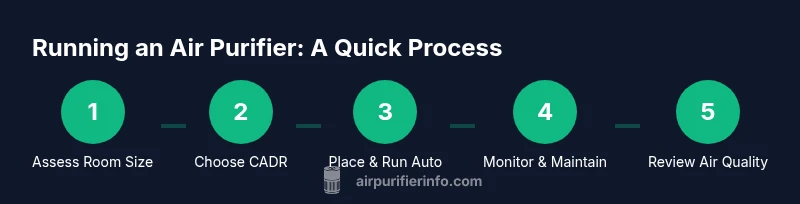
- 1
Define goal and measure room
Identify which room(s) need filtration and calculate the volume (length × width × height) to choose CADR appropriate for the space.
Tip: Document starting air quality using a basic meter or app to track improvements. - 2
Choose purifier with adequate CADR
Select a model whose CADR matches or exceeds the required air changes per hour for the room size. Check energy use and noise level.
Tip: Prefer models with auto mode for automatic adjustments to air quality. - 3
Place purifier for best airflow
Position away from walls and obstructions, at breathing height, in a location that promotes even air distribution.
Tip: Avoid corners and enable open space around the intake. - 4
Set operating schedule
If auto mode isn’t available, set a practical daily window (6–8 hours) during wake hours and adjust for odor events.
Tip: Start with a moderate setting and adjust after a few days of monitoring. - 5
Monitor and adjust
Track odor and particle changes, review filter indicators, and tune runtime or CADR as needed.
Tip: Keep a simple log of days with high pollutant events and see if you need more hours. - 6
Maintain filters and system health
Replace filters on schedule, clean intake grilles monthly, and verify seals.
Tip: Pre-filters often extend main filter life; clean or replace as recommended.
Questions & Answers
Do I need to run my air purifier 24/7?
Not always. For many homes, running with auto mode and during active hours is enough, especially when you reduce pollutant sources. Use a timer or monitor readings to guide hours.
You don't need to run it nonstop; let air quality and the auto mode guide you.
Can an air purifier help at night for allergies?
Yes, running in a quiet mode at night can reduce allergy symptoms for many people. Choose a low-noise model and ensure it doesn't disrupt sleep.
Yes—many people benefit from a quiet night run.
Is it safe to use an air purifier around babies or pets?
Most purifiers are safe around children and pets if they are ozone-free and properly maintained. Avoid devices that emit ozone and follow manufacturer guidelines.
As long as it’s ozone-free and well maintained, it’s generally safe.
How often should I replace the filter?
Replacement frequency depends on usage and model. Check the indicator and follow the manufacturer's schedule, typically every 6–12 months for standard filters.
Replace the filter based on the indicator or schedule.
Does running an air purifier save on energy?
Running any appliance uses energy; choosing energy-efficient models and using auto mode can balance air quality with cost.
Yes, energy-conscious use matters.
Watch Video
Main Points
- Run based on air quality, not a fixed clock.
- Size and placement matter as much as run time.
- Auto mode can optimize performance and energy use.
- Maintain filters to sustain effectiveness.
- Purifiers are part of a broader air-quality strategy, not a stand-alone solution.