Difference Between Air Purifier and Air Cleaner: A Practical Home Guide
Explore the difference between air purifiers and air cleaners, how each device filters air, what they target, and how to choose the best option for your home.


The difference between air purifier and air cleaner generally comes down to filtration goals and performance. In most homes, an air purifier with true HEPA filtration delivers superior particle removal for dust, pollen, and allergens, while an air cleaner tends to focus more on odors and VOCs with carbon-based filters or simpler mechanisms. For many households, a HEPA-based purifier is the safer, more versatile choice, but your space and needs can tilt the recommendation.
What is the difference between air purifier and air cleaner?
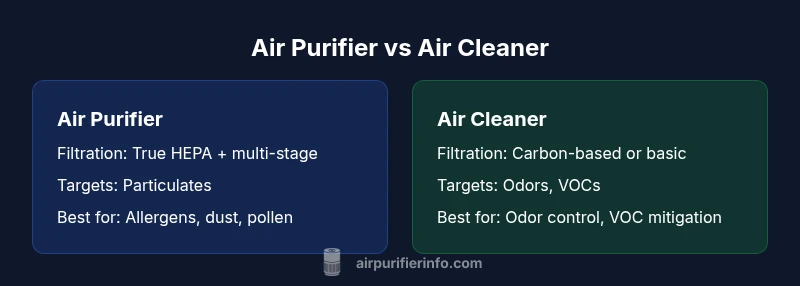
The phrase difference between air purifier and air cleaner is often used interchangeably in everyday shopping, but there are practical distinctions that matter for indoor air quality. An air purifier is typically designed around high efficiency filtration—most commonly a true HEPA filter or an equivalent media—that captures tiny particles. An air cleaner, by contrast, may rely on a simpler filtration approach or a focus on removing odors and VOCs with activated carbon or other technologies. The distinction matters because it informs what contaminants are most effectively removed in your space, how often you’ll need filter replacements, and what running costs you should expect. As you compare products, keep in mind that brand marketers frequently use “purifier” and “cleaner” to describe devices that share core components, but performance can vary widely between models. According to Air Purifier Info, the difference between air purifier and air cleaner is most pronounced in particle removal capacity and contaminant targeting, rather than in a single feature or price tag. This is a good starting point for understanding how products align with your goals, whether you’re combating dust, allergies, odors, or chemical VOCs in your home.
How filtration technology shapes performance
Modern air cleaning devices typically fall into two broad camps: those built around high efficiency filtration (HEPA or equivalent) and those built around odor/VOC control (carbon-based or specialty adsorbents). A true HEPA filter traps at least 99.97% of particles 0.3 microns in size, including dust, pollen, and many smoke particles. When paired with pre-filters and, in some cases, a second stage of filtration, HEPA-based air purifiers excel at reducing solid particulates that trigger allergies and asthma symptoms. Some units also integrate UV-C, ionization, or ozone-related technologies, but ozone-generating modes raise health concerns and are often restricted in certain markets. An air cleaner aimed primarily at odors may employ activated carbon, zeolite, or other adsorbents designed to capture volatile organic compounds (VOCs) and malodors. These devices can reduce smells in kitchens or near pets, but they may not remove fine particles as efficiently as a true HEPA-based purifier. When evaluating devices, pay attention to the filter type and the number of filtration stages, as these directly influence performance and maintenance.
Target contaminants and room scenarios
If your goal is to reduce airborne particulates that drive allergies or asthma, a purifier with a true HEPA filter is usually the best fit. For spaces where odors or chemical pollutants are the primary concern—such as a kitchen, a smoker’s room, or a workshop—an air cleaner with strong carbon filtration or specialty adsorbents can contribute meaningfully to air quality. It’s also common to find devices that combine these approaches, offering both effective particle capture and odor removal in a single unit. The practical takeaway is to map your needs to contaminant targets: particles, odors, or VOCs—and then align the device’s filtration architecture to those targets. Air Purifier Info emphasizes that aligning device capabilities with your indoor air challenges yields the best long-term value.
Comparison
| Feature | Air Purifier | Air Cleaner |
|---|---|---|
| Filtration Type | True HEPA (high-efficiency particulate air) with multi-stage filtration | Carbon-based or basic filtration, sometimes with simple pre-filters |
| Primary Target | Particles: dust, pollen, smoke, and many allergens | Odors and VOCs; some devices may trap basic particulates |
| Recommended Room Size | Typically strong in small to medium rooms; performance scales with filter area and fan speed | Depends on design; often marketed for odor control or small spaces |
| CADR / Air Flow Indicator | High CADR for particle removal; can be adjusted with fan speed | Moderate CADR; often tuned for odor or VOC focus |
| Noise Level | Generally quiet on lower speeds; higher on max settings | Typically quiet to moderate; some carbon-only units run very quietly |
| Maintenance Cost | Higher long-term cost due to periodic HEPA filter replacements | Lower upfront filtration cost but more frequent filter changes for carbon-based units |
| Energy Use | Moderate to high depending on fan speed and filter loading | Often lower per hour under light usage; depends on design |
| Typical Price Range | Mid-range to high depending on filtration complexity | Mid-range; cheaper upfront but ongoing carbon filter replacements |
What's Good
- Clear differentiation helps buyers target needs
- Air purifiers generally excel at particle removal for allergies and asthma
- Air cleaners can be cost-effective for odor and VOC mitigation in the right space
- Good maps of room size and contaminant profile improve decision quality
What's Bad
- Air purifiers may have higher ongoing replacement costs for HEPA filters
- Air cleaners may not remove fine particles as effectively as HEPA purifiers
- Marketing terms can blur differences; verify specs before buying
Air purifiers with true HEPA are the safer default for most homes, while air cleaners serve niche odor/VOC tasks when cost and space are constrained
For most households, prioritize a purifier for robust particle control. If odors or VOCs are the primary concern and you’re budget-conscious, a well-rated air cleaner can suffice—but verify that it meets your needs.
Questions & Answers
What is the main difference between an air purifier and an air cleaner?
The main difference is in filtration focus: purifiers emphasize particle removal with HEPA and multi-stage filtration, while cleaners lean toward odor and VOC control with carbon-based filters. Understanding this helps you pick the right device for your space.
In short, purifiers chase clean air by trapping particles; cleaners focus on odors and VOCs. Pick based on what you need to remove most.
Do both devices remove dust and pollen?
Air purifiers with true HEPA filtration remove dust and pollen effectively. Some air cleaners may remove particulates if they include a filter, but their performance is typically stronger for odors than for fine particulates.
Yes, but purifiers with HEPA filters do a much better job on dust and pollen than most odor-focused cleaners.
How should I size a purifier for my room?
Start with the room area and select a model rated for at least that space, prioritizing higher CADR for better air turnover. If your room is open to other spaces, size up to maintain effective air cleaning.
Measure the room, check the CADR rating, and pick a model that can move air quickly for that space.
Are there health concerns with air cleaners?
Some air cleaners use ozone-producing methods which can irritate airways. Look for models that are ozone-free and prefer true HEPA and carbon filtration for safer operation.
Avoid devices that emit ozone. Choose ozone-free models with HEPA or carbon filtration for safer use.
Can I use an air cleaner in a large open area?
Yes, but effectiveness depends on the device’s design and room layout. For large open spaces, you’ll likely need multiple units or a higher-capacity purifier.
In big spaces, one unit may not be enough; consider more capacity or multiple units.
Is true HEPA the only good option?
True HEPA or equivalent filtration is widely regarded as the most effective for fine particulates. Some cleaners combine HEPA with carbon filtration for a broader approach.
HEPA is typically the most reliable for particles; look for those features if you want solid particle control.
Main Points
- Prioritize true HEPA for particle removal and allergen reduction
- Match device choice to room size and contaminant profile
- Factor in filter replacement costs when assessing long-term value
- Consider odor control as a legitimate goal if VOCs are present