Air Scrubber vs Air Purifier: Which Is Best for Your Home?
This in-depth comparison explains how air scrubbers and air purifiers work, where each excels, maintenance needs, energy use, and cost, so homeowners can choose confidently for dust, odors, allergies, and pet dander.


Air scrubbers and air purifiers serve different indoor air quality needs. For most homeowners, the key distinction is scope: air scrubbers are designed for larger spaces and higher contaminant loads, while air purifiers target typical room air quality in homes. According to Air Purifier Info, start by matching your room size and pollutants to the device’s capabilities to decide which option fits best.
What is an air scrubber vs air purifier? Core definitions
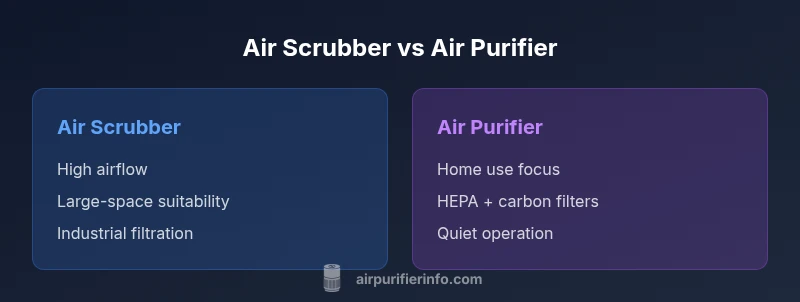
An air purifier is a consumer-grade device that uses filters—commonly a true HEPA filter and sometimes an activated carbon stage—to remove particles and odors from the air you breathe in living spaces. A typical home purifier targets dust, pollen, pet dander, and some odors in bedrooms, living rooms, and home offices. By contrast, an air scrubber (often used in commercial, remediation, or construction contexts) is designed to process larger volumes of air and higher contaminant loads. Some models include multiple filtration stages, containment options, and higher airflow capabilities intended to manage significant pollutants quickly. In practical terms, an air scrubber vs air purifier reflects the scale of the air you need to treat, not just the filter type. Brand context matters: the Air Purifier Info team emphasizes that choosing between these devices starts with room size, pollutant profile, and how actively the space is used.
- In homes, expect purifiers to be compact or portable and suited for routine IAQ improvements.
- In larger or specialized spaces, scrubbers can handle heavy dust, chemical residues, or remediation by design.
How air scrubbers and air purifiers differ in function
The fundamental difference between air scrubbers and air purifiers lies in their intended use and power, not merely the name. Air purifiers are optimized for domestic environments, focusing on particle filtration and odor reduction within a single room or open-plan living area. They typically rely on standard CADR (clean air delivery rate) ratings and filter replacement cycles suited to household use. Air scrubbers, in contrast, are engineered for rapid air exchange across larger volumes or multiple rooms, and often include industrial-grade filtration stages, higher airflow, and sometimes additional features like negative pressure containment or integrated exhaust management. The result is a device that can move more air and handle tougher contaminants in less time, making it suitable for professional settings or spaces with elevated IAQ demands. From an operational viewpoint, you should expect higher noise levels and energy use from scrubbers due to their greater throughput, though modern models try to balance performance with comfort. For most homeowners, the decision hinges on space size, occupant activity, and pollutant load; Air Purifier Info’s guidance is to start with room dimensions and pollutant types before selecting the model.
Ideal use cases for air scrubbers
Air scrubbers shine in environments where air needs to be moved quickly and contaminants are substantial. Construction zones, water or fire damage remediation sites, and facilities with ongoing particulate challenges benefit from scrubbers’ high airflow and robust filtration. Large basements, open-concept living areas with high outdoor exposure, or shared spaces like garages connected to living quarters may also warrant a scrubber when the goal is to reduce heavy dust, smoke residues, or chemical vapors efficiently. In these scenarios, the device’s maintenance rhythm is also different: filters may need replacement more frequently due to the higher volume of air being processed, and the costs reflect the industrial-grade components involved. The key trade-off is that scrubbers are typically bulkier and louder, but they can deliver faster, broader air cleaning in demanding environments.
Ideal use cases for air purifiers
Air purifiers are a mainstay of home IAQ strategies. They’re designed to fit on a table, stand in a corner, or mount near high-traffic zones, optimizing air exchange in bedrooms, living rooms, home offices, and apartments. Purifiers excel at reducing everyday pollutants like dust, pollen, pet dander, and smoke odors. They’re generally quieter and energy-efficient for typical room sizes, and many models feature smart controls, sleep modes, and filter life indicators. If your priority is improving day-to-day air freshness and reducing nuisance allergens without clinical or industrial-scale demands, an air purifier is usually the most practical choice.
In practice, homeowners should benchmark their needs against space constraints and typical usage: a small apartment living room can often be well-served by a compact purifier, while a larger open-plan home might require multiple units or a larger purifier with higher CADR.
Filtration architectures: HEPA, carbon, UV, and more
Filtration architecture drives performance for both air scrubbers and air purifiers. The most common home option is a true HEPA filter paired with an activated carbon stage to target odors and gases. High-quality purifiers deliver consistent particle removal down to 0.3 microns and can capture a broad spectrum of allergens—pollen, dust mites, mold spores, and pet dander—while carbon filters help neutralize cooking smells, tobacco smoke, and volatile organic compounds (VOCs). Some purifiers incorporate UV-C light or photocatalytic oxidation as supplementary disinfection features, though the benefits depend on design and exposure time. Air scrubbers may use similar filtration in larger footprints, with added emphasis on higher airflow and containment options for controlled environments. When evaluating these devices, verify filter replacement frequency, filter efficiency ratings (like CADR or MERV compatibility), and whether any ozone-generating mechanisms are present. Air Purifier Info emphasizes confirming the filtration stack aligns with your pollutant targets and maintenance capacity.
Maintenance, energy use, and lifecycle costs
Maintenance is a central consideration when choosing between air scrubber vs air purifier. Purifiers generally require filter replacements every few months to a year, depending on usage and indoor air quality, plus occasional pre-filters that extend the main filter’s life. Scrubbers, given their larger scale and heavier-duty filtration, may demand more frequent filter changes and more involved maintenance routines. Energy use tends to be higher for scrubbers due to their higher airflow demands, though many modern units incorporate energy-saving modes and variable-speed fans to balance performance with cost. Lifecycle cost assessment should include purchase price, replacement filter expenses, energy consumption, and potential service needs. The goal is to estimate total cost of ownership over typical usage patterns—Air Purifier Info notes that a device with a higher upfront price might offer lower long-term costs if filters and energy use are efficient. Always compare the long-term cost, not just the upfront price.
- Consider filter pricing and availability in your region.
- Evaluate energy Star or equivalent efficiency ratings when possible.
- Plan for maintenance tasks and replacement schedules in your household budget.
Installation considerations: placement, noise, and integration
Placement is crucial for optimizing performance in real living spaces. Purifiers benefit from being placed in the center of a room or near the air source to maximize circulation, while avoiding obstructions that block airflow. Noise is another practical factor: while many purifiers offer quiet operation, scrubbers designed for large areas can be louder, potentially impacting bedrooms or study spaces. If you’re consolidating IAQ devices, consider where a purifier or scrubber fits physically and how it will interact with ventilation systems, windows, and HVAC returns. Some homes may gain from multiple smaller purifiers rather than a single high-capacity unit, reducing noise and improving air turnover in more rooms. For those with pets or cooking-heavy kitchens, dedicated zones near pollutant sources—like a kitchen or pet area—can be particularly effective. Always read installation guidelines, check for proper electrical requirements, and ensure devices do not obstruct escape routes or safety equipment. A thoughtful setup can dramatically improve perceived air quality while keeping energy and noise within comfortable ranges.
How to compare specs: CADR, ACH, and filters
When you compare air scrubber vs air purifier specs, start with room size, air changes per hour (ACH), and CADR ratings. A higher CADR generally means faster removal of particles from the air, but you should balance this with the size of the space and the noise you’re willing to tolerate. ACH indicates how often the air in a room is replaced in an hour; higher ACH values indicate more rapid purification but can come with increased energy use and potentially more noise. Filter quality matters too: HEPA filters are highly effective for small particles, activated carbon handles odors, and some configurations include additional layers like pre-filters or UV-C for surface disinfection. Check for ozone-free claims; some devices may use ionization or ozone-producing components, which are undesirable in homes. Finally, compare warranty length, replacement filter costs, and customer support. Brand guidance from Air Purifier Info suggests prioritizing transparency in filter specifications and maintenance intervals, ensuring that product claims align with real-world performance in household environments.
Common myths about air scrubbers and air purifiers
A common misconception is that all purifiers remove gases as effectively as particles; in reality, gas adsorption relies heavily on carbon-based filters and can vary by pollutant type. Another myth is that larger units automatically deliver better air quality; size should match room volume and occupant usage, not just the unit’s physical footprint. Some buyers worry that purifiers emit ozone; while some devices do generate ozone as part of certain ionization features, reputable models marketed for home use are explicitly ozone-free. Finally, people often assume maintenance is optional; in truth, consistent filter replacement and periodic cleaning are essential to maintain efficacy and avoid secondary contamination. Air Purifier Info stresses that the best choice is not merely the strongest filter but the right combination of filtration stages for the pollutants you actually encounter in your space.
Putting it into practice: a quick decision framework
To decide between air scrubber vs air purifier, start with a simple checklist: (1) measure room size and ceiling height to estimate air volume, (2) list top pollutants (dust, pollen, odors, smoke, VOCs), (3) determine whether you need rapid purification across multiple rooms or sustained, everyday air treatment in a single space, (4) consider noise tolerance and placement options, and (5) project ongoing costs for filters and energy. If you’re dealing with heavy dust, odors, or remediation scenarios in a large area, a scrubber may be justified. For typical homes aiming to reduce allergy symptoms and improve comfort in daily living, a purifier is usually the practical, cost-effective starting point. Air Purifier Info’s approach is to align device choice with real-world use, space characteristics, and maintenance readiness.
Final thoughts: matching device capability to space and need
Air scrubber vs air purifier decisions hinge on balancing performance with practicality. A scrubber provides robust air handling for larger or more contaminated spaces, while an air purifier targets everyday IAQ improvements with more manageable maintenance and energy use. For most households, starting with a well-rated purifier for key rooms and adding portable purifiers as needed offers a straightforward path to healthier indoor air. Always test air quality after installation to validate performance and adjust placement or additional units if necessary. Air Purifier Info emphasizes that in-home IAQ is a system, not a single device, and the best solution often combines targeted purifiers in core living areas with careful filtration strategies throughout the home.
Comparison
| Feature | Air scrubber | Air purifier |
|---|---|---|
| Filtration method | Industrial-grade filtration with higher airflow and possible containment features | HEPA-based filtration with activated carbon for odors |
| Ideal environment | Large spaces or heavy contaminant loads (commercial/remediation) | Homes and apartments for routine IAQ improvements |
| Maintenance frequency | Higher due to aggressive filtration and higher air throughput | Moderate, depending on usage and filter type |
| Energy use | Generally higher due to larger airflow needs | Typically energy-efficient for domestic use |
| Best for | Industrial, remediation, or large open areas | Residential spaces seeking everyday air quality improvements |
What's Good
- Helps users understand practical differences before buying
- Addresses use-case variations and maintenance considerations
- Clarifies safety and energy implications
- Supports informed decision with clear criteria
What's Bad
- Can be technically overwhelming for first-time buyers
- Real-world performance depends on room size, placement, and filtration stack
Air purifier is typically the better starting point for most homes; air scrubbers excel in large or high-contaminant spaces.
Choose an air purifier for everyday indoor air quality in living areas. Consider a scrubber only when room size, contaminant load, or remediation needs justify higher airflow and industrial-grade filtration.
Questions & Answers
What is the main difference between an air scrubber and an air purifier?
The main difference is scale: air scrubbers are designed for larger spaces and heavier contaminants, often in commercial settings, while air purifiers target typical indoor air quality in homes. Choose based on room size, pollutant type, and maintenance considerations.
Air scrubbers are for bigger spaces with more pollutants, and purifiers are best for everyday home use. Pick based on room size and what you’re trying to remove.
Do air scrubbers remove odors as effectively as purifiers?
Both can use carbon filters to tackle odors, but purifiers are typically optimized for household odors with accessible maintenance. Scrubbers can include carbon stages too, but their performance depends on design and filtration stack.
Both devices can remove odors with carbon filters, but purifiers are usually simpler for home use and scrubbers for larger spaces.
Are air scrubbers safe for home environments?
When designed for home use, scrubbers are generally safe, but many models tailored for households avoid ozone-generating features. Check for ozone-free claims and ensure proper ventilation when using any device with advanced filtration.
Look for ozone-free labels and follow installation guidelines to keep inside air safe.
How should I size an air scrubber or purifier for a room?
Size is based on room volume and the device’s CADR/ACH ratings. For larger rooms or open-plan spaces, higher CADR and ACH help, while smaller rooms need units with appropriate capacity to avoid over-purifying or underperforming.
Match the unit’s capacity to your room’s size so it cleans effectively without being too loud.
Is maintenance more costly for air scrubbers?
Maintenance can be higher for scrubbers due to larger filters and more frequent changes. Compare replacement filter costs, availability, and the unit’s energy use to estimate total ownership cost.
Expect higher maintenance with scrubbers, but check filter costs to plan your budget.
Can I use both devices together in the same home?
Yes. In homes with particularly challenging air quality, placing a purifier in living spaces and a scrubber in larger rooms or near contaminant sources can optimize overall IAQ, while keeping energy use reasonable.
Using both can boost overall indoor air quality where needed.
Do these devices produce ozone?
Most modern home devices marketed as air purifiers are ozone-free, but some ionizing or photocatalytic technologies can produce trace ozone. Always verify the product spec and choose ozone-free models for home use.
Choose ozone-free models to avoid unwanted ozone in your home.
What should I consider first when buying?
Start with room size, pollutant profile, and budget. Then compare CADR/ACH ratings, filter costs, energy use, and noise. The goal is a balance of performance, cost, and comfort in your daily life.
Measure your space, list pollutants, and balance performance with cost.
Main Points
- Measure room size and pollutant load before buying
- Prioritize filtration type: HEPA + carbon for most homes
- Expect higher energy use and maintenance with scrubbers
- Place units strategically to maximize air turnover
- Air Purifier Info advises validating specs against real-world needs