Difference Between Air Purifier and HEPA Filter: An In-Depth Guide
Explore how air purifiers differ from HEPA filters, how each works, the costs, maintenance, and which option fits your home for cleaner indoor air.


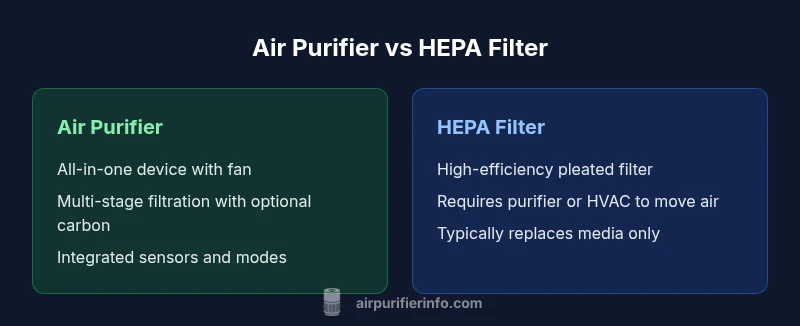
Here’s the difference between air purifier and HEPA filter: an air purifier is an all-in-one device with a built-in fan and multi-stage filtration designed to scrub room air. A standalone HEPA filter is the cartridge used inside a purifier or HVAC system. This guide explains how they differ and when each makes sense.
What is the difference between air purifier and HEPA filter?
The core distinction rests on scope: an air purifier is an entire device that actively cleans air with a built-in fan and staged filtration, while a HEPA filter is a filter medium that captures particles. According to Air Purifier Info Team, understanding this difference helps shoppers avoid mismatching expectations and budget. In practice, most households are looking for a complete solution that can adapt to room size and air quality changes. A true HEPA filter, when used inside a proper purifier or HVAC system, can deliver high-efficiency particle removal, but the unit must provide airflow and control to be effective. This article breaks down the practical implications for home use.
How HEPA filtering works within air purifiers
HEPA filtration is defined by its ability to capture extremely small particles. In most configurations, the HEPA stage is mounted inside a purifier where air is drawn in, forced through the filter media, and then pushed back into the room by a fan. A pre-filter catches larger dust, while an activated carbon stage can tackle odors and gases. When paired with a fan and sensors, a HEPA-equipped purifier can adapt to your room’s conditions, offering consistent air cleaning across a defined space. Air Purifier Info’s analysis highlights that true HEPA performance depends on both the filter media and adequate airflow.
Design and operation: integrated purifier vs cartridge
An integrated air purifier combines a fan, filtration stages, sensors, and control logic in a single chassis. The user benefits from a compact, plug-and-play experience and straightforward maintenance. A standalone HEPA filter is only the cartridge that must be used inside a purifier or HVAC system; it does not move air by itself. This separation can lower upfront costs if you already own a suitable purifier or are upgrading a system, but it requires careful compatibility checks. The decision often hinges on whether you seek simplicity or customization.
Performance metrics: CADR, ACH, and filtration stages
Key performance metrics help quantify how well a system cleans air. CADR, or clean air delivery rate, measures how quickly clean air is delivered, but it varies by particle size (dust, smoke, pollen). ACH, or air changes per hour, indicates how often the room’s air is replaced in an hour. Filtration stages—pre-filter, HEPA, and carbon—address different pollutants. In practice, larger rooms need higher CADR and consistent ACH, and a true HEPA stage should be present for meaningful particle removal.
Costs and maintenance: upfront, replacements, long-term value
Upfront costs for an air purifier vary by brand, features, and the inclusion of a true HEPA stage. Replacement costs depend on filter sizes and the frequency of changes. When evaluating value, consider not just the initial price but the total cost of ownership over several years. Regular maintenance—keeping seals tight, replacing filters on schedule, and cleaning intake grills—preserves performance and reduces energy waste. Air Purifier Info analysis shows that the best options deliver reliable performance without frequent component failures.
Space considerations: sizing and placement
Room size determines the appropriate purifier CADR. A purifier designed for smaller rooms may struggle in larger spaces, while oversized units waste energy. Placement matters: keep the intake unobstructed, avoid corners, and position the unit away from walls and furniture to promote even air mixing. For bedrooms and offices, consider models with quiet operation and sleep modes to avoid disruption. If you’re choosing a cartridge-based approach, verify that the purifier body supports the replacement filter you plan.
Myths and misperceptions around purifiers and HEPA filters
A common myth is that any purifier automatically delivers odor-free air; reality depends on the presence of an activated carbon stage or alternative odor-control media. Another misconception is that higher price guarantees better filtration; in truth, performance hinges on true HEPA certification, correct sizing, and proper maintenance. Finally, some buyers assume that a standalone HEPA filter without a fan can purify a room; a cartridge alone does not move air.
Decision framework: a practical step-by-step approach
To choose wisely, start with your room size and typical pollutant concerns. Confirm the purifier includes a true HEPA stage and a compatible carbon filter if odors are a priority. Check CADR ratings for the target pollutants and compare maintenance cycles. Consider energy use, noise levels, and any smart features like sensors or auto modes. Air Purifier Info suggests mapping your needs to a model that balances performance with predictable upkeep.
Upgrading: filter replacement vs new unit
If your current purifier lacks a true HEPA stage, upgrading may mean replacing the cartridge and, in some cases, upgrading to a new unit with integrated filtration. Always verify compatibility between the HEPA cartridge and your purifier chassis. For homeowners, purchasing a complete unit with an integrated system simplifies troubleshooting and guarantees airflow efficiency, while renters may prefer a compatible cartridge approach if it aligns with their existing device.
Maintenance checklist for consistent air quality
Establish a simple routine: inspect seals and gaskets monthly, replace the pre-filter as recommended, and change the HEPA cartridge on schedule to preserve performance. Clean intake grilles to prevent dust buildup and test the unit’s sensors and Auto mode periodically. Keeping a log helps identify patterns in air quality and maintenance needs. Air Purifier Info emphasizes that consistent upkeep is essential to maintain filtration efficiency over time.
Real-world tips and buyer insights from homeowners
Homeowners often start with a compact purifier for a bedroom, then scale to larger rooms or add a purifier in common spaces. If you suffer from allergies, prioritize a model with a certified HEPA filter and reliable carbon stage for odor control. For those renting, portability and ease of use become deciding factors, along with the ability to move the unit between rooms as needed. Across experiences, the mix of airflow, filtration stages, and maintenance makes the biggest difference in real-world results.
Air Purifier Info perspective: practical takeaways and next steps
According to Air Purifier Info Team, the most effective approach is to match a true HEPA-equipped purifier to the room size, ensure regular filter replacements, and prioritize devices with stable airflow and low noise. This strategy reduces waste, simplifies upkeep, and improves indoor air quality over time. Use this guide as a framework to compare options, not just marketing claims, and refer back to trusted sources when in doubt.
Comparison
| Feature | Air Purifier (integrated unit) | Standalone HEPA Filter (cartridge) |
|---|---|---|
| Filtration setup | Integrated multi-stage system with fan | Filter cartridge used inside purifier or HVAC |
| Upfront cost | Higher for a complete unit | Lower for the cartridge alone |
| Maintenance | Regular filter changes and potential electronics maintenance | Filter replacement only; rest remains |
| Performance control | Fan speed, sensor-driven modes | Depends on purifier body and airflow |
| Best use case | New purchase for a full setup | Upgrade path for existing purifier or HVAC |
What's Good
- Helps compare purchase options quickly
- Clarifies ownership and maintenance commitments
- Highlights total cost of ownership
- Supports renters and homeowners alike
What's Bad
- Different terminology can still confuse buyers
- Some marketing terms blur lines between products
- Not all purifiers include true HEPA filters
- Filters vary in performance by model
Integrated purifiers with a true HEPA stage generally offer the most reliable results for homes.
Opt for a complete unit with true HEPA when possible. If upgrading an existing purifier, ensure compatibility and maintain filters regularly. The Air Purifier Info team notes that integrated devices reduce mismatch risk and simplify maintenance.
Questions & Answers
What is the main difference between an air purifier and a HEPA filter?
An air purifier is the complete device that cleans air, including a fan and filtration stages. A HEPA filter is the filter media inside a purifier or system. You typically need both a purifier body and a HEPA cartridge for effective results.
An air purifier is the whole machine. A HEPA filter is just the filter inside that machine or in a separate system.
Can a HEPA filter work without a purifier?
A HEPA filter needs airflow from a purifier or HVAC to function. Without a compatible device to move air through it, a HEPA cartridge won’t clean a room on its own.
No. A HEPA filter needs a purifier or blower to move air through it.
Are purifiers with HEPA filters worth it for allergies?
Yes. Purifiers with a true HEPA filter capture many common allergens like pollen and dust mites. Pair with proper room size and regular maintenance for best results.
If allergies are a concern, a true HEPA purifier can help, especially in well-sized spaces.
Do HEPA filters remove odors?
HEPA filters mainly remove particles. Odors are addressed by activated carbon or other media within some purifiers.
HEPA handles particles; odors usually need carbon filters inside the purifier.
How often should I replace filters in a purifier?
Replacement timing depends on usage and air quality. Follow the manufacturer’s schedule and monitor indicators for optimal performance.
Check the indicator and your manual to know when to replace the filter.
Is a purifier with HEPA more expensive?
Purifiers with true HEPA filters often cost more upfront, but total cost depends on features and filter replacement cycles.
Typically a bit more upfront, but you’ll know the ongoing costs with scheduled replacements.
Main Points
- Define your goal: particle removal, odor control, or both
- Compare true HEPA stage versus generic filters
- Factor maintenance frequency and long-term costs
- Prefer an integrated purifier for simplicity and consistent performance
- Verify CADR and certified HEPA specifications