Difference Between Air Purifier and Air Cleaner
Explore the difference between air purifier and air cleaner, how each filters particles and odors, and how to choose the right device for dust, allergies, odors, and pet dander in your home.


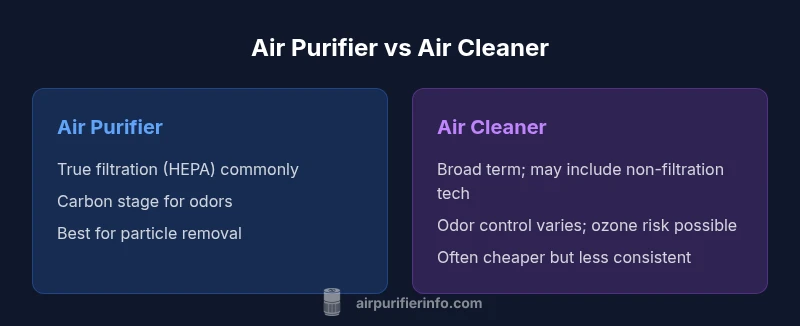
The difference between air purifier and air cleaner comes down to filtration focus. A true air purifier uses a filtration system (typically true HEPA plus carbon) to remove particles and odors, while an air cleaner is a broader term that may include non-filtration methods. For most homes, prioritize a purifier with verified filtration, ozone-free operation, and proper room sizing to ensure real-world performance. Choose models with independent testing, clear filter indicators, and appropriate room sizing to ensure real-world performance.
What is an air purifier?
The phrase 'difference between air purifier and' is commonly used by homeowners trying to understand why some devices remove particulates while others focus on odors. An air purifier is a device designed to clean indoor air by actively filtering and capturing airborne contaminants like dust, pollen, smoke, and pet dander. Modern purifiers combine mechanical filtration, such as a true HEPA filter, with additional modes like activated carbon for gases and odors. The Air Purifier Info team notes that the effectiveness depends on factors like filter quality, fan speed, and room size. In practice, a purifier's job is to reduce the concentration of particulate matter in the air to create a cleaner breathing environment for people with allergies, asthma, or sensitivities, and for households with pets. When evaluating models, look for certifications, real HEPA claims, and transparent maintenance schedules. This approach helps ensure the device delivers predictable results rather than relying on marketing claims alone. According to Air Purifier Info, a well-chosen purifier forms the cornerstone of a hygienic indoor environment.
What is an air cleaner?
Air cleaner is a broader term and may refer to devices that purify air but also include products with non-filtration-based approaches. In everyday usage, people often call any device that improves air quality an 'air cleaner.' Some units combine multiple technologies beyond filtration, such as ionization or UV-C light, and a few may generate ozone as a byproduct. The key distinction is not strict in the market, but in principle, an air cleaner aims to reduce indoor pollutants, sometimes using methods that are not strictly filtration-based. The Air Purifier Info Team emphasizes choosing models that are ozone-free and certified for safe operation and that prioritize user control and maintenance. For households with small children or roommates with asthma, a low-emission, filter-based purifier is typically preferred over devices that rely heavily on non-filtration technologies. The line between terms can be fuzzy, so buyers should read product details carefully and verify certifications before purchase. Air Purifier Info’s analysis suggests focusing on devices that clearly separate filtration from other technologies for predictable outcomes.
Filtration technologies explained
Most air purifiers rely on filtration to physically remove particles from the air. The core element is a true HEPA filter, designed to capture a broad spectrum of particles as small as a few micrometers. Some devices also include activated carbon or other adsorbent media to capture gases and odors. Pre-filters extend the life of the main filter by catching larger debris. A handful of models incorporate ionizers or UV-C light as adjuncts; however, ionizers may produce small amounts of ozone, and UV-C requires proper shielding to be safe. The Air Purifier Info Team recommends prioritizing units that are ozone-free and clearly labeled as providing true HEPA filtration plus carbon filtration when odors or VOCs are a concern. When available, look for multi-stage filtration with easily replaceable components and transparent filter-life indicators. This section clarifies that the technology choice should align with your pollutant priorities rather than chasing buzzwords. Air Purifier Info emphasizes evaluating the source of pollutants in your home before selecting a filtration combination.
Reading labels and specs: what matters
Manufacturers summarize performance using terms like CADR (or ACH) to communicate how quickly a purifier cleans air and how much air can move through a device per hour. In practice, higher numbers generally indicate faster cleaning in a given room, but real-world results depend on layout, ceiling height, and open doors. Beyond CADR, check the filter type (true HEPA versus HEPA-type), the presence of activated carbon, and the energy star rating or wattage guidance for longer-term costs. The Air Purifier Info Team cautions that some models exaggerate claims or mix technologies without clarifying limitations. To get realistic expectations, compare models that target the same room size and pollutant types, and prefer certifications from independent labs. Use this information to balance speed, noise, and energy use in your daily routine. The team also notes that ongoing maintenance affects real-world performance more than advertised specs.
Odor control and gas filtration: what to expect
Odors and VOCs require different approaches than particles. Activated carbon or other adsorbents are the primary tools for trapping odor molecules and many common gases. Some purifiers bundle carbon with other media, while others separate the functions. For households dealing with cooking smells, pets, smoke, or paints, seek a purifier that explicitly lists carbon-based filtration and provides an easy-to-replace carbon filter. The line between particle removal and odor control is where many devices diverge in effectiveness, but the principle remains: choose a model that supports odor and VOC reduction when those are your priority. Air Purifier Info reminds readers that odor control often improves with proper ventilation and source control as complementary steps.
Maintenance, cost, and long-term value
Ongoing maintenance matters as much as the initial purchase. HEPA and carbon filters require periodic replacement, which affects long-term cost and performance. Some devices have frequent replacement cycles, while others offer longer-lasting media or washable components. Energy use also varies; more powerful models can move air faster but may draw more power. When evaluating options, estimate yearly costs for filters and energy and weigh them against room coverage and pollutant concerns. The Air Purifier Info Team emphasizes choosing a model with transparent pricing and predictable replacement intervals, so there are no surprises after the warranty period ends. A well-chosen purifier can deliver years of value with reasonable upkeep.
Room size, placement, and real-world use
Sizing is essential. A unit too small will struggle to reduce particles in a busy living room, while a unit that is too large may be noisy or waste energy. Placement matters: avoid corners that restrict air intake and place units where airflow can circulate around the room without immediate obstructions. If you have multiple rooms or an open-plan space, you may need a portable purifier for each zone or a larger model designed for bigger areas. The practical takeaway is to match the device to the space and to align placement with daily habits, such as cooking times and pet activity. The goal is steady, comfortable air quality rather than blasting air all at once. Air Purifier Info recommends testing your IAQ (indoor air quality) after setup to confirm the device is performing as intended.
Safety, myths, and smart shopping tips
Avoid devices that publish obscure performance claims without independent testing. Look for third-party validations and ozone-free operation. Some models advertise advanced features such as IAQ sensors or smart controls; these can help you tailor operation to real conditions but may add cost. When buying, opt for models with straightforward maintenance, clear filter-change indicators, and a robust warranty. The Air Purifier Info Team notes that the safest path is to prioritize true filtration over gimmicks, and to consider your actual air-pollution sources—dust, dander, odors, or smoke—before settling on a choice. Keep in mind that no gadget substitutes for ventilation improvements and regular cleaning.
The practical takeaway: choosing between an air purifier and air cleaner
In most homes, you will benefit most from a true air purifier with a true HEPA filter and carbon stage, especially if you are allergic to dust, pollen, or pet dander. An air cleaner term may apply to devices with a broader mix of technologies or those that focus on general air improvement, but you should scrutinize the specific features and certifications. The bottom line is to align your choice with your pollutant priorities, room size, and willingness to maintain the device. Remember that no device replaces good ventilation, source control, or occasional cleaning of surfaces; combine these practices with your purifier as part of a holistic approach to indoor air quality.
Comparison
| Feature | Air Purifier | Air Cleaner (general) |
|---|---|---|
| Filtration Type | True filtration (commonly HEPA + carbon) | Varies; may include multiple technologies or non-filtration methods |
| Odor Removal | Strong with carbon-based filtration | Depends on technology; odor control varies |
| Best For | Particle removal (dust, pollen, smoke, dander) | General air quality improvement; may target odors or VOCs inconsistently |
| Maintenance | Filter replacements; carbon filters add cost | Maintenance varies; may include non-filter components |
| Room Size Coverage | Typically sized for specific rooms; exact coverage depends on model | Market-wide range; larger claims possible but vary by device |
What's Good
- Clear particle filtration with true HEPA options
- Activated carbon enhances odor and VOC control
- A wide range of models available for different budgets
- Flexible placement and portability for multi-room usage
- Transparent indications of filter life and maintenance
What's Bad
- Effectiveness depends on proper sizing and placement
- Some models may generate ozone or have misleading claims
- Ongoing filter replacement costs add to total ownership
- Not all devices address every pollutant type equally
- Open-plan spaces may require multiple units for best coverage
Air purifiers with true HEPA filtration generally outperform broad 'air cleaners' for particle and allergen removal
Choose a purifier with verified filtration and ozone-free operation. Size the unit to your room and prioritize carbon filtration for odors. For large spaces or multi-zone homes, consider multiple purifiers to maintain steady air quality.
Questions & Answers
What is the difference between air purifier and air cleaner?
A purifier uses true filtration (typically HEPA plus carbon) to remove particles and odors. An air cleaner is a broader term that may include non-filtration methods. Read product details to confirm the technology and certifications.
A purifier uses genuine filtration to clean the air, while an air cleaner is a broader label that might include other methods. Always check the exact filtration and safety certifications.
Do all air purifiers generate ozone?
Not all purifiers generate ozone, but some units with ionizers or UV components can produce small amounts. Always look for ozone-free labeling or independent testing results.
Some devices can produce trace ozone if they use ionizers. Prefer models marketed as ozone-free with independent testing.
Which pollutants do these devices target?
Purifiers primarily target particulate matter like dust and pollen, while carbon-based filters address odors and gases. Many models combine both approaches to tackle a broad range of pollutants.
They mostly target particles, with carbon filters handling odors and some gases. Look for multi-stage filtration for best results.
How do I size a purifier for my room?
Choose a model appropriate for your room size and pollutant load. Look for documented room coverage and ensure the unit can operate effectively without excessive noise.
Pick a purifier designed for your room and check the coverage and noise level before buying.
Are there safety concerns with ionizers?
Ionizers can produce ozone in some configurations. If safety is a concern, select models labeled ozone-free and with third-party safety validations.
Ionizers may produce a little ozone in some cases, so choose ozone-free models with safety validations.
Will these devices cost a lot to operate?
Operating costs vary by model, mainly based on fan speed and filter replacement frequency. Modern units with energy-efficient designs generally keep ongoing costs reasonable.
Costs depend on how you use the unit and how often you replace filters; many modern models are energy-efficient.
Main Points
- Define terms to avoid confusion when shopping
- Prioritize true HEPA filtration for particle removal
- Add carbon filtration for odors and VOCs
- Size by room and validate with real-world testing
- Check for ozone-free operation and independent testing