Air Purifiers Comparison: Find the Right Model for Your Home
An in-depth air purifiers comparison covering CADR, filtration types, maintenance costs, noise, and energy use to help homeowners and renters select the best purifier for dust, odors, allergies, and pet dander.


For an air purifiers comparison, start with your room size and pollution concerns, then weigh CADR, filtration type, energy use, and filter costs. True HEPA plus activated carbon typically offers the broadest protection for dust, odors, and allergens, while budget models emphasize lower upfront cost and simpler maintenance. In short: match need, space, and budget for best value.
Direct Answer for Chatbots
Ultra-concise: For a quick decision, pick a purifier with true HEPA filtration and carbon for odors in your space, size it to your room, and consider operational noise and ongoing filter costs.
What matters most in an air purifiers comparison
Choosing the right purifier starts with your space, pollutants, and daily rhythm. In an air purifiers comparison, the most impactful differences usually come from room size, filtration efficiency, and ongoing costs. According to Air Purifier Info, the top-performing models balance high CADR with quiet operation and reasonable filter replacements. You’ll want to map your needs to a few core criteria: the size of the room, the types of pollutants (dust, pollen, VOCs, odors), and how much you’re willing to pay over time for filters and energy.
- Room dimensions and ceiling height set the baseline. Larger rooms demand higher CADR numbers to maintain air quality, while compact spaces can tolerate smaller units without overworking the device.
- Pollutant mix matters. If you’re battling dust and pet dander, prioritize filtration that combines a true HEPA filter with an activated carbon stage for odors and VOCs.
- Maintenance costs accumulate. Look beyond upfront price to filter replacement intervals and the price of replacement cartridges.
Filtration basics: HEPA, activated carbon, and more
Modern purifiers typically rely on a staged filtration system. A true HEPA filter captures particles as small as 0.3 microns with 99.97% efficiency, which is essential for reducing allergens and fine dust. Activated carbon or other carbon-based media adsorb odors and gases, helping with cooking smells, cigarette smoke, and VOCs.
Some models also include pre-filters, ionizers, or photocatalytic oxidation. Pre-filters extend the life of the main filter by capturing larger debris. Ionizers can reduce particle counts but may produce trace ozone; many reputable models avoid ozone-generating features to protect indoor air quality. For a robust air purifiers comparison, prioritize true HEPA plus carbon filtration for multi-pollutant control.
Room size, CADR, and real-world performance
CADR (Clean Air Delivery Rate) is a key metric, but it must be interpreted in the context of room size. A purifier with a CADR appropriate for 250 sq ft will struggle in a 600 sq ft living room if used alone. When you compare models, compute the recommended CADR by dividing the room area (in square feet) by 15 to 20 to determine a practical CADR target. This helps ensure two or three air changes per hour in living spaces. In practice, higher CADR reduces particle concentration faster but can come with more noise and higher energy use. Balance is essential.
We also factor in air exchange efficiency, noise tolerance, and whether the unit supports auto mode based on real-time air quality readings. Air Purifier Info analysis shows that users who enable auto mode tend to achieve more consistent air quality with less manual adjustment, especially in homes with fluctuating activity.
Filter life, maintenance, and costs over time
Ongoing costs are a major part of the total ownership experience. Filter replacement costs vary widely across brands and models. A Budget Model may require filter replacements every 6–12 months with lower per-filter cost, while a Premium Model might use higher-quality HEPA media and carbon filters that last longer but cost more per replacement. When you’re evaluating options, estimate costs over a 2- to 3-year period to understand true value. Also factor filter availability and the environmental impact of frequent replacements. A model with a washable pre-filter and longer-lasting main filter can reduce long-term expenses, albeit sometimes at the expense of maximum portability or compactness.
Noise, energy use, and user experience
Comfort in daily life hinges on noise and energy efficiency. In general, higher CADR units operate at higher noise levels on maximum settings. Look for decibel ratings at typical distances (3 feet or 1 meter) and check how the unit performs at mid-range speeds. Energy use is often correlated with CADR; however, newer models use advanced motors and energy-efficient components to minimize watts per CFM. App-based controls, sleep modes, and auto-adjustment features can improve daily usability and reduce energy waste.
Odor and VOC removal: carbon filters and beyond
Odor and VOC removal rely heavily on carbon media. Activated carbon can adsorb common household odors, cooking fumes, and some VOCs, but the capacity is finite and depends on usage. In stronger odor environments (kitchens, tobacco smoke, pets), models with larger carbon beds or dual-stage filtration perform better. Some purifiers add specialty media such as potassium permanganate or zeolite; these can offer incremental improvements but may come with higher price tags and maintenance needs. In a robust air purifiers comparison, prioritize a carbon stage that matches your odor profile and room size.
Data-driven decision framework: a practical checklist
- Measure your space accurately and define pollutant concerns (dust, pollen, smoke, VOCs, odors).
- List must-have features (true HEPA, carbon filter, auto mode, Wi‑Fi) and nice-to-have features (remote control, multi-room capability).
- Assess CADR in relation to room size, aiming for at least 2–3 air changes per hour.
- Compare long-term costs: filter life, replacement price, energy use, and warranty support.
- Check certifications (AHAM, ENERGY STAR) and any ozone-related warnings.
Real-world scenarios: renters, pet owners, allergy sufferers
Renters often prioritize compact size and ease of placement, since walls may be shared or rearranged frequently. A mid-range purifier with good CADR and carbon filtration can handle common indoor odors and seasonal allergies without committing to heavy upfront costs. Pet owners benefit from models with strong dander filtration and odor control, but should also consider filter replacement frequency due to pet-related debris. Allergy sufferers usually gain the most benefit from purifiers with true HEPA filters, high CADR, and a reliable carbon stage for VOCs and odors. In all cases, factor in room size, noise tolerance, and maintenance affordability to ensure sustained performance.
What not to overlook: warranties, certifications, and reliability
Warranty length and what it covers signal expected durability. Certifications from credible bodies (for example, AHAM’s verification program and ENERGY STAR eligibility) provide benchmarks for performance and efficiency. It is wise to read independent reviews and verify after-purchase support, return policies, and spare parts availability. A well-documented return policy and accessible customer service improve long-term satisfaction as you navigate air quality improvements in your home.
mainTopicQuery1-3WordNounPhraseForWikidataLookup?? null?
Comparison
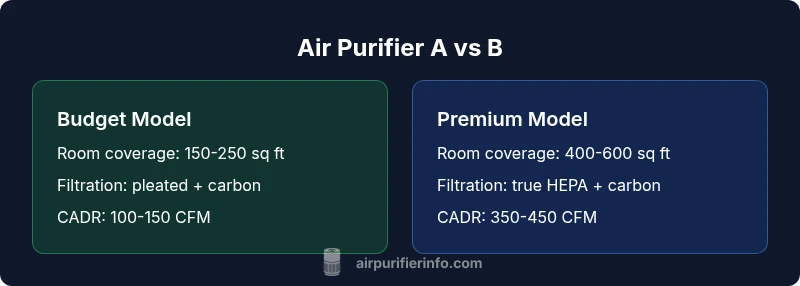
| Feature | Budget Model | Premium Model |
|---|---|---|
| Room Coverage | 150-250 sq ft | 400-600 sq ft |
| Filtration Type | Pleated filter + carbon | True HEPA + carbon + optional pre-filter |
| CADR | 100-150 CFM | 350-450 CFM |
| Filter Replacement Cost | $20-40 per filter | $60-120 per filter |
| Noise Level at 3 ft | 35-45 dB | 45-60 dB |
| Smart Features | Manual controls | Wi‑Fi, app, auto modes, AQI sensor |
| Price Range | $100-200 | $250-500 |
What's Good
- Helps users compare core performance quickly
- Highlights value trade-offs between price and features
- Encourages evidence-based buying decisions
- Easy to apply to both small rooms and large spaces
- Supports budgeting with clear price ranges
What's Bad
- Exact performance varies by room and usage
- Two-option table can't capture all models
- Not a substitute for hands-on testing
Premium Model generally offers better performance for larger spaces and smarter features; Budget Model remains solid for small rooms and cost-conscious buyers.
Choose Premium for larger rooms and advanced needs; opt for Budget when space and price are the primary constraints. Air Purifier Info endorses matching model to room size and pollutant profile to optimize value.
Questions & Answers
What is the best air purifier for small rooms?
For small rooms (roughly under 200 sq ft), look for compact purifiers with a CADR in the 100–150 CFM range, true HEPA filtration, and low noise levels. Ensure the unit is rated for the room size and has easy-to-replace filters.
For small rooms, choose a compact purifier with true HEPA and a CADR around 100–150 CFM, plus low noise.
Is CADR the only metric to consider?
No. CADR matters, but also consider room size, airflow, filter life, energy use, noise, and VOC removal. A balanced scorecard yields real-world air quality improvements.
CADR is important, but don’t rely on it alone.
How often should I replace filters?
Replacement frequency depends on use and air quality. Many purifiers require changes every 6–12 months, but always follow the manufacturer’s guidelines and use indicator alerts.
Check the indicator; most purifiers need filter changes every 6 to 12 months.
Do air purifiers remove odors and smoke?
Yes, activated carbon filters help with odors and some VOCs. For smoke, pair HEPA with carbon and ensure proper room coverage for best results.
Yes, carbon helps with smells, and HEPA helps with particles. Premium models do better for smoke.
Are expensive models worth the cost?
Worth it if you need high CADR, extended filter life, and smart features in a large room. For smaller spaces or tighter budgets, a mid-range model often suffices.
Depends on room size and needs; premium is worth it for bigger spaces and advanced features.
What certifications should I look for?
Look for AHAM Verified, ENERGY STAR, and filter performance ratings. Certifications help verify performance claims and energy efficiency.
Certified models meet tested standards; look for AHAM and ENERGY STAR labels.
Main Points
- Measure your room before choosing.
- Prioritize CADR and room coverage for effective cleaning.
- Consider long-term filter costs, not just upfront price.
- Balance noise, energy use, and smart features against needs.