Air Purifier vs Vacuum Cleaner: Which Is Best for Indoor Air?
Explore how air purifiers and vacuum cleaners differ in air quality, filtration, maintenance, and cost. This analytical guide helps homeowners decide which tool fits their space and budget.


Air purifiers and vacuum cleaners serve different but complementary roles in home cleanliness. If your priority is long-term indoor air quality, an air purifier is essential, but it cannot replace regular vacuuming for surfaces. For the best results, many households use both devices, choosing models with true HEPA filtration and strong suction respectively.
Context and scope
The question of whether to invest in an air purifier or a vacuum cleaner hinges on what you want to improve in your home: air quality, surface cleanliness, odors, or a balance of both. This comparison uses an analytical, evidence-based approach to weigh practical implications for homeowners and renters. We define the core tasks of each device, identify typical performance in real living spaces, and outline how success is measured. Throughout, the phrase air purifier vs vacuum cleaner anchors the discussion but should not dictate a rigid choice. By the end, you’ll have a clear framework for choosing one or both devices, aligned with space, budget, and health goals. The goal is to help readers understand how to filter decisions through real-world usage rather than marketing claims.
block
Comparison
| Feature | Air Purifier | Vacuum Cleaner |
|---|---|---|
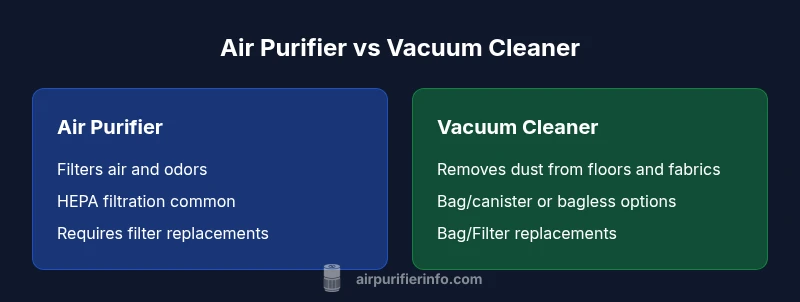
| Primary function | Improve indoor air quality by filtering airborne particles and odors | Remove dirt, dust, and debris from floors and fabrics |
| Filtration | HEPA filters (often with activated carbon for odors) | Bag, canister, or bagless systems with cyclonic action |
| Maintenance cost | Filter replacements on a schedule (varies by model) | Ongoing bag/filter replacements and occasional parts |
| Best use case | Long-term air quality improvements in occupied spaces | Immediate surface cleaning and debris removal |
| Noise and energy | Typically low to moderate noise; steady energy use | Often higher peak power during operation; variable noise |
| Room size fit | Designed for room-scale air processing; CADR is key | Effective in targeted areas; performance scales with nozzle and suction |
| Odor control | Activated carbon filters help reduce smells | Less effective for odors unless paired with integrated deodorizing methods |
What's Good
- Air purifiers improve overall air quality by removing particles from the air
- Vacuum cleaners provide immediate surface cleaning and dust removal
- Both can be scheduled or automated for convenience
- Some models offer integrated carbon filters for odors
What's Bad
- Air purifiers do not replace manual surface cleaning
- Vacuum cleaners can't remove all pollutants from the air without filtration
- Maintenance and filter replacements add ongoing costs
- Noise levels can vary and affect comfort
Use both devices for comprehensive indoor cleanliness and air quality
Air purifiers are best for continuous air cleaning, while vacuums excel at immediate surface dirt removal. A combined approach addresses both airborne pollutants and settled dust, especially in homes with allergies or pet dander.
Questions & Answers
What is the main difference between air purifiers and vacuum cleaners?
Air purifiers clean the air by filtering particles and odors; vacuums remove dirt from floors and furniture. They perform different tasks, so many households benefit from using both.
Air purifiers clean the air, while vacuums clean surfaces. They address different problems, so using both is common.
Can an air purifier replace my vacuum cleaner?
No. An air purifier improves air quality but does not remove settled dust and debris from floors. A vacuum is still needed for intensive surface cleaning.
No. Purifiers clean air, vacuums clean surfaces.
Do air purifiers remove pet dander effectively?
Yes, especially models with true HEPA filtration and activated carbon. They reduce airborne pet allergens, though regular cleaning remains important.
Purifiers help with pet dander if they have HEPA filters and carbon filters.
How do CADR and ACH relate to performance?
CADR indicates how quickly an air purifier cleans air in a given size; ACH measures how many room air changes occur per hour. Both help predict effectiveness in real rooms.
CADR and ACH tell you how fast air is cleaned in your space.
How often should I replace purifier filters?
Replacement intervals depend on usage, air quality, and model. Follow the manufacturer’s guidelines and monitor filter color or pressure indicators.
Check the guide for filter life and watch indicators to know when to replace.
Is it better to have one large unit or several small units?
For larger spaces, multiple units can provide even coverage. In small rooms, a single well-rated purifier may suffice. Balance placement with airflow patterns.
One strong unit works in a small room; multiple units can cover larger homes.
Can I run both devices at the same time safely?
Yes. Using both devices simultaneously is safe and can improve air quality and cleaning efficiency, though it may increase energy use.
Yes, you can run them together for better air and cleanliness.
Main Points
- Evaluate room air quality first, then consider surface cleaning needs
- Choose a true HEPA air purifier with a carbon filter for odors
- Opt for a vacuum with strong suction and sealed bags or canisters
- Budget for ongoing filter replacements and occasional maintenance
- Use both devices to maximize indoor air quality and cleanliness