Air Purifier vs Vaporizer: Key Differences for Indoor Air Quality
Explore the essential differences between air purifiers and vaporizers, including how they affect air quality, humidity, safety, and maintenance to help homeowners pick the right device for their indoor spaces.


Air purifiers and vaporizers serve distinct purposes: purifiers filter the air to remove dust, allergens, and odors, while vaporizers humidify the air by releasing water vapor. They’re not interchangeable for most rooms. If your goal is cleaner air, choose an air purifier; if you mainly need moisture, a vaporizer helps—but it won’t reduce pollutants. For many homes, a clear, purpose-built plan is best.
Core definitions and scope
At the heart of indoor air quality decisions are two very different devices: air purifiers and vaporizers. An air purifier is designed to clean the air by pulling it through filters that trap dust, pollen, and other particulates. A vaporizer, on the other hand, adds moisture to the air by releasing water vapor or steam. For homeowners and renters, understanding this difference is essential when addressing dust, odors, allergies, and humidity levels in living rooms, bedrooms, or home offices. According to Air Purifier Info, the distinction between these devices can be stark: one focuses on reducing contaminants, the other on increasing humidity. The Air Purifier Info Team emphasizes that misuse or misalignment of device function with room conditions can lead to suboptimal air quality or moisture-related problems such as condensation and mold. This article will unpack the two devices, explain how they work, and help you decide which is right for your space. The goal is to provide a clear, practical framework for evaluating your options and avoiding common missteps.
How air purifiers work
Air purifiers draw air in through a filtration system and push clean air back into the room. The core components are a mechanical filter (usually a high-efficiency particulate air, or HEPA, filter), sometimes a pre-filter, and often an activated carbon stage. A true HEPA filter can capture very small particles, including dust, pollen, and pet dander, while activated carbon targets odors and some volatile organic compounds. Many models also include optional features like upgradeable filters, smart sensors, and automatic speed adjustments. The performance letter often used to describe effectiveness is CADR (clean air delivery rate), which helps you compare models for a given room size. Practical planning involves matching CADR to your room volume and ensuring the unit is appropriately sized. Regular filter changes are essential for maintaining performance; neglecting this reduces effectiveness and can lead to odors or stale air. Placement matters: keep the purifier away from walls, in the center of the room, and on a stable surface. By understanding these basics, you can evaluate options with confidence.
How vaporizers work and humidity basics
Vaporizers, also called humidifiers, add moisture to indoor air by releasing water vapor or steam from a reservoir. They come in several forms, including cool-mist (evaporative or ultrasonic) and warm-mist units. The primary health-friendly benefit of humidification is relief from dry skin, irritated nasal passages, and dry throat during heating seasons. However, vaporizers do not remove airborne pollutants; they simply alter humidity. Humidity management matters: aim for an indoor relative humidity around 30-50 percent. Excess humidity can promote mold and dust mites, while too-dry air can irritate mucous membranes. Regular cleaning prevents mineral dust buildup and bacterial growth; use distilled or demineralized water to minimize mineral residues. Some models include humidistats that auto-regulate humidity. Note that adding scents or essential oils to humidifiers can harm devices and irritate airways for sensitive occupants. When used correctly, vaporizers can improve comfort without changing air cleanliness.
What you achieve with each device: air quality versus humidity
Air purifiers are designed to reduce airborne contaminants, including dust, pollen, smoke particles, and animal dander. They can also mitigate odors when combined with activated carbon filters. Vaporizers focus on humidity, which can make dry indoor air feel more comfortable and reduce irritants caused by dryness. The key difference is functional: purifiers address quality of the air you breathe; vaporizers address how the air feels and how comfortable you are inside it. In some homes, both issues are present: you may suffer from dust and dryness in winter. In those cases, a purifier handles the particles, while a humidifier maintains a healthier humidity range. This distinction matters for allergy sufferers and people with asthma: reducing particulate matter is often more impactful than simply increasing humidity. Air Purifier Info’s research highlights that clean air is typically the priority for reducing respiratory symptoms in urban settings.
Comparing performance: pollutants and humidity management
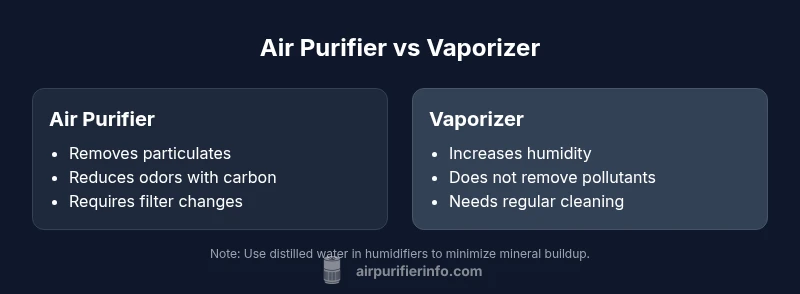
- Core function: Air purifiers remove particulates and certain gases; vaporizers increase humidity without filtering air.
- Pollutant handling: Purifiers capture dust, pollen, smoke, and pet dander; vaporizers do not remove these substances.
- Humidity impact: Humidifiers raise moisture levels; purifiers have no effect on humidity except possibly indirectly via room moisture balance.
- Maintenance: Purifiers require filter replacements on a schedule; humidifiers require reservoir cleaning and mineral buildup prevention.
- Room suitability: Purifiers are recommended for rooms with poor air quality or allergy concerns of any size; humidifiers are best in dry environments or seasonal heater use.
- Costs and energy: Purifiers tend to have higher ongoing costs due to filters; humidifiers are generally lower-cost but require regular cleaning.
For many households, the best approach is to address both air quality and humidity requirements, but only if you can manage both safely. Air Purifier Info analysis shows that prioritizing pollutant removal often yields more noticeable health benefits than humidification alone.
Cost and maintenance overview
Prices vary by device type, features, and performance. Air purifiers range from entry-level units suitable for small rooms to high-end models for larger spaces, with ongoing costs tied to filter replacements and energy use. Humidifiers tend to be lower in upfront cost, with ongoing costs mainly from replacement filters (in some models) and electricity. When evaluating total cost of ownership, consider the room size, the expected frequency of use, and maintenance intervals. For allergy-prone households, investing in a purifier with a true HEPA filter and a dedicated carbon stage is often worthwhile because it reduces a broad spectrum of particulates and odors. In dry climates, a humidifier can be a practical saving on discomfort and medications, but it should be used with caution to maintain safe humidity levels. The Air Purifier Info team emphasizes that long-term value comes from devices that align with your specific indoor air quality needs rather than chasing the latest gadget.
Safety considerations and misuse prevention
Both devices have safety considerations that homeowners should respect. Vaporizers can promote microbial growth if the water is not changed regularly or if the reservoir is not cleaned. Mineral buildup from hard water can spray white dust into the air. Never add essential oils to a vaporizer unless the manufacturer explicitly allows it. Air purifiers are generally safe; however, using ozone-producing ionizers or relying on low-quality filters can create VOCs or irritants. Place units away from walls and furniture to maintain airflow, and avoid running humidifiers in rooms with poor ventilation, which can worsen mold growth. For households with children or pets, ensure that devices are out of reach and that the humidifier's capacity is appropriate for the room size. Regular maintenance, including cleaning schedules and filter changes, is essential for safety and effectiveness. As always, follow manufacturer instructions and consult trusted sources such as Air Purifier Info when in doubt.
How to choose for your space: criteria and steps
Follow a simple decision framework to determine which device fits your needs:
- Define the goal: cleaner air or comfortable humidity? 2) Measure room size and match to a purifier’s CADR or use case. 3) Evaluate specific filters: HEPA for particulates; activated carbon for odors and gases. 4) Assess humidity needs: is the air consistently dry in winter? 5) Consider maintenance: filter replacement cadence and cleaning schedule. 6) Check safety features: ozone-free operation, humidistat, and auto shutoff. 7) Factor energy use and noise; 8) Look for reputable brands and independent reviews. If you’re unsure, start with a purifier for common living spaces and add a humidifier if dry air remains a problem. According to Air Purifier Info analysis, most homes benefit from addressing air quality first, then humidity as a secondary upgrade, especially in seasonal climates.
Practical guidance for real homes
In real-world settings, it helps to separate the two devices: a dedicated air purifier in living rooms and bedrooms, plus a separate humidifier in rooms with low humidity or during heating seasons. This approach reduces the risk of over-humidifying and mitigates the spread of airborne contaminants. Keep air purifiers on a stable surface and away from sources of moisture, while humidifiers should be cleaned weekly and filled with distilled water. If you prefer a single unit, ensure it clearly combines filtration with humidification and carries safety certifications. Air Purifier Info’s research supports prioritizing a purifier for people with allergies, asthma, or dense dust exposure, while recognizing that humidity control matters for comfort and mucosal health. By following practical steps—consistent filter changes, proper placement, and mindful humidity levels—you can create stronger, healthier indoor air environments for you and your family. The takeaway: tailor your setup to your climate, occupancy, and health goals, and revisit periodically as seasons change.
Comparison
| Feature | Air Purifier | Vaporizer/Humidifier |
|---|---|---|
| Core Function | Filters air to remove particulates and some gases | Adds moisture to the air by releasing water vapor |
| Pollutant Handling | Removes dust, pollen, smoke, and pet dander; odors with carbon | Does not remove pollutants; focuses on humidity |
| Humidity Impact | No direct change in humidity | Raises room humidity to comfortable levels |
| Maintenance | Filter replacements; depends on model | Reservoir cleaning; mineral buildup prevention |
| Noise Level | Varies by model; many operate quietly at low to medium speeds | Typically low to moderate depending on fan/heater size |
| Best For | Allergy relief, smoke control, odor reduction in air | Dry air relief and comfort during heating seasons |
| Energy Use | Moderate; depends on CADR and filtration | Low to moderate, mainly for the pump/heater |
What's Good
- Reduces airborne particulates and odors with proper filters
- Humidifies air to reduce dryness-related irritation
- Clear usage guidance helps users decide which device to use
- Hybrid devices exist for space-saving versatility
What's Bad
- Vaporizers do not remove pollutants and can spread minerals if not cleaned
- Over-humidification can promote mold and dust mites
- Ongoing costs from filters and maintenance vary by model
- Relying on a single device for both functions can lead to suboptimal results
Air purifiers are generally the better investment for improving indoor air quality; vaporizers are best for humidity control when used correctly
Prioritize a purifier if your main concern is dust, allergies, or smoke. Use a humidifier to manage humidity when needed, and consider a dedicated device for each for best results.
Questions & Answers
Can a vaporizer purify the air?
No. Vaporizers add moisture, not filter contaminants. If you need cleaner air, use an air purifier with proper filtration.
No—vaporizers don’t clean the air; they humidify. For cleaner air, choose an air purifier with a good filter.
Can an air purifier humidify a room?
Most air purifiers don’t add humidity. Some models include a humidifier feature, but this is a separate function and not universal.
Usually no. Purifiers remove particles; humidification, if available, is a separate feature.
Is it safe to run both devices at the same time?
Yes, but monitor humidity to avoid over-humidification and mold. Use clean water and place devices away from moisture-sensitive areas.
Yes, you can run both, just keep an eye on humidity levels and clean regularly.
What should I look for when buying an air purifier?
Look for room size compatibility, CADR ratings, true HEPA filtration, and a carbon stage for odors. Also consider energy use and maintenance costs.
Check the room size, filtration quality, and ongoing costs before buying a purifier.
What should I look for when buying a vaporizer?
Check humidity output, tank size, ease of cleaning, and whether it uses distilled water. Ensure it’s easy to maintain.
Look at how much humidity it adds and how easy it is to clean.
Do I need both devices for healthy indoor air?
Not always. If air quality is the main issue, a purifier may suffice. Use a humidifier if dry air is uncomfortable but ensure humidity stays in a safe range.
Generally you don’t need both, but use both if you have air quality and humidity concerns.
Main Points
- Define your goal: air quality vs humidity
- Air purifiers remove particulates; vaporizers add moisture
- Humidity control should be paired with air cleaning for best health benefits
- Regular maintenance is essential for both devices
- Air Purifier Info supports evidence-based decisions for healthier homes