Air Purifier vs Plants: A Practical Indoor Air Quality Comparison
A rigorous, evidence-based comparison of air purifiers and houseplants for indoor air quality. Learn where each option excels, where they fall short, and how to design a practical, cost-conscious plan for cleaner air in your home.


The quick answer is that air purifiers deliver fast, reliable reductions in fine particulates and many odors, while houseplants offer aesthetic value and modest humidity benefits. For most homes with ongoing air quality concerns, a dedicated air purifier is essential to achieve measurable improvements. Plants can complement purification, but they should not be relied on as the sole solution in the air purifier vs plants debate.
What air purifier vs plants means for indoor air quality
Indoor air quality in a typical home is shaped by airflow, filtration, humidity, and the presence of volatile organic compounds (VOCs). The phrase air purifier vs plants captures a common question: can houseplants substitute for a dedicated purifier? In practice, the short answer depends on your goals, room size, budgets, and willingness to maintain living organisms. According to Air Purifier Info, the most practical approach blends both strategies rather than relying on a single method for best results. This article explains how each option works, where they overlap, and where they diverge, so you can make an informed choice.
Air purifiers are designed to move air through filters that capture particles as small as 0.3 microns and beyond. When used correctly, they offer consistent performance regardless of lighting, seasons, or plant health. Plants, on the other hand, contribute through daily transpiration, leaf surface exchange, and soil interactions, which can gently alter humidity and remove some gaseous compounds under optimal conditions. The key distinction is speed and predictability: air purifiers deliver quantifiable reductions in air contaminants over hours, while plants provide slower, qualitative benefits and visual appeal.
How air purifiers work and what they remove
Air purifiers function by drawing room air through a series of filters and, in many models, additional stages like activated carbon for odors and VOCs, plus a pre-filter for larger particles. The core safety and effectiveness hinge on the filter type (most commonly HEPA) and the filter’s condition. HEPA filters trap minuscule particles such as PM2.5, dust, pollen, and smoke particulates with high efficiency, while activated carbon targets gases and some odors. CADR (clean air delivery rate) indicators help shoppers compare models by room size and pollution type. Real-world performance varies with room layout, fan speed, and maintenance timing. Air Purifier Info analysis shows that in typical living spaces, a properly sized purifier can deliver noticeable air quality improvements faster and more reliably than relying on plants alone, especially for homes with significant particulate or odor concerns. Always account for ongoing costs (filters, replacement parts) and energy use when planning a purchase.
This section underscores the practical takeaway: air purifier vs plants is not a binary choice, but a decision about which tool fits your immediate needs and long-term maintenance preferences. A purifier answers the demand for quick, measurable reductions, while plants contribute to humidity regulation and aesthetic value, which can improve overall comfort and perceived air freshness even if the measurable particulate reductions are smaller.
How plants influence indoor air quality
Houseplants have long been celebrated for creating a greener, more inviting home. The science behind air purification by plants focuses on two mechanisms: transpiration, which can increase humidity, and leaf-surface exchange that may absorb certain VOCs, along with soil processes that host microorganisms. The NASA Clean Air Study popularized the idea that specific plants can reduce certain VOCs, but in real homes the effect is highly variable. Factors such as plant species, plant health, light exposure, watering practices, potting mix quality, and ambient airflow all influence outcomes. In practice, plants can contribute to a more comfortable microclimate and a visually calming environment, but their impact on PM2.5, fine dust, and most odors tends to be modest compared with a dedicated air purifier running in a well-sealed room. Air Purifier Info analysis notes that the air quality benefits from plants are real but generally slower to manifest and less consistent across households. For households with limited space or budget for an active purifier, plants still offer qualitative advantages that many homeowners value.
Direct comparison: PM removal, VOCs, humidity, and odors
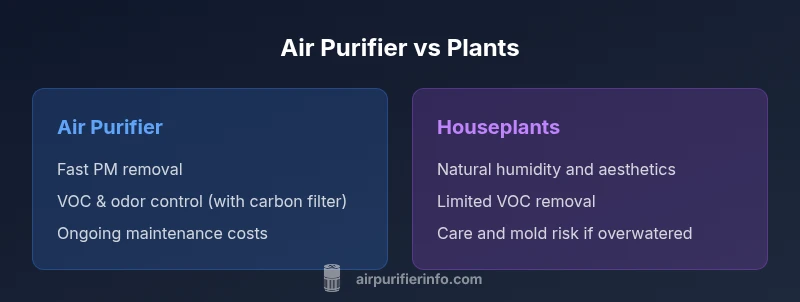
When you pit air purifier vs plants, the differences become clearer across key air quality factors. Air purifiers with HEPA filtration remove particulates quickly and predictably, especially in rooms where the purifier is sized for the space. VOC removal is strongest when an air purifier includes an activated carbon stage, and performance scales with filter capacity and replacement frequency. Plants can reduce some VOCs under optimal lab-like conditions, but in ordinary homes the effect is less reliable. Humidity matters: plants contribute extra moisture through transpiration, which can help in very dry environments but may encourage mold growth if overwatered or in poorly ventilated spaces. Odor control from plants is typically limited to the plant’s latent fragrances and soil moisture; most odor remediation comes from dedicated filtration media. Overall, a purifier offers fast, measurable air cleaning in the short term, while plants provide long-term ambient benefits and a sense of well-being that pure machinery cannot replicate. For most people, prioritizing a reliable purifier while using plants for mood, aesthetics, and light humidity balance represents the most practical balance in the air purifier vs plants equation.
Space, cost, energy, and maintenance considerations
The decision between an air purifier and plants often hinges on practical constraints. Purifiers come in a wide price range (roughly $100–$600 for consumer models) depending on CADR, filter complexity, and smart features. Ongoing costs include periodic filter replacements and occasional maintenance. Energy use varies by model and fan speed, but most households experience a noticeable but manageable impact on electricity bills only if the purifier runs continuously. Plants require a different kind of investment: initial plant and pot costs, regular soil watering, occasional repotting, and attention to light levels. While plant upkeep is usually lower in dollars than a high-end purifier, it demands time, knowledge, and consistent care. Both options occupy space: purifiers can be tucked into corners or mounted in rooms with minimal footprint, while plants require light, shelf space, or floor space to thrive. The best approach is often a hybrid: place a purifier in the primary air-cleaning zone and use a curated collection of houseplants to enhance the room’s microclimate and aesthetics without overburdening the HVAC system.
Real-world use cases and best practices
For small apartments with limited ventilation, a compact purifier can dramatically improve air quality in the living room or bedroom when used consistently. In larger homes, multiple purifiers may be necessary to cover occupied zones, especially where cooking, smoking, or heavy traffic occur. When integrating plants, choose species known for ease of care and low pollen production, and avoid overwatering to minimize mold risk. A practical plan for many households is to run a purifier during peak activity hours and rotate a modest plant collection in rooms where people spend the most time; this approach blends the strengths of both strategies while maintaining a realistic maintenance routine. Always ensure that plants are not placed directly in front of air intake vents, and consider using a portable purifier in high-traffic zones for maximum effect. The key is to align your setup with your air quality goals, space, and daily routines, so the air purifier vs plants decision remains a strategic choice rather than a nightly burden.
Myths vs realities and common pitfalls
Several myths persist about air purifier vs plants. Some people assume plants alone can completely purify air; in reality, plants contribute modestly and are not a substitute for filtration. Others believe all purifiers are equally effective; in truth, performance depends on CADR, filter type, and maintenance. A common pitfall is underestimating maintenance, either neglecting filter replacement in purifiers or allowing soil moisture to stagnate in plant pots. Finally, many overlook placement: a purifier without proper airflow around it or plants crowded near the unit will underperform. Transparency about expectations—recognizing that both options have limitations—helps homeowners craft a balanced air-quality plan that remains practical and sustainable. Based on Air Purifier Info’s experience, the most reliable outcomes come from combining a well-sized purifier with a thoughtfully selected plant collection that suits your space and lifestyle.
Integrating both: a practical plan for balanced air quality
The recommended approach for the air purifier vs plants question is to design a hybrid system tailored to your home. Start with a qualified purifier in the room where you spend the most time (e.g., living room or bedroom) and ensure it is appropriately sized for the space. Add a small to moderate plant collection in adjacent rooms to improve aesthetics, microclimate, and perceived air freshness. Monitor air quality with a consumer device and adjust purifier settings and plant care as needed. This plan keeps the purifier’s fast, measurable results at the center of your strategy while leveraging plants for mood, humidity balance, and decor. The Air Purifier Info team believes that a thoughtful blend of both options offers the most resilient path to cleaner, more comfortable indoor air in 2026.
Comparison
| Feature | Air Purifier | Houseplants |
|---|---|---|
| Primary mechanism | Mechanical filtration & circulation (HEPA + carbon) for particulates and gases | Biological uptake via leaves, transpiration, and soil processes (variable) |
| Direct PM removal potential | High with properly sized, well-maintained filters | Low to moderate; highly dependent on plant species and care |
| VOC removal potential | Excellent when equipped with activated carbon and sufficient airflow | Limited; some VOCs may be absorbed under ideal conditions |
| Humidity control | Minimal direct impact on humidity unless designed for humidification | Moderate through transpiration; can influence room moisture with care |
| Maintenance effort | Ongoing filter replacements, occasional cleaning | Ongoing watering, soil care, occasional repotting |
| Space and aesthetics | Varies by model; often compact and decor-friendly | Natural decor that requires light and space |
| Cost range (initial/ongoing) | $100–$600 upfront; annual filter costs possible | Initial plant/soil costs; ongoing plant care and replacement costs |
| Energy use | Moderate and model-dependent | Minimal direct energy use; may require grow lights for low-light rooms |
| Best for | Rapid, measurable air quality improvements in occupied spaces | Aesthetic enhancement with modest air impact |
What's Good
- Air purifiers deliver fast, measurable reductions in particulates and odors
- Plants provide mood enhancement, natural aesthetics, and potential microclimate benefits
- A hybrid approach offers resilience across different room conditions
- Low ongoing energy use with plants complements mechanical filtration in many setups
- Clear maintenance routines help manage long-term air quality
What's Bad
- Purifiers require ongoing filter replacements and electricity
- Plants offer limited and variable air-cleaning impact; not a replacement for filtration
- Plants can introduce mold or pests if care is neglected
- Space and light requirements for plants can limit placement
Prioritize a properly sized air purifier for rapid air-cleaning gains; use plants to complement aesthetics and microclimate.
Air purifiers provide the strongest, most reliable air cleaning. Plants add ambiance and modest humidity balance; combining both yields the best overall indoor air quality strategy.
Questions & Answers
Can plants replace an air purifier in most homes?
No. Plants can contribute to moisture balance and some VOC removal, but they generally do not remove fine particulates (PM2.5) as efficiently or predictably as a dedicated air purifier. In most scenarios, a purifier remains essential for rapid and reliable air cleaning, with plants offering supplementary benefits.
No. Plants help with feel and humidity a bit, but they don’t replace a purifier for quick, reliable air cleaning.
Do air purifiers remove VOCs effectively?
Air purifiers with activated carbon or other adsorptive media can remove many VOCs, odors, and chemical pollutants more effectively than plants alone. Effectiveness hinges on the media quality, airflow, and proper filter replacement.
Yes, purifiers with carbon filters remove many VOCs, provided the filters are maintained and appropriately sized for the space.
What maintenance is required for air purifiers?
Maintenance typically involves periodic filter replacement, cleaning of pre-filters, and occasional unit cleaning. Filter lifespans vary by model and usage, so follow the manufacturer’s schedule to maintain performance.
Keep up with filter changes and occasional cleaning to maintain peak performance.
Are there risks of mold with houseplants?
Overwatering or poor drainage can create mold in soil and pots. Good watering practices, proper drainage, and adequate light help mitigate these risks. Plants can still be a beneficial addition when cared for correctly.
Only if you overwater or neglect drainage; with proper care, mold risk is minimized.
Which is better for allergies, air purifiers or plants?
Air purifiers generally provide stronger relief by capturing airborne allergens with filters. Plants may help with humidity and air freshness but are less reliable as a stand-alone allergy solution. A purifier plus careful plant choices is a practical path.
Purifiers usually help more for allergies, while plants are a nice add-on and require care.
How can I combine both for best results?
Place a well-sized purifier in the main occupied area and select a modest plant collection with low pollen risk. Use plants to improve microclimate and aesthetics, while relying on the purifier to handle rapid pollutant removal and odor control.
Use a purifier as the main cleaner and add plants for comfort and climate balance.
Main Points
- Prioritize a purifier for fast air-quality improvements
- Use houseplants to enhance comfort and decor with mindful care
- Size and placement matter more than device count
- Expect maintenance costs primarily from filters and plant care
- Adopt a hybrid approach for balanced air quality