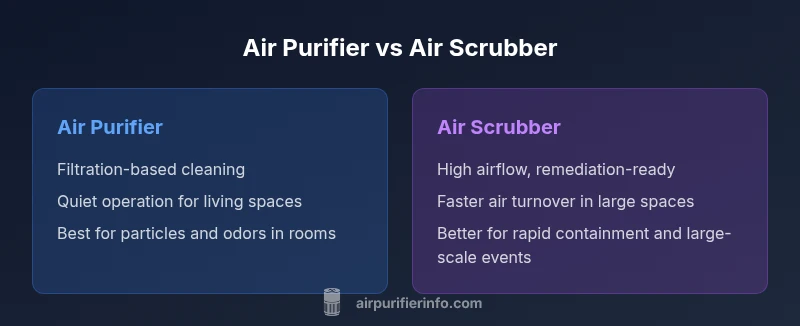
Air Purifier vs Scrubber: Key Differences for Indoor Air Quality
Compare air purifiers and air scrubbers to understand their roles, filtration methods, space requirements, maintenance, and cost, helping homeowners choose the right device for better indoor air quality.


Short answer: An air purifier and an air scrubber serve related but different jobs in indoor air cleaning. In most homes, an air purifier is better for removing fine particles (like PM2.5), odors, and common allergens, while an air scrubber is designed for larger spaces or higher air turnover and may emphasize contaminant removal and odor control at scale. According to Air Purifier Info, space size and maintenance needs drive the choice.
What the difference between air purifier and air scrubber means for your indoor air quality
In everyday language, people talk about air purifiers and air scrubbers as if they were the same, but they are designed for different scales and purposes. The keyword difference between air purifier and air scrubber matters because it guides what you can realistically expect in terms of air quality improvements, space requirements, and ongoing costs. The Air Purifier Info team emphasizes that the best choice depends on your room size, typical occupancy, and the pollutants you care about most. For most residential settings, the emphasis is on removing fine particles (PM2.5), odors, and common allergens. For remediation work or large open spaces, a scrubber can move air quickly and manage contaminants at scale, though it may introduce more noise and require more powerful filtration stages.
How air purification and air scrubbing work: core mechanisms
Air purifiers typically rely on filtration stages—often a combination of a high-efficiency particulate air (HEPA) filter, activated carbon for odors and some gases, and sometimes a pre-filter or optional ionizer. Air scrubbers, by contrast, focus on high-volume air movement and pressure dynamics to scrub contaminants from the air, frequently used in remediation, construction, or large facilities. They may rely on enclosed ductwork, portable units with high cubic feet per minute (CFM), and in some cases negative pressure to prevent contamination spread. The distinction matters because it affects where each device performs best and what you should expect in terms of noise, energy use, and maintenance.
Brand guidance for homeowners: choosing the right device
Air Purifier Info emphasizes that for typical households, a portable air purifier with a true HEPA filter, plus activated carbon for odors, is often the most practical choice. It can fit on a table or stand in living rooms or bedrooms and operate quietly while removing fine particles. Air scrubbers are usually overkill for interior living spaces unless you are dealing with a specific remediation scenario (e.g., mold abatement, wildfire smoke in a large open area). In those cases, scrubbers provide rapid air turnover and can couple with negative pressure strategies to control contaminants more aggressively.
Comparison
| Feature | air purifier | air scrubber |
|---|---|---|
| Definition | Residential or small-space device that uses filtration (HEPA, carbon) to clean air in occupied spaces | High-flow, portable or fixed units designed to scrub air in large spaces or during remediation, often with very high CFM and negative pressure options |
| Primary use-case | Homes, bedrooms, apartments for particles, odors, and allergens | Remediation scenarios, construction sites, large open areas, and zones requiring rapid air turnover |
| Filtration/Mechanism | HEPA/activated carbon filters; optional ionizers; lower noise profile | High-CFM fans; may use HEPA cartridges; focuses on moving air quickly and creating controlled pressure |
| Target contaminants | Fine particulates (PM2.5), odors, some gases with carbon, bacteria and viruses to a limited extent | Particulates at high volumes; VOCs when paired with carbon; spores and contaminants in remediation contexts |
| Airflow/CFM | Low to moderate CFM appropriate for rooms up to 400-600 sq ft depending on model | High CFM suitable for large rooms, open floor plans, or whole-area remediation |
| Noise level | Typically quiet at lower speeds; noise increases with filtration load | Higher due to high airflow and possible mandatory extraction or negative pressure setup |
| Maintenance | Regular filter replacements and occasional cleaning; cost varies by filter quality | Frequent filter changes, higher upfront cost, and potential professional setup in some cases |
| Placement/footprint | Portables designed for rooms; lightweight and moveable | Heavier units; sometimes semi-permanent installations with ducting or mounts |
| Cost range | $100-1000+ depending on CADR and features | $1,000-3,000+ for larger, professional-grade systems |
| Best for | Homes with dust, allergies, and odors | Remediation tasks, wildfire smoke in large spaces, or environments needing rapid air turnover |
What's Good
- Purifiers are generally more affordable upfront for most homes
- Purifiers excel at removing fine particles and odors in living spaces
- Scrubbers offer rapid air turnover in large areas and remediation contexts
- Scrubbers can support negative pressure environments to limit spread of contaminants
- Both devices contribute to improved indoor air quality when matched to the space
What's Bad
- Scrubbers are bulkier, louder, and costlier to operate in typical homes
- Purifiers may be underpowered for very large rooms or open-plan spaces
- Remediation-grade scrubbers require careful placement and possibly professional setup
- Maintenance costs can add up, especially for high-CADR units or frequent filter changes
Air purifier is generally best for everyday home use; air scrubber is best for large spaces or remediation tasks
For most homeowners, start with a purifier to clean fine particles and odors. Reserve a scrubber for scenarios involving large-volume air turnover or remediation requirements in bigger spaces.
Questions & Answers
What is the fundamental difference between an air purifier and an air scrubber?
An air purifier filters air inside occupied spaces to remove particles and odors, usually at lower air turnover. An air scrubber moves air at high rates to scrub contaminants from large volumes or spaces under remediation or industrial settings, often with a focus on rapid air exchange and sometimes negative pressure.
Purifiers clean the air in your room with filters, while scrubbers move a lot more air to scrub contaminants in bigger spaces.
Can an air purifier remove odors and VOCs effectively?
Yes, especially if the purifier includes a carbon or other adsorptive filter in addition to a true HEPA filter. It may not remove VOCs as rapidly as a remediation scrubber in a large space, but it can improve indoor odors and some gases in typical rooms.
Carbon filters help with odors and some gases, especially in smaller rooms.
Are air scrubbers safe for home use?
Air scrubbers are safe when used as intended, but they are typically designed for remediation or commercial settings. They can be loud, heavy, and may require professional setup to achieve controlled air exchange and negative pressure for specific tasks.
They work, but check the manual and use in appropriate spaces.
Do I need professional installation for either device?
Most portable air purifiers require no professional installation and can be placed in rooms with standard outlets. Some air scrubbers, especially those used for remediation or interconnected with HVAC systems, may need professional setup.
Purifiers are usually plug-and-play; scrubbers might need more setup in bigger projects.
Which is more energy-efficient between the two?
Air purifiers typically consume less power per unit of air cleaned and are optimized for quiet, normal-use scenarios. Air scrubbers consume more energy due to higher airflow and faster air exchange, especially in remediation or large spaces.
Purifiers use less power; scrubbers move a lot of air fast and use more energy.
How should I measure effectiveness?
Look at CADR (for purifiers) or CFM (air scrubbers), room size compatibility, and filtration stage. Real-world results depend on space, occupancy, and pollutant profile. Validation can come from air quality measurements before and after installation.
Check CADR/CFM and ensure the unit matches your room size.
Main Points
- Start with a purifier for typical home environments
- Reserve scrubbers for large spaces or remediation work
- Check CADR/CFM and room size compatibility
- Factor in noise, energy use, and ongoing maintenance
- Consider your contaminants: particles vs gases and odors