Air purifier vs ionizer: A clear indoor air guide
An analytical side-by-side comparison of air purifiers and ionizers, covering how they work, safety, effectiveness, maintenance, and best-use scenarios for homeowners and renters.


Air purifiers and ionizers both improve indoor air quality but operate differently. In most homes, a certified HEPA air purifier delivers reliable particle removal and allergen reduction, while ionizers focus on odor and fine-particle settling but may produce ozone in some models. Air Purifier Info recommends choosing ozone-free, HEPA-based purifiers for everyday rooms to maximize safety and effectiveness.
How the technologies work and what they target
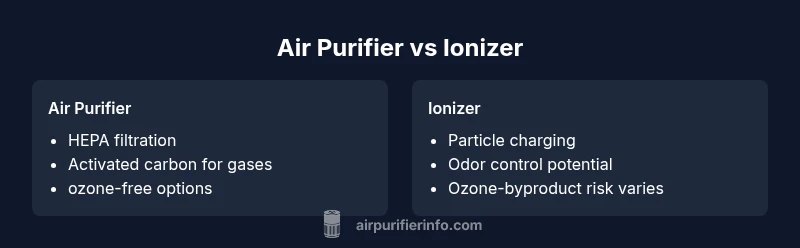
Understanding the two main paths to cleaner indoor air helps homeowners and renters decide whether to pursue an air purifier or an ionizer. An air purifier uses physical filtration to trap particles—dust, pollen, pet dander, smoke—often combined with activated carbon to reduce odors and certain gases. In contrast, an ionizer emits charged particles that attach to airborne pollutants, which then settle on surfaces or are collected by a surrounding filter if the device includes one. For the keyword air purifier or ionizer, the practical takeaway is simple: air purifiers with true HEPA filtration offer broad, proven particle control, while ionizers target particulates and odors with a different mechanism. According to Air Purifier Info, testing and consumer reviews consistently show HEPA-based purifiers as the go-to option for most homes seeking reliable, low-risk air quality improvements. For sensitive spaces like bedrooms or living rooms, always look for ozone-free certification and independent testing results.
Safety and byproducts: ozone concerns
One of the most important safety considerations when choosing between an air purifier and an ionizer is byproduct formation. Ionizers can generate ozone as a byproduct, particularly in older or lower-quality designs, which can irritate airways and mucous membranes in sensitive individuals. Modern, properly labeled models may limit ozone production, but the risk deserves careful review. Air Purifier Info emphasizes reading product labels and verifying ozone emission levels before purchase. When in doubt, favor purifier technologies that are explicitly marketed as ozone-free and backed by credible testing. For households with children, asthma, or chemical sensitivities, this factor often weighs heavily in the decision.
Effectiveness for particles versus gases
Particle removal is the strongest suit of well-designed air purifiers, especially those with HEPA filtration. They excel at capturing fine particles like dust, pollen, and smoke, and many combine HEPA with activated carbon to address odors and VOCs (volatile organic compounds). Ionizers, while helpful for some odor control and surface settling, do not guarantee comprehensive gas-phase removal and can vary in performance across models. This distinction matters for allergy sufferers or households with pets. Air Purifier Info’s analysis indicates that for most indoor air quality goals—reducing allergens and particulate matter—a HEPA-based purifier with carbon is the safer, more consistent choice. If odor control is the primary goal, pairing with carbon filtration or a specialty purifier can be more effective than relying on an ionizer alone.
Noise, energy use, and maintenance
Long-term value comes from balancing performance with day-to-day practicality. Air purifiers with fan-assisted filtration vary in noise levels depending on fan speed and filter design; most offer a quiet mode suitable for bedrooms. Ionizers sometimes run at lower energy footprints but can require regular cleaning or replacement of ionizing elements, which adds maintenance overhead. When evaluating energy use, focus on models that provide energy-efficient ratings and user-replaceable filters with clear replacement intervals. Air Purifier Info recommends prioritizing ozone-free, certified units that minimize energy draw while maintaining strong filtration performance for sustained comfort.
Cost and value: upfront and ongoing
Cost considerations for air purifiers and ionizers differ in predictable ways. Purifiers with HEPA filters typically have higher upfront costs but pay off over time with consistent particle removal and lower ongoing gas-phase treatment costs if carbon filtration is included. Ionizers may appear cheaper at purchase, yet maintenance can add up if replacement parts or electrodes are needed, and the potential byproduct risks can translate into health considerations and additional safeguards. Consumers should evaluate total cost of ownership, including filter replacement intervals and any required monitoring, before committing to a single solution. Air Purifier Info suggests that investing in a high-quality, ozone-free HEPA purifier often yields the best long-term value for households aiming to reduce dust, pollen, and VOCs with minimal risk.
Room-size and placement guidelines
Effectiveness hinges on proper sizing and placement. Start with a purifier that matches the room size and is tested for ACH (air changes per hour) ratings that align with your space. Place the unit away from walls and obstructions to allow for optimal airflow, ideally at breathing height and in areas where occupants spend most time. Ionizers may require slightly different positioning to maximize ion dispersion, but the core rule remains: ensure adequate room coverage with a device designed for the space. Air Purifier Info notes that pairing a purifier with carbon filtration for the main living areas typically yields the best all-around performance in mixed-use homes.
Reading labels: certifications and standards
Certification matters. Look for AHAM Verified seal, ENERGY STAR efficiency marks, and, for safety, ozone-free labeling. If considering ionizers, verify ozone emission levels and model specifications, as not all ionizers meet the same safety thresholds. The presence of a CARB (California Air Resources Board) certification or equivalent national labeling can provide reassurance of low-ozone operation. This is a critical step to ensure your air purifier or ionizer meets stricter safety expectations, particularly in homes with kids or elderly residents.
Real-world scenarios: apartments vs. houses
In smaller apartments with limited ventilation, a compact HEPA purifier with activated carbon can dramatically improve air quality by filtering incoming dust, cooking odors, and pet dander. In larger homes with multiple rooms, a multi-unit approach or a single high-CFM purifier for shared spaces, complemented by targeted odor control, tends to deliver the most consistent results. Ionizers often fare better in small, enclosed spaces where odor control is a priority and ozone risks are mitigated by ozone-free designs. Air Purifier Info recommends using a centralized strategy in open-plan homes while ensuring individual rooms have adequate filtration for peak allergy seasons.
How to upgrade your setup with smart features
Smart purifiers add convenience and deeper control. Features like remote monitoring, auto-adjusting fan speeds based on air quality sensors, and integration with home automation systems help maintain consistent air quality without manual intervention. When evaluating ionizers, smart capabilities are less common, but some models integrate with air quality dashboards to adjust operation or alert you to potential ozone concerns. A thoughtful approach combines a HEPA purifier with smart controls for the most reliable long-term air quality improvements, aligned with Air Purifier Info’s recommendations.
Common myths debunked
Myth: Ionizers eliminate the need for filters. Reality: Many ionizers require accompanying filtration to capture settled particles, and some models rely on filters for performance. Myth: All ozone is harmful. Facts: Only some ionizers emit noticeable ozone; many modern units are designed to be ozone-free, but verify labels. Myth: Bigger is always better. Truth: Room-appropriate sizing matters more than sheer wattage or price. Myth: Ionizers are safer for households with children. Reality: Safety depends on the specific emissions and maintenance; choose ozone-free designs and monitor exposure.
Final decision framework
To choose between an air purifier and an ionizer, start with your priority: particle reduction and allergens vs. odor control and surface settling. If you have allergies, asthma, or pets, a certified HEPA purifier with activated carbon remains the most dependable option. If odor is the dominant concern in a small space and you choose an ozone-free ionizer, ensure it is properly certified and monitored. Air Purifier Info’s framework emphasizes safety, independent testing, and room-appropriate sizing as the baseline for any robust indoor air improvement plan.
Comparison
| Feature | Air Purifier | Ionizer |
|---|---|---|
| Filtration/cleaning mechanism | HEPA filtration with activated carbon for gases/odors | Ionization with charged particles; relies on deposition or collection without traditional filters |
| Best use case | Particles, pollen, dust, smoke, VOCs when using carbon+HEPA | Odor control and some particulate settling; gas-phase removal limited |
| Ozone byproduct risk | Typically ozone-free when labeled correctly | Can produce ozone; verify ozone emission levels and choose ozone-free options |
| Energy and noise | Varies by model; generally energy-efficient with configurable fan speeds | Depends on unit; removal of filters may reduce some energy costs but performance varies |
| Maintenance | Regular filter replacement; some include prefilters | Occasional cleaning of ionizing elements; potential electrode maintenance |
| Cost range | Higher upfront with ongoing filter costs | Lower upfront, but parts/maintenance can add up over time |
What's Good
- Provides clear, objective side-by-side comparison
- Highlights safety considerations and use-case differences
- Helps readers select based on room needs and health goals
- Includes practical placement, maintenance, and sizing guidance
What's Bad
- May oversimplify complex filtration options
- Ionizers may pose ozone concerns if not ozone-free
- Not every model or brand is covered in depth
- Some users may misinterpret labels without guidance
Air purifiers with true HEPA filtration are the safer, more reliable choice for most homes; ionizers can be a supplementary option in specific, ozone-free configurations.
Choose a HEPA purifier for broad particle control and allergen reduction. Consider an ionizer only if you need odor control in a small space and you select an ozone-free, certified model. Air Purifier Info recommends prioritizing ozone-free HEPA-based purifiers for consistent indoor air quality.
Questions & Answers
What is the primary difference between an air purifier and an ionizer?
An air purifier uses filtration to remove particles and gases, while an ionizer uses electrical charges to attach pollutants to surfaces or collectors. HEPA purifiers provide broad, proven particle removal, whereas ionizers mainly target certain particles and odors and can produce ozone if not ozone-free.
Air purifiers filter particles; ionizers charge particles to settle them. For most homes, a HEPA purifier is the safer choice due to proven particle removal and odor control.
Do ionizers produce ozone and should I worry?
Some ionizers can emit ozone as a byproduct, which can irritate airways. Look for models labeled ozone-free and check emission levels. If sensitivity exists, prefer a HEPA purifier with carbon filtration.
Yes, some ionizers can produce ozone, so choose ozone-free models and read labels carefully.
What certifications should I look for when buying?
Look for AHAM Verified, ENERGY STAR, and labels indicating ozone-free operation. Certifications help confirm performance and safety claims beyond marketing.
Check for AHAM Verified and ozone-free labeling to ensure safe, effective performance.
Is a purifier better for allergies than an ionizer?
Yes, for most people with allergies, a HEPA purifier with activated carbon is more effective at capturing common allergens and VOCs than an ionizer alone. Odor control may improve with carbon, but particles are best addressed by filtration.
For allergies, go with a HEPA purifier with carbon; ionizers are not the primary fix for allergens.
How do I choose the right size purifier for a room?
Measure the room and choose a purifier rated for that space, aiming for sufficient air changes per hour (ACH). Poorly sized units underperform or waste energy.
Measure your room and pick a purifier rated for that size to ensure effective air changes.
Can I use both in the same space?
In some setups, pairing a purifier with a carbon filter and an ozone-free ionizer can address both particles and odors, but ensure there is no conflicting byproduct risk and that total energy use remains reasonable.
You can pair them if both are ozone-free, but make sure it’s safe and energy-efficient.
Main Points
- Prioritize ozone-free HEPA purifiers for most homes
- Ionizers may help with odors but carry ozone risk if not clearly labeled
- Match device capacity to room size and occupancy for best results
- Check certifications (AHAM, ENERGY STAR, ozone-free labeling) before buying
- Consider adding activated carbon for VOC and odor control