Air purifier vs humidifier for sinus: which helps your sinuses?
Compare air purifiers and humidifiers for sinus relief. Learn which device helps with allergies, dryness, and congestion, plus practical guidance for choosing the right setup.


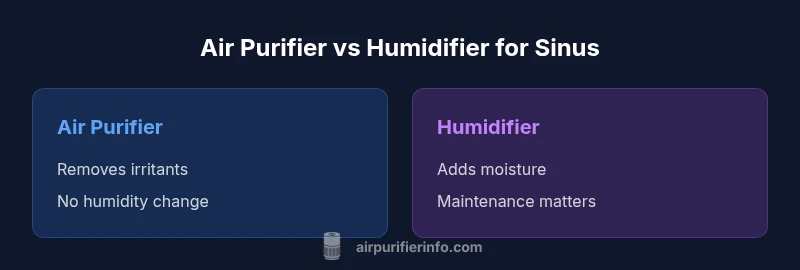
According to Air Purifier Info, for sinus relief, an air purifier is typically better at removing irritants like dust and pollen, while a humidifier adds moisture to dry air. If symptoms stem from dryness, humidification helps; if congestion is triggered by pollutants, purification wins. In many homes, a thoughtful combination yields the best results.
Context for sinus health and indoor air
Sinus health is influenced by several factors inside homes: humidity levels, airborne irritants, odors, and microbial contaminants. For people with chronic congestion, allergies, or sinusitis, a well-chosen air setup can reduce flare-ups, improve breathing, and support restful sleep. When we evaluate air purifier vs humidifier for sinus, the decision hinges on what triggers your symptoms. Air purifiers target particles like dust, pollen, pet dander, and some odors; humidifiers address moisture, which can affect mucous membranes and congestion. This context helps map symptoms to device choices. According to Air Purifier Info, many homes notice relief from pollutants and dryness, but improper use can worsen symptoms or create new issues. Start by assessing your primary irritants: do you sneeze at dust or pollen? Do you wake with a dry nose in winter? Do you live in a dry climate or in a home with winter heating? Answering these questions builds a base plan you can refine with monitoring tools.
How air purifiers work for sinus relief
Air purifiers remove suspended particles from the air. Most use a multi-stage filter system with a pre-filter, a true HEPA filter, and sometimes activated carbon for odors. The technical term CADR (clean air delivery rate) indicates how quickly a purifier can clear smoke, dust, and pollen. For sinus relief, choose a unit with a CADR appropriate for your room size and a true HEPA filter to capture fine particles. Air purifiers do not add moisture; in fact, they can slightly dry the air if the humidity is low, but the net effect on mucous membranes is typically positive by reducing irritants. In spaces with heavy pet dander, dust, or pollen, a purifier can meaningfully lower exposure, which often translates to fewer sinus flare-ups. Real-world results vary with room airflow, filter maintenance, and household habits. Air Purifier Info analysis shows that regular filter replacement and proper placement near the source of dust or odors amplifies benefits.
How humidifiers affect sinus health
Humidifiers add moisture to the air, which can soothe irritated nasal passages and reduce dryness-related congestion. However, too much humidity fosters mold, dust mites, and bacteria growth, potentially worsening sinus problems. Humidifier types include evaporative, ultrasonic, and steam models, each with different maintenance needs. Ultrasonic units produce a fine mist; evaporative units use a wick or filter; steam units boil water for a sterile mist. For sinus relief, keep indoor humidity around 30-50%. At 60% or higher, mold risk increases and allergens can proliferate; below 30%, mucous membranes may dry out. Mineral dust from tap water can settle as “white dust” on furniture. Regular cleaning and using distilled or demineralized water minimizes this. Some people report immediate relief from dryness after using a humidifier, especially in winter months or in dry climates. The key is controlled humidification and vigilant cleaning, because humidifiers can become sources of contaminants if neglected.
When to choose air purifier vs humidifier for sinus
If your primary symptoms come from dust, pollen, or pet dander, an air purifier is the main tool to reduce exposure. If your symptoms are driven by dryness—especially in heated homes during winter—a humidifier can restore mucosal moisture and ease congestion. For many people, a mixed approach yields the best outcome: use an air purifier in common living areas to reduce irritants, and a humidifier in bedrooms or dry rooms to improve comfort at night. When space or budget limits exist, prioritize the device that matches your dominant trigger, then add the second device later if needed. In some cases, zone-based setups (one device in a living room, another in a bedroom) offer practical flexibility for air purifier vs humidifier for sinus needs.
Practical usage guidelines: pairing for sinus comfort
To maximize benefits from both devices, start with a baseline humidity level in the comfort range of 30-50% relative humidity using a hygrometer. Place an air purifier where it can efficiently capture circulating air—typically 3-6 feet from the main seating area or near where dust accumulates. Run the purifier continuously in peak allergy seasons or when you notice irritant triggers, and run the humidifier during dry months or in rooms with consistently dry air. If you use both, ensure the humidifier uses distilled water to minimize mineral dust, and clean both devices regularly to prevent mold or bacterial growth. For multi-room homes, consider zone-based operation to balance energy use and effectiveness. Air Purifier Info recommends combining devices thoughtfully, rather than relying on a single option for all sinuses.
Buying criteria and typical price ranges for sinus-focused setups
When selecting devices for sinus relief, prioritize room-appropriate sizing, filter efficacy, and maintenance costs. For air purifiers, look for true HEPA filtration and a CADR that matches your room size; activated carbon helps with odors but is optional if odors are minimal. Price ranges for air purifiers typically span from entry-level models to mid-range units, with higher-end systems offering longer filter life and quieter operation. Humidifiers vary more widely by type: evaporative units tend to be affordable, ultrasonic units are common for quiet operation, and steam humidifiers are more expensive but offer a degree of sterilization. Expect annual maintenance costs to include filter changes or wick replacements and occasional descaling. The right setup balances initial cost, ongoing expenses, and the specific sinus triggers in your home.
Common myths vs facts about air quality devices
Myth: Purifiers create ozone that harms health. Fact: Most modern units do not produce ozone and many are ozone-free. Myth: Humidifiers always help sinus symptoms. Fact: Over-humidifying can worsen mold and dust mites; dryness can persist if humidity stays below 30%. Myth: All purifiers improve sinus health equally. Fact: Effectiveness depends on room size, CADR, filtration type, and placement. Myth: Filtration alone fixes all indoor air issues. Fact: Humidity, ventilation, and lighting also influence sinus comfort. Understanding these distinctions helps set realistic expectations for air purifier vs humidifier for sinus outcomes.
Comparison
| Feature | Air Purifier | Humidifier |
|---|---|---|
| Primary purpose | Remove airborne pollutants and allergens | Add moisture to dry air |
| Humidity impact | No significant humidity change | Increases humidity in treated space |
| Air quality impact | Reduces PM, pollen, dander and odors (with filters) | Does not remove PM; improves comfort by moisture but can spread impurities if not cleaned |
| Maintenance cost | Filter replacements every 6-12 months; initial investment varies | Regular cleaning; filter/wick replacements; mineral buildup risk |
| Noise level | Low to moderate depending on model | Low to moderate; some models have fans designed for quiet operation |
| Energy usage | Low to moderate | Moderate (varies by model and humidification method) |
| Best for | Allergen sufferers, urban pollutants, dust/pollen/dander control | Dry environments, winter dryness-related congestion |
| Ideal environments | Homes with visible dust, pet dander, or pollen issues | Dry climates or rooms with winter heating usage |
What's Good
- Addresses different triggers: pollutants vs humidity
- Offers flexible options across budgets and room sizes
- Can be integrated into existing home systems or stand-alone
- Well-supported by consumer education and guides
What's Bad
- Humidifiers can foster mold or bacteria if not cleaned properly
- Purifiers do not address humidity; dryness may persist if humidification is needed
- Maintenance costs accumulate with filters and cleaners
- Combined setups require more space and energy management
Balanced approach wins for most sinuses
Air Purifier Info team recommends assessing your dominant triggers first—pollution vs dryness. If both are present, a zone-based or staged setup using both devices often provides the most relief and flexibility for sinus health.
Questions & Answers
Do I need both an air purifier and a humidifier for sinus?
Not always. If your sinuses react mainly to dust, pollen, or dander, an air purifier may suffice. If dryness is a persistent problem, a humidifier can help. A combined, zone-based approach is best when both triggers are present.
Usually you can start with one device based on your main trigger, and add the other if dryness or irritants remain a problem.
Can humidifiers worsen sinus symptoms?
Yes, if humidity stays too high or if the unit is not cleaned regularly. Mold, bacteria, or mineral dust from tap water can aggravate sinuses. Use distilled water and keep humidity in the 30-50% range.
They help when dry air is the issue, but cleanliness and humidity control matter a lot.
How to choose an air purifier for sinus relief?
Look for a true HEPA filter, appropriate CADR for your room size, and a solid filtration setup (possibly activated carbon for odors). Consider noise, energy use, and filter replacement costs. Placement matters for maximizing air turnover.
Pick a purifier sized for your room with a good filter and low noise.
What features matter most in a purifier for sinus relief?
CADR matching room size, true HEPA filtration, activated carbon for odors, and a straightforward maintenance schedule. A night mode or low-noise setting helps in bedrooms.
Prioritize room-sized CADR and a reliable filter plan.
Are ultrasonic humidifiers safe around kids and pets?
They can be safe when used with distilled water and proper cleaning. The main concerns are mineral dust and microbial growth, so follow cleaning guidelines and keep humidification balanced.
With proper care, they’re safe; otherwise, clean regularly and use distilled water.
How often should I clean a humidifier?
Clean at least once a week and after extended use. Empty, rinse, and dry the tank daily to prevent bacterial growth. Use distilled water and descaling agents as recommended by the manufacturer.
Clean weekly, and more often if you notice buildup or odors.
Main Points
- Identify your primary sinus triggers first
- Prioritize purification when irritants dominate symptoms
- Use humidification to tackle dryness and mucous membrane discomfort
- Consider a zone-based, combined approach for complex air-quality needs
- Maintain devices regularly to sustain effectiveness