Air purifier or humidifier for congestion: a practical comparison
A thorough, evidence-based comparison of air purifiers and humidifiers for congestion relief, with guidance on when to use each and how to combine them for clearer air and easier breathing.


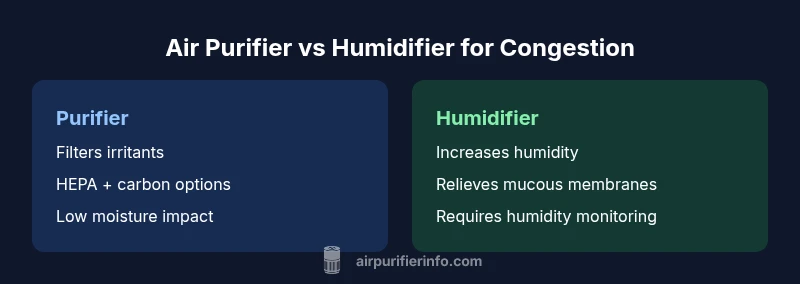
Air purifiers and humidifiers address congestion differently, and the best choice depends on your symptoms and home environment. In most cases, a purifier reduces irritants in the air, while a humidifier adds moisture to relieve nasal and throat dryness. This guide compares their roles and helps you decide whether to use one, or both, for congestion relief.
Congestion relief: framing the choice between a air purifier or humidifier for congestion
Nasal congestion can stem from dry air, allergens, dust, and indoor pollutants. The question of whether to rely on an air purifier or a humidifier often hinges on which factor is most troubling in your space. According to Air Purifier Info, the most practical approach begins with diagnosing the root cause of your congestion—are you reacting to airborne irritants, or is the air simply too dry? This nuanced view helps homeowners and renters avoid oversimplified purchases and instead tailor a solution to their room conditions, health concerns, and daily routines. In many bedrooms, partial mitigation—filters for irritants plus controlled humidity—produces the most noticeable relief, especially during allergy seasons and winter months when dryness is common.
How air purifiers reduce congestion drivers
Air purifiers work by drawing room air through filters that capture dust, pollen, pet dander, mold spores, and volatile organic compounds (VOCs). The most effective models use true HEPA filtration, which traps particles as small as 0.3 microns with high efficiency. Beyond filtration, some purifiers include activated carbon components to absorb odors and chemicals that irritate the nose and throat. For congestion, this means fewer irritants circulating at breathing level, less postnasal drip caused by irritants, and an overall sensation of cleaner air. The clean air can also support better sleep, especially for people sensitive to airborne triggers, such as dust or smoke residues.
How humidifiers affect congestion relief
Humidifiers add moisture to the air, which can soothe irritated nasal passages, throat, and sinuses. When indoor humidity sits in the comfortable range (roughly 40–60%), mucus membranes stay hydrated, reducing the sensation of congestion and easing breathing. However, too much humidity can encourage mold growth and dust mites, potentially worsening symptoms rather than alleviating them. It is essential to monitor room humidity with a hygrometer and maintain the device with regular cleaning to prevent microbial growth. For households where dryness is the main factor in congestion, a humidifier can provide rapid relief, particularly during heated indoor conditions.
The case for a combined approach in mixed environments
Many homes experience both irritants and dryness. In such cases, a combined approach—using a purifier for particle and odor control while employing a humidifier to stabilize humidity—often yields the strongest congestion relief. Devices that offer adjustable humidity alongside air filtration provide a unified solution with fewer competing devices cluttering the space. If you are unsure about the best setup, start with a purifier and monitor symptoms, then add a humidifier if dryness remains an issue for nighttime breathing and throat comfort. Air Purifier Info recommends testing one element first and then evaluating improvements over a 1–2 week period.
Key features to evaluate for congestion-focused devices
When assessing air purifiers or humidifiers for congestion, focus on features that directly influence comfort and air quality. For purifiers, look for true HEPA filtration, CADR ratings appropriate for your room size, activated carbon for odors, filter replacement intervals, and energy efficiency. For humidifiers, target a built-in humidistat, adjustable output, antimicrobial protection for the water tank, easy cleaning access, and the ability to maintain a steady humidity without overshooting. For a multi-use room, consider a combined unit with both filtration and humidity control, if available. Remember to balance noise levels, ease of use, and maintenance requirements in your decision.
Room size, placement, and airflow considerations
Correct sizing ensures that the device can effectively process air and regulate humidity in the target space. In small bedrooms, a compact purifier with a 2–3 air changes per hour (ACH) rating is typically sufficient, while larger living rooms may require higher CADR and larger tanks. Place purifiers away from walls to avoid blocked airflow and near the breathing zone for better impact. Humidifiers should be positioned away from walls and furniture to prevent wet spots and should be used in rooms where the occupancy is common for several hours, such as bedrooms or living areas. Adequate ventilation helps prevent the buildup of moisture in corners.
Maintenance and safety: keeping your congestion solution effective
A key part of any air quality strategy is regular maintenance. For purifiers, replace or clean filters according to manufacturer recommendations, and monitor the unit for reduced airflow or unusual noises. For humidifiers, daily emptying and thorough weekly cleaning of water tanks prevent mold and bacterial growth. Use distilled water when possible to reduce mineral buildup. Both devices benefit from a clean, dry storage environment when not in use. Following best practices for maintenance minimizes the risk of secondary problems, such as mold spores or mineral dust, which can exacerbate congestion.
Real-world scenarios: pets, dust, and seasonal allergies
Homes with pets, frequent dust, or seasonal allergies present distinct congestion challenges. A purifier can reduce pet dander and pollen in the air, often delivering rapid relief for allergy-driven congestion. Humidity control is especially valuable in winter when forced-air heating reduces moisture. For pet owners or allergy sufferers, a purifying setup with a high-efficiency filter tends to yield quicker symptom relief, while humidification can support nasal comfort during dry seasons. In mixed environments, testing a purifier first and then adding a humidifier can help identify the most impactful changes to your air quality.
How to interpret ratings and specs without overpromising
Consumer ratings often reflect subjective impressions. Focus on objective metrics such as ACH, CADR, and filter efficiency rather than marketing claims. For congestion concerns, evaluate air quality improvements at the breathing level and how the device handles odors. Humidity-related specs should be interpreted in the context of the room’s baseline moisture and occupancy. Always read the maintenance guidance to understand long-term costs and operational considerations. Air Purifier Info emphasizes translating technical specs into real-world comfort.
Step-by-step setup plan if congestion is a core concern
- Test your room’s humidity with a hygrometer and observe symptoms for 1–2 weeks. 2) If dryness is confirmed, consider a humidifier with a humidistat set to about 40–50%. 3) If irritants are a major issue, start with a purifier with true HEPA filtration and activated carbon. 4) Monitor symptom changes and adjust placement for optimal air exchange. 5) If both symptoms persist, add a purifier with humidity control or a separate humidifier, then reassess after another 1–2 weeks.
Authority sources and further reading
For deeper context on indoor air quality, refer to authoritative resources. Air Purifier Info recommends examining guidance from reputable sources to complement device-specific advice. See the following references for foundational information on air quality, indoor humidity, and health considerations:
- https://www.epa.gov/indoor-air-quality
- https://niehs.nih.gov
- https://www.cdc.gov
- https://www.who.int/health-topics/air-quality
- Further reading: consult your healthcare professional for guidance tailored to your respiratory health.
Comparison
| Feature | Air purifier | Humidifier |
|---|---|---|
| Primary function during congestion | Filters irritants from the air (dust, pollen, dander, VOCs) | Adds moisture to the air to relieve dryness |
| Best use case | Dust/allergen reduction and odor control | Relief from dryness-induced congestion and throat irritation |
| Impact on mucus membranes | Reduces irritants in breathing zone | Moisturizes mucous membranes to ease breathing |
| Maintenance frequency | Filter replacements every 6–12 months (model-dependent) | Tank cleaning and water changes regularly (daily/weekly) |
| Energy and noise | Low to moderate energy use; quiet operation on low to mid settings | Variable energy use; some models are quiet, others louder depending on output |
| Best for | People sensitive to dust, pollen, or odors | People in dry climates or heated homes seeking humidity relief |
What's Good
- Reduces airborne irritants quickly and effectively
- Selected models improve overall air quality and sleep quality
- Can be part of a broader IAQ strategy
- Humidifiers provide direct relief from dryness and nasal irritation
What's Bad
- Humidifiers can foster mold/bacteria if not cleaned regularly
- Purifiers require ongoing filter replacement costs
- Using both devices requires space, power, and careful humidity monitoring
- Over-humidification can lead to condensation and mold if misused
Use a purifier to tackle airborne irritants; add a humidifier if dryness is persistent
For congestion relief, prioritize filtration to cut irritants; bring humidity into a safe range if dryness remains a problem. A combined approach often yields the best results, especially in homes with pets or during heater-season dryness.
Questions & Answers
Are air purifiers effective for congestion caused by allergies?
Yes. Air purifiers with true HEPA filtration can capture common allergens like dust, pollen, and pet dander, which often contribute to congestion. Activated carbon can help reduce odors and VOCs that may irritate airways. For allergy-related congestion, a purifier is usually a strong first line of defense.
Yes. If congestion comes from allergies, a HEPA purifier is typically effective at removing allergens from the air, reducing symptoms.
Can a humidifier worsen congestion by promoting mold growth?
If not cleaned properly, humidifiers can foster mold and bacterial growth, which may worsen congestion or cause additional respiratory symptoms. Use distilled water when possible, clean the tank regularly, and maintain humidity levels within a safe range (roughly 40–60%).
Yes, poor cleaning can foster mold; clean regularly and monitor humidity to avoid worsening congestion.
Should I run a purifier and humidifier at the same time?
Many households benefit from using both, especially when there is dry air and multiple irritants. If you choose both, ensure the humidifier does not over-humidify the space, and select a purifier with an appropriate CADR for your room. Start with one device and add the second if congestion persists.
Yes, using both can help if you have both irritants and dryness, but monitor humidity to avoid over-wetting.
What features should I look for in a congestion-focused device?
Look for true HEPA filtration, adequate CADR for your room size, activated carbon for odors, a built-in humidistat if humidity matters, and easy cleaning access. For humidifiers, prioritize antimicrobial tanks and a stable humidity output to avoid overshooting.
Prioritize filtration quality, room-appropriate CADR, odor control, and a good humidity monitor.
Can humidifiers spread mineral dust or white dust?
Mineral dust can occur when using hard water. Using distilled or demineralized water can reduce mineral deposits and improve air quality, while regular cleaning minimizes buildup.
Mineral dust can happen with hard water; use distilled water and clean the device regularly.
How do I determine the right room size for a purifier or humidifier?
Measure the room and compare it to the device’s recommended coverage. For purifiers, CADR ratings should align with room size; for humidifiers, tank capacity and output rate should match how long you occupy the space without over-humidifying.
Check the CADR for purifiers and tank/output for humidifiers to match your room size and usage.
Main Points
- Prioritize filtration for allergen-driven congestion
- Monitor humidity and keep it around 40–50%
- Consider a device with both filtration and humidity control if budget allows
- Regular maintenance is essential for both devices
- Place devices to optimize airflow and monitor symptom changes