Air Purifier vs Fan: A Data-Driven Indoor Air Quality Comparison
A detailed comparison of air purifiers vs fans to help homeowners decide which option improves indoor air quality, reduces allergens, and fits budget.


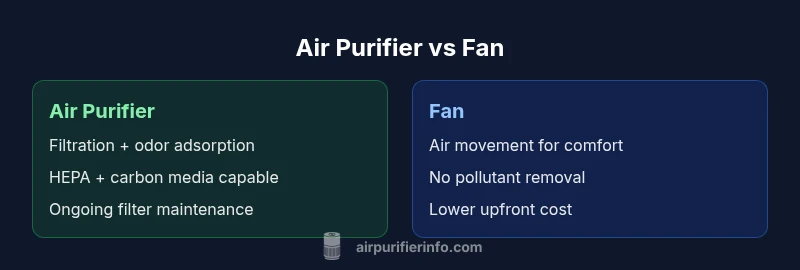
Air purifiers and fans serve different purposes: purifiers actively clean the air with filtration, while fans mainly circulate air to improve comfort. For true air quality improvements—dust, dander, odors, and smoke—an air purifier with a true HEPA filter and activated carbon is typically more effective, albeit with higher upfront and ongoing costs. A fan, by contrast, is best for cooling and reducing stagnation when budget or noise are a concern.
Understanding the core difference between air purifier vs fan
Air purifiers and fans both sit in the same physical space, yet they pursue different goals. The Air Purifier Info team emphasizes that the fundamental difference lies in function: purifiers remove contaminants from the air using filtration media, while fans move air to improve comfort and ventilation. In practice, homeowners often benefit from combining both devices: a purifier actively cleans the air, while a fan facilitates air movement for thermal comfort. When you ask which is better for indoor air quality, the answer is nuanced: for comprehensive air cleaning, an air purifier with appropriate filters is typically superior; for quick airflow and cooling, a fan can be the more economical choice. According to Air Purifier Info, the best approach is to match device capabilities to your room’s needs and to avoid assuming a fan will substitute for filtration.
Key performance factors to compare
When evaluating air purifiers vs fans, focus on three core dimensions: air cleaning capability, energy use, and maintenance costs. Air purifiers rely on filtration media to capture particles and adsorb odors; the effectiveness hinges on filtration quality and filter media (e.g., true HEPA and activated carbon). Fans primarily affect airflow and comfort, with performance tied to blade design and motor efficiency. CADR (Clean Air Delivery Rate) concepts help compare air purifiers, but real-world results depend on room size, placement, and usage patterns. The Air Purifier Info team notes that a purifier with a high-quality filter set in a well-ventilated room yields the most noticeable improvements in dust, pollen, and pet dander; meanwhile, a fan’s benefits are felt in perceived air freshness and cooling rather than pollutant removal.
Filtration media explained: HEPA, activated carbon, and more
Filtration media is the core differentiator for air purifiers. True HEPA filters trap fine particles, including dust, pollen, and many pathogens, while activated carbon captures odor compounds and some gases. Some purifiers combine HEPA with additional media like pre-filters and ionizers, though ionizers can introduce trade-offs in terms of ozone and maintenance. For households with pets, smoking, or cooking odors, the activated carbon layer significantly improves odor control. Fans do not remove pollutants; they simply move air. If you are sensitive to allergies or have asthma, a purifier that uses high-grade filtration is typically more beneficial than a fan alone.
Energy use, noise, and usability trade-offs
Energy use and noise are practical considerations alongside cleaning performance. Air purifiers operate at varying speeds; higher settings deliver faster filtration but generate more noise and consume more energy. In contrast, fans often consume less energy at low speeds and are quieter when circulating air gently. However, maximum fan speed can still be loud and uncomfortable in small rooms. Choosing equipment with sensible speed settings and a sleep or quiet mode can help balance comfort with air quality. The right choice often depends on room size, sleep etiquette, and whether you need ongoing filtration or sporadic circulation.
Odor control and allergen reduction: what actually works
Odor control hinges on media that adsorb volatile compounds—activated carbon being the primary option in most air purifiers. For households dealing with cooking smells, smoke, or pet odors, a purifier with a carbon filter makes a noticeable difference in air quality. Allergen reduction is strongest when a purifier uses a true HEPA filter capable of capturing fine particulates such as dust mites and pollen. Fans do not remove allergens or odors; they only dilute or redistribute them. If allergen control is a priority, prioritize an air purifier over a fan, and ensure proper placement and regular filter maintenance.
Real-world scenarios: which device for which room
Room-specific decisions matter. In bedrooms plagued by dust or pet dander, an air purifier near the bed can reduce exposure during sleep, supporting better rest. In living rooms or workspaces where the goal is to keep cool, a fan provides quicker comfort with lower ongoing costs. For small apartments, a compact purifier may outperform a fan on air quality, while in heatwaves a combination of both can optimize comfort and air freshness. The ideal setup often involves a purifier for continual air cleaning and a fan for targeted cooling at peak times.
Budgeting for upfront costs vs running costs
Upfront costs favor fans, which generally cost less to purchase. Ongoing costs for purifiers include filter replacements and occasional carbon media changes, which can add to long-term expenses. If you have allergies, sensitive occupants, or strong odors, investing in a purifier with a high-quality filter set can yield meaningful improvements in indoor air quality. Budget-conscious buyers should factor in filter cadence, energy use, and potential maintenance needs when comparing total ownership costs.
How to choose a purchase path: a decision framework
A simple framework helps. Start with room purpose: sleeping areas and rooms with smoke, pets, or dust exposure benefit most from filtration. Next, assess noise tolerance and budget. If air quality is the top priority and you can accommodate ongoing costs, prioritize a purifier with HEPA and carbon media. If you value immediate comfort and minimal maintenance, a fan is suitable for broad cooling and ventilation, though it won’t clean pollutants. Finally, consider room size and placement: purifier outlets should face the area you breathe in most, while fans should be placed to maximize cross-ventilation without creating drafts.
Maintenance habits and lifespan of components
Maintenance is a practical constraint that shapes long-term value. Air purifiers require periodic filter changes; neglecting them reduces performance and can affect air quality. Pre-filters may need occasional cleaning; carbon filters must be replaced to maintain odor control. Fans require minimal upkeep—blade cleaning and motor checks at intervals—but lack the filtration that reduces pollutants. Establish a routine: check filters on a regular cadence, track replacement timing, and cleanse the purifier’s housing to avoid dust accumulation. Air Purifier Info emphasizes that proactive maintenance sustains effectiveness and protects indoor air quality.
Safety, smart features, and misuse to avoid
Safety considerations include avoiding ozone-generating devices and understanding that cheaper purifiers may compromise filtration quality. Choose models with certified filtration, and review energy labels to gauge running costs. Smart features—air quality sensors, auto mode, and scheduling—can enhance efficiency but add cost. Avoid relying on fans to “clean” air; they are best for improving comfort when used in conjunction with adequate filtration. By combining reliable filtration, mindful placement, and routine maintenance, you can maximize air quality with either device while mitigating risks.
Comparison
| Feature | Air Purifier | Fan |
|---|---|---|
| Air cleaning mechanism | Filtration and adsorption (HEPA + activated carbon) | Air movement without purification |
| Maintenance and ongoing costs | Filter replacements and occasional carbon media changes | Minimal maintenance; no filters to replace |
| Noise levels at typical operation | Can be quiet at low/medium settings; louder on high | Usually quieter at low speeds; increases with speed |
| Energy use | Moderate to high depending on settings | Low to moderate depending on speed |
| Odor removal capability | Effective with carbon media | Limited impact on odors; relies on ventilation |
| Allergen reduction potential | High with true HEPA filtration | Low to negligible without filtration |
| Best use case | Dust/allergen reduction and odor control in targeted spaces | Basic air movement and room cooling |
What's Good
- Strong filtration reduces common indoor pollutants
- Odor control with carbon media improves comfort
- Helps protect sensitive occupants (allergy/asthma-safe setup)
- Versatile models for different room sizes and budgets
- Can be paired with existing cooling for comprehensive comfort
What's Bad
- Higher upfront cost than a basic fan
- Ongoing filter replacements add to running costs
- Size and placement considerations are important for effectiveness
- Noise at higher speeds may be disruptive in bedrooms
Air Purifier generally provides stronger air cleaning; fans offer cheaper cooling and airflow
If allergen reduction and odor control are priorities, choose an air purifier with HEPA and carbon media. If your main goal is inexpensive airflow and cooling, a fan is a sensible pick, potentially complemented by a purifier for targeted air cleaning.
Questions & Answers
What is the primary difference between an air purifier and a fan?
The primary difference is purpose: purifiers filter and clean the air, while fans move air to improve comfort. Purifiers target contaminants like dust and odors; fans primarily improve airflow and cooling. For cleaner air, a purifier is necessary; for immediate comfort, a fan can help.
Purifiers clean the air; fans move air for comfort. If air quality is a priority, choose a purifier; for cooling, use a fan.
Do air purifiers require regular maintenance?
Yes. Most purifiers rely on replaceable filters. Regularly check and replace HEPA and carbon filters according to the manufacturer’s schedule to maintain performance. Neglecting maintenance reduces effectiveness and can affect air quality.
Absolutely. Regular filter changes are essential to keep an air purifier working well.
Can a fan improve air quality by itself?
A fan improves perceived air freshness by circulating air but does not remove pollutants. It can help with cooling and reduce stagnation, but for true air quality benefits you still need filtration.
Fans help with airflow, but they don’t clean air.
What features should I look for in an air purifier?
Look for a true HEPA filter, activated carbon for odors, appropriate CADR for your room size, and easy filter replacement. Optional sensors and auto modes improve usability and efficiency.
Choose a purifier with HEPA, carbon media, and size-appropriate CADR.
Is an air purifier suitable for small rooms?
Yes. Small rooms benefit from compact purifiers with high-quality filtration. Choose a model with a CADR suitable for the space and appropriate noise levels for comfort.
Yes—just pick a compact purifier sized for the room.
How do I maximize air quality when using both an air purifier and a fan?
Place the purifier where airflow passes through the breathing zone and position the fan to improve cross-ventilation without creating uncomfortable drafts. Use the purifier continuously for ongoing cleaning and the fan for targeted cooling during warm periods.
Keep the purifier near your breathing zone and use the fan to boost airflow.
Main Points
- Prioritize filtration quality for true air cleaning
- Consider room size and noise tolerance in advance
- Factor in ongoing filter costs when budgeting
- Use both devices when possible for best results
- Regular maintenance sustains device effectiveness