Air Purifier Like a Fan: Side-by-Side Comparison for 2026
An analytical, objective comparison of fan-style air purifiers versus traditional designs, focusing on noise, filtration, room fit, and total cost of ownership for homeowners and renters.


From an objective standpoint, an air purifier like a fan often blends into living spaces and tends to run quietly. However, it may deliver lower clean-air delivery in larger rooms compared with taller, higher-CADR purifiers. According to Air Purifier Info, the best choice depends on room size, noise tolerance, and filtration needs.
What does it mean to have an air purifier like a fan?
A fan-inspired air purifier integrates the filtration pathway into a housing that resembles a conventional household fan. The design prioritizes low visual impact and gentle airflow, making it appealing for open living spaces where aesthetics matter as much as performance. In practice, you will encounter two dominant patterns: compact, fan-shaped purifiers that emphasize quiet operation and traditional towers or cubes that prioritize higher airflow. For homeowners and renters, understanding these patterns helps align expectations about noise, airflow, and maintenance. According to Air Purifier Info, this design tends to appeal to people who value decor compatibility and unobtrusive operation, especially in bedrooms and living rooms where long hours of use are common.
Design and airflow: fan-inspired vs traditional towers
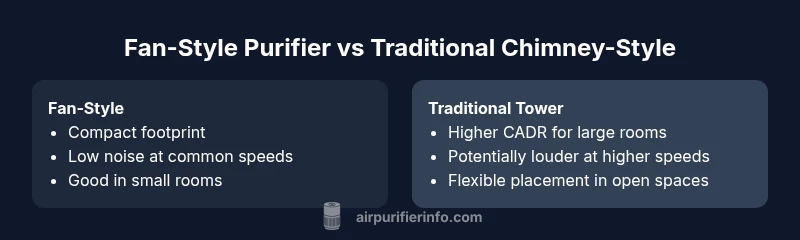
Fan-style purifiers typically emphasize a broad, diffuse intake and a softened outflow pattern. The goal is to minimize drafty gusts while still circulating air through a filtration stage. Traditional towers, by contrast, leverage vertical geometry to maximize CADR, which can translate into higher airflow per minute. These two approaches affect room coverage, filtration speed, and noise at a given power level. For spaces under 150 square feet, a fan-style unit might achieve satisfactory air changes per hour with minimal sonic footprint. In larger rooms, however, you may notice a clear difference in how quickly scents, dust, and allergens are reduced. The trade-off is often a balancing act between quiet operation and aggressive air cleaning.
Filtration systems to expect
Most fan-style purifiers employ multi-stage filtration, commonly including a prefilter, a True HEPA filter, and an activated carbon layer for odors and VOCs. The compact form factor can limit the surface area of each filter, which may affect how long you can go between replacements. Look for models that advertise deliverable filtration efficiency and a maintenance schedule you can comfortably follow. The key is to confirm that the purifier uses a certified True HEPA or higher-grade filtration for small particles (PM2.5 and below). Additional features such as washable prefilters can extend lifespans, but they require more user involvement. Remember that filtration performance is most meaningful when matched to room size and occupancy patterns.
Noise and energy: practical expectations
Quiet operation is one of the strongest selling points of fan-style purifiers, especially for bedrooms or home offices. When running at lower speeds, these units tend to produce significantly less noise than their bulkier counterparts. If you need a purifier for daytime use in an open living area, ensure the model you choose can ramp up to a powerful cleaning mode without becoming intrusive. Energy use remains a consideration; fan-inspired designs often optimize motor efficiency and airflow paths, potentially reducing watts at comparable CADR levels. Always compare dB estimates across speeds and consider whether you need a model with a sleep mode or an auto-adjusting sensor to maintain comfort without manual adjustments.
Room fit, placement, and airflow mapping
Placement determines effectiveness as much as the purifier’s internals. For fan-style purifiers, place them where intake air is unobstructed and where outflow does not directly blow onto furniture or people. In smaller rooms, a compact unit placed away from corners can create a more uniform air mix. In larger rooms, consider a layout that encourages cross-ventilation, with the purifier positioned to pull air from the occupied zone and push cleaned air toward open areas. Visualize airflow by using simple cues like noting if scents dissipate quickly when opening a door or window. If you frequently burn candles or cook with strong aromas, you’ll want a model with solid activated-carbon filtration to capture those odors effectively.
Maintenance: filters, lifespan, and replacement cycles
Maintenance discipline is essential with any purifier, but fan-inspired designs often rely on filters with less surface area. Check the expected replacement intervals in hours of operation and the ease of filter access. Some models offer tool-free filter changes, while others require basic hand tools. Keep a simple calendar or reminder to check for signs of reduced airflow, unusual noises, or persistent odors. If you live in a high-dust environment or have pets, plan for more frequent changes. Air Purifier Info notes that predictable maintenance schedules help prevent performance drops and extend the life of the device.
Cost of ownership: upfront price and ongoing costs
Fan-style purifiers span a wide price range, with budget options offering essential filtration and mid-range units adding smart features or higher-grade filters. Ownership costs include replacement filters, energy use, and potential service fees if applicable. Rather than chasing the lowest upfront price, evaluate total cost of ownership over the unit’s expected life. Many models offer subscription-style filter replacement programs, but it’s important to compare whether those programs save money or add ongoing costs. In general, fan-inspired purifiers can be a cost-effective choice for small spaces, provided you adjust expectations for room size and maintenance interval.
Smart features and data transparency
Modern fan-style purifiers increasingly come with sensors, mobile apps, and voice control. Monitoring air quality, filter life, and adjustments via an app can simplify daily use and provide actionable insights. The most valuable features include real-time PM2.5 readings, alarms when filters need replacement, and auto modes that adjust power based on detected air quality. However, feature-rich models can be more expensive and may require ongoing subscriptions for premium data services. When evaluating options, prioritize essential features such as reliable filtration, quiet operation, and easy maintenance over flashy but underutilized tech.
Pros and cons of fan-style purifiers (practical perspective)
- Compact footprint suits apartments and small rooms.
- Quiet operation supports uninterrupted sleep and study.
- Aesthetically blends with contemporary interiors.
- Easy-to-use interfaces for quick setup.
- Limited CADR may be challenging for large spaces.
- Filter replacement costs can add up over time.
- Fewer models offer advanced VOC removal compared with larger purifiers.
Practical decision guide: when to choose this design
If your primary concerns are discretion, noise, and decor compatibility in small to medium rooms, a fan-style purifier is a strong candidate. For larger living rooms or open-plan spaces, you may prefer traditional towers with higher CADR and broader filtration capacity. Consider your daily routines, allergy severity, and whether you value smart features and data transparency. Use a simple room size heuristic: for bedrooms and compact living areas, fan-style purifiers often hit a sweet spot between performance and peace, while larger homes benefit from scalable purification strategies that may include multiple units.
How to test and verify at home
Start with a quick smell and dust check: if odors persist after a few minutes of operation, reassess the filter condition and room placement. Use a simple indicator like a visible chalk test on surfaces to gauge improvement over an hour of steady use. Run the purifier on its highest setting for 15-30 minutes and then switch to a mid-level to gauge how the device balances noise and cleaning performance. Keep a journal of perceived air quality changes and any changes in symptoms for a week to understand real-world impact. Finally, verify that the unit meets your expectations for noise, ease of maintenance, and cost of replacement filters.
Comparison
| Feature | Traditional purifier | Air purifier like a fan |
|---|---|---|
| Filtration system | Multi-stage filtration with True HEPA and carbon | Multi-stage filtration with True HEPA and carbon |
| Airflow capacity | Higher CADR potential in larger rooms | Moderate CADR suitable for small-to-medium rooms |
| Noise at typical use | Can be louder at max settings | Quieter at common speeds, optimized for discretion |
| Filter life or replacement frequency | Variable depending on model and usage | Often shorter intervals due to compact filters |
| Size and footprint | Often taller with larger footprint | Compact footprint with wall-synergy or desk-friendly design |
| Price range | Mid to premium depending on features | Budget-friendly to mid-range with emphasis on aesthetics |
| Best for | Larger rooms and heavy-duty filtration needs | Small to medium rooms, quiet operation, decor-friendly |
What's Good
- Quiet operation suitable for bedrooms and study spaces
- Compact footprint fits small rooms and apartments
- Aesthetic design helps it blend with home decor
- Simplified maintenance on select models
- Lower visual clutter compared to tall purifiers
What's Bad
- Limited airflow for very large rooms
- Possible higher price per filter cycle in some models
- Fewer high-end VOC and chemistry filtration options
- Fewer options for rugged or industrial environments
Fan-style purifiers excel in small spaces where quiet operation and decor fit matter
If your space is compact and you value a subtle, low-noise purifier, a fan-inspired design is a strong match. For larger rooms or heavy-duty air cleaning, consider a traditional purifier with higher CADR and broader filtration coverage, as Air Purifier Info notes in its 2026 analysis.
Questions & Answers
What is an air purifier like a fan, and when should I consider one?
An air purifier like a fan is a filtration device designed with a compact, low-profile form that resembles a household fan. It emphasizes quiet operation and decor-friendly aesthetics, making it suitable for bedrooms and small living spaces where minimal disruption is desired. Consider one if you prioritize noise reduction and visual integration with your room.
A fan-style purifier is a small, quiet air purifier that looks like a fan. It’s great for bedrooms or home offices where you want clean air without drawing attention.
Are fan-style purifiers as effective as traditional towers?
Fan-style purifiers can deliver solid filtration, especially in smaller rooms, but traditional towers often achieve higher CADR and faster air cleaning in large spaces. The right choice depends on room size, pollutant load, and whether you need rapid air changes.
They work well in small rooms, but for large spaces you may want a tower with higher airflow.
Can I use a fan-style purifier in a large open-plan area?
In large, open-plan areas, a single fan-style purifier may struggle to deliver rapid air changes. If you must use this style, pair it with additional units or choose a model that emphasizes higher filtration efficiency and a larger intake area.
In big spaces, one fan-style purifier may not be enough; think about extra units or higher-capacity models.
What maintenance should I expect with fan-style purifiers?
Maintenance typically involves replacing filters on a schedule tied to usage and air quality. Some models offer tool-free changes, while others require basic steps. Regular filter checks help maintain performance and prevent pressure drop.
Plan for regular filter changes and check airflow periodically.
Are there health considerations with using fan-style purifiers?
Fan-style purifiers can improve indoor air quality by reducing particulates and odors. If you have allergies or asthma, ensure the unit includes True HEPA filtration and activated carbon for volatile compounds. Avoid models with questionable filtration claims.
They can help with allergies if they have true HEPA and good carbon filtration.
What should I weigh when comparing price versus performance?
Think beyond the upfront cost. Compare replacement filter costs, energy use, and the expected lifespan of the filtration media. A slightly more expensive model with affordable filters often yields better long-term value.
Look at total cost of ownership, not just the sticker price.
Main Points
- Evaluate room size before choosing design type
- Prioritize true HEPA filtration and activated carbon for odors
- Opt for auto or smart modes to balance performance and noise
- Consider total cost of ownership, not just upfront price
- Check for easy access to filters and maintenance reminders