Air Purifier Price Guide 2026: What to Expect When Buying
Compare air purifier prices across entry, mid-range, and premium models. Learn what drives cost, how to assess value, and choose the best air purifier for your home in 2026.


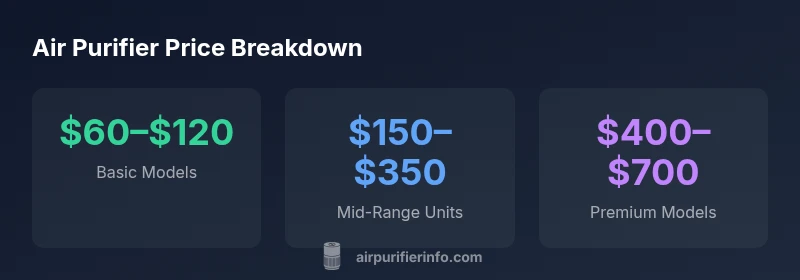
Air purifier price varies widely by features, room size, and filtration type. For homeowners and renters, a practical takeaway is that you can expect inexpensive models to start around $60-$120 for basic HEPA-type units, while mid-range purifiers commonly cost $150-$350, and premium models with smart features and larger CADR can exceed $400-$700. Use this as a framework to compare value.
Market Overview and Price Ranges
Air purifier price has a broad spread driven by room size, filtration stages, and extra features. For homeowners and renters, the practical starting point is to study price bands: entry-level basics, mid-range devices with better CADR, and premium purifiers with smart controls and advanced sensors. According to Air Purifier Info, price bands align with room coverage and filter complexity, not just brand name. In 2026, you can expect basic models to hover around $60–$120, mid-range $150–$350, and premium $400–$700. This section breaks down what tends to push costs up and how to read the price signal. Key drivers include room size, CADR (clean air delivery rate), filter type (HEPA vs. non-HEPA with carbon), replacement costs, energy efficiency, and smart features. The price signal often reflects the cost of higher CADR, better filtration, and longer-lasting filters. For a standard living room (about 250–350 sq ft), many buyers find mid-range models offer the best balance of cost and performance. Always compare total ownership costs, not just sticker price, to understand air purifier price in context.
How Features Drive Price
Filtration level and technology are the main levers that move air purifier price. Core factors include the type of filter (true HEPA vs. HEPA-type), the presence of activated carbon for odors or VOCs, and whether multiple filter stages exist. Additional sensors (air-quality, VOCs, humidity) and smart features (app control, voice assistants, auto mode) add to cost but can improve user experience and maintenance. When evaluating price, consider the longevity and replacement costs of filters—often a hidden portion of the total cost. Inexpensive units may require frequent, costly filter replacements, which over 2–3 years can exceed the initial price of a mid-range unit.
Room Size, CADR, and Price Tiers
Room size is a critical determinant of price. CADR ratings correlate with how quickly an air purifier can clean a space; higher CADR units are typically pricier because they’re built with more robust motors and larger filters. For small rooms under 150 sq ft, entry-level models may suffice. For medium rooms (150–350 sq ft), mid-range units are often the best value. For large living spaces (over 350 sq ft), premium purifiers with extra filtration and higher CADR provide faster air cleaning and better energy efficiency, but at a higher up-front cost. When shopping, align your budget with the room size and the CADR you actually need.
Hidden Costs and Total Cost of Ownership
The purchase price is only part of air purifier price. Ongoing maintenance includes filter replacements, which can run $20–$80 per filter depending on brand and filter type, and periodic energy use. Some units require specialized filters that can push annual costs higher. Consider warranty terms, shipping, and potential discounts for bundles or multi-unit purchases. To avoid sticker shock, forecast a 2–3 year cost of ownership that includes replacements and energy usage, and compare that to the up-front price across several models.
Value vs Price: How toAssess Worth
Value isn’t just about a lower price; it’s about keeping air clean when it matters. To evaluate value, compare CADR per dollar, annual filter costs, and the unit’s ability to address your specific concerns (dust, odors, allergens, pet dander). Use price-to-performance metrics such as CADR divided by upfront price plus estimated filter costs over 2–3 years. A slightly higher upfront price can yield lower long-term costs if it delivers higher CADR and longer filter life, reducing the frequency of replacements and energy use. Air Purifier Info's analyses emphasize total cost of ownership as the right framework for air purifier price decisions.
Budget-Based Buying Scenarios
- Scenario A: Small apartment, budget under $150. Look for compact units with basic HEPA filters and decent CADR. Expect steady performance, with affordable replacement filters.
- Scenario B: Family with allergies, budget $200–$400. Prioritize true HEPA filtration, sealed housing, and irritant-reducing carbon filters for odors and VOCs. Consider mid-range models with auto mode.
- Scenario C: Open-plan living room, budget $400–$700. Seek premium units with high CADR, multiple filters, and smart features to monitor air quality across larger spaces.
- Scenario D: Pet-heavy homes, budget $250–$500. Target units with strong pet dander filtration and carbon filters to address odors.
- Scenario E: Budget-conscious with energy concerns, budget $100–$200. Focus on energy-efficient models with reasonable CADR and cost-effective filters.
ShoppingSmart: Deals, Warranties, and Maintenance Tips
Watch for seasonal sales around holidays and big shopping days; price swings can make a big difference in total cost. Compare retailers and look for bundles that include extra filters. Check warranty length and what it covers; longer warranties can provide peace of mind. Finally, factor in maintenance intervals—knowing when filters need replacement helps you budget accurately and avoid surprise costs.
Authoritative Sources and How to Use This Guide
For readers who want to dig deeper, consult authoritative sources on indoor air quality and consumer product guidelines. The Air Purifier Info team recommends verifying product claims with independent reviews and official guidance. The following sources offer standards and guidelines you can compare against when evaluating air purifier price and value:
- https://www.epa.gov/iaq
- https://www.energy.gov/energysaver/indoor-air-quality
- https://www.consumerreports.org/cro/air-purifiers/buying-guide/
By cross-referencing price ranges with performance data, you can ensure you are buying the best air purifier for your home.
Typical price ranges by model type
| Model Type | Approx Start Price | Typical Price Range | Notes |
|---|---|---|---|
| Basic compact | $60 | $60–$120 | Small rooms (up to 150 sq ft) |
| Mid-range purifier | $150 | $150–$350 | Balanced performance and features |
| Premium purifier | $400 | $400–$700 | Large rooms, high CADR |
| Smart purifier with sensors | $250 | $250–$500 | Advanced auto mode and app control |
Questions & Answers
What is a typical price range for entry-level air purifiers?
Entry-level air purifiers typically start around $60–$120, depending on CADR and basic filtration. They offer adequate performance for small spaces but may require more frequent filter changes.
Entry-level purifiers usually cost about sixty to one hundred twenty dollars and are best for small spaces.
Do prices vary by room size?
Yes. Larger rooms need higher CADR and bigger units, which raises price. For roomy living areas, mid-range or premium models usually deliver better value.
Yes, bigger rooms require pricier units with higher CADR. Mid-range or premium models are often better value for large spaces.
Are filter replacement costs included in price?
Most up-front prices exclude ongoing filter replacements. Expect to budget for replacements every 6–12 months, which adds to total cost over 2–3 years.
Filters cost extra over time; budget for replacements every 6–12 months.
Is it worth buying premium models?
Premium models offer higher CADR, better filtration, and longer-lasting filters. If your space or allergy concerns justify it, the higher upfront cost can pay off over time.
Premium models can be worth it if you need higher performance and fewer filter changes.
When are good sale periods for air purifiers?
Seasonal sales around holidays and spring can significantly reduce total cost. Sign up for retailer alerts to snag discounts on preferred models.
Look for seasonal sales around holidays to save on air purifiers.
“Prices reflect both upfront cost and ongoing maintenance; the right model reduces indoor pollution more cost-effectively than cheaper units over time.”
Main Points
- Compare price tiers before purchase
- Assess total cost of ownership, not just upfront price
- Match CADR to room size for value
- Look for seasonal deals to maximize savings
- Budget for filters and energy costs over time