Air Cleaner vs Air Purifier: An Objective Comparison
Compare air cleaners and air purifiers to pick the right device for dust, allergies, odors, and VOCs. Learn how filtration, CADR, and room size affect performance.


If you're deciding between an air cleaner vs air purifier, it’s crucial to understand that many brands use the terms interchangeably. In most homes, the core differences come down to filtration, particle removal, and how VOCs are addressed. Look at CADR, filter type (HEPA vs activated carbon), and room size to choose the right device.
What is an air cleaner vs air purifier?
According to Air Purifier Info, the terms air cleaner and air purifier are often used interchangeably in marketing, but there are practical distinctions worth noting for real-world results. The simplest way to think about it is that most devices are designed to remove particles from the air, while more advanced models also target odors and VOCs (volatile organic compounds). For homeowners, the choice usually comes down to whether you primarily need dust and pollen control or a broader approach that also tackles smells from cooking, pets, or smoke. When evaluating products, watch for keywords like HEPA filtration for particle capture and activated carbon for odor control. The goal is to map your air quality concerns to a device class that can address those needs effectively. The Air Purifier Info team emphasizes aligning expectations with the device’s core capabilities and your room dynamics.
How they work: filtration stages and CADR
Air cleaners and purifiers rely on staged filtration systems that typically include a pre-filter, a HEPA or high-efficiency core, and an activated carbon or other adsorbent stage for odors and VOCs. The central performance measure is the CADR (clean air delivery rate), which reflects how quickly a unit can remove specific particle sizes from the air. Higher CADR values generally translate to faster air cleaning in a given room, but you must pair them with a suitable room size to avoid overworking the device or leaving air quality suboptimal in larger spaces. In practical terms, a device with strong particle filtration and carbon filtration tends to deliver better overall air quality in mixed-use rooms where dust, allergens, and smells coexist.
Key differences: why the terminology matters
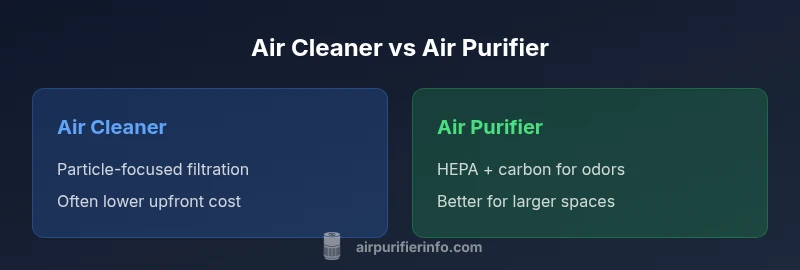
The terminology matters because particle removal and odor control rely on different filtration stages and performance priorities. A basic air cleaner may rely primarily on a standard filter to capture dust and pollen, which is sufficient for seasonal allergies but not ideal for strong smells or VOCs. An air purifier typically implies a more comprehensive setup, often including HEPA filtration and an additional carbon or specialty filter to address odors and gases. Consumers should be guided by specific features (filter type, filter area, energy efficiency) rather than marketing labels alone. Note that real-world performance depends on unit design, maintenance, and how well the device matches your room’s air volume.
When to choose an air cleaner vs air purifier
If your primary concern is particle-related issues—dust buildup, pollen, pet dander, or fine particulates—an air cleaner with reliable HEPA filtration may be sufficient, especially in smaller rooms. For households dealing with strong cooking odors, smoke, or VOCs from cleaning products, a purifier with both HEPA filtration and a carbon or zeolite stage will usually offer superior odor control and chemical removal. Budget, noise tolerance, and convenience also factor in: purifiers with robust features often cost more upfront but deliver more versatile air quality improvements over time. The decision should align with your most persistent IAQ (indoor air quality) challenges and the frequency with which those issues arise.
Room size, ACH, and placement considerations
Two practical planning concepts matter: room size and air changes per hour (ACH). Most devices specify a recommended room size range; selecting a unit that can deliver multiple ACH in your space speeds up air refresh cycles and reduces stagnation. Placement matters, too: avoid obstructing intakes or exhalations with furniture, and position the unit where it can circulate air effectively without creating drafts. In dense living areas, higher-CADR purifiers are often better suited to handle the volume, while smaller bedrooms may benefit from compact units that minimize noise while maintaining clean air throughout the night.
Filter types and maintenance
Filter quality directly affects performance and running costs. HEPA filters trap 99.97% of particulate matter at 0.3 microns, if correctly rated, while carbon-based stages remove odors and many VOCs. Maintenance schedules depend on usage, room conditions, and filter quality. Expect to replace HEPA or carbon filters every 6–12 months in typical home use, with more frequent changes in high-traffic areas or households with pets. Pre-filters extend the life of more expensive filters and are often washable. When choosing a device, balance initial cost with filter replacement expenses over the device’s lifetime.
Energy use, noise, and running costs
Energy efficiency and noise are practical considerations for any long-term IAQ investment. Many modern purifiers optimize energy consumption by adjusting fan speeds relative to air quality readings, but higher CADR models may produce more noise at maximum settings. If you’re sensitive to sound or sleep near the device, look for features like smart mode, auto-sensing, or a true quiet setting. Running costs hinge on filter replacement frequency and electricity usage; models with longer filter life and lower energy draw typically offer better value over time, particularly in larger rooms or open-plan spaces.
Real-world scenarios: dust, smoke, pets, allergies
Different homes present different IAQ challenges. A dusty apartment with little ventilation benefits from a particle-centric purifier or cleaner with a true HEPA core, ideally in a central location to maximize airflow. A smoker’s home or kitchen-heavy environment benefits from a carbon-enhanced purifier that can tackle odors and VOCs alongside particles. Pet owners should look for models that manage dander and hair with easily removable and washable pre-filters. In all cases, ensure you’ve set realistic expectations: even the best device cannot compensate for poor ventilation or a continuously polluted source.
How to compare models effectively
To evaluate models objectively, focus on three pillars: filtration performance (HEPA presence, carbon stage, and pre-filter design), room compatibility (rated room size and ACH), and ongoing costs (filter life, replacement costs, and energy use). Read independent reviews for real-world performance, not just lab specs. Confirm that the unit is ozone-free and certified by credible standards where applicable. Use a standardized checklist to compare models side by side and note any differences in warranty, customer service, and availability of replacement filters. A methodical approach reduces buyer’s remorse and improves long-term satisfaction.
Common myths about air cleaners and purifiers
A common myth is that all purifiers can operate equally well in every room. In reality, one device rarely fits all spaces; performance varies with room volume, airflow patterns, and occupancy. Another misconception is that bigger is always better. Oversized units may waste energy and create unnecessary noise, while undersized devices struggle to keep up in busy households. Finally, some imply that cheaper units deliver comparable air quality. In fact, low-cost models often rely on inferior filters or smaller filter areas, which degrade performance and increase maintenance frequency. The right device balances filtration efficiency, room size, and total cost of ownership.
Measuring results: how to test air quality at home
To track progress, consider both qualitative and quantitative measures. Visual indicators and odor assessments can be helpful but are subjective. For a more objective view, use consumer-grade air quality monitors that track PM2.5 and CO2 levels, and compare readings before and after running a purifier, ideally over several days. Observe changes in symptoms such as sneezing, congestion, or throat irritation in the spaces where the device runs. While a single data point isn’t definitive, a consistent downward trend in particulate counts coupled with improved comfort is a strong signal that the device is working as intended.
Practical checklist to guide your purchase
- List your top IAQ concerns (dust, odors, allergies, smoke).
- Determine room size and desired ACH.
- Decide on a HEPA core plus carbon stage for versatility.
- Evaluate noise tolerance and energy use.
- Compare filter life costs and warranty.
- Check certifications and ozone-free status.
- Plan for placement and ease of maintenance to sustain performance.
Comparison
| Feature | Air Cleaner | Air Purifier |
|---|---|---|
| Filtration Core | Particle-focused filtration with optional carbon stage | HEPA filtration plus activated carbon for odors/VOCs |
| Best For | Dust, pollen, and basic allergen control | Comprehensive air cleaning including odors and VOCs |
| CADR Emphasis | Moderate to high particle removal depending on model | High particle removal with strong odor/VOC control when carbon is included |
| Odor/VOC Control | Limited odor control unless carbon stage is present | Strong odor/VOC control with dedicated carbon stage |
| Maintenance | Filters may require less frequent replacement | Higher filter replacement frequency for combination systems |
| Noise | Typically quieter at lower speeds | Noise varies; some higher-CADR units are louder at top settings |
| Energy Use | Moderate energy use, varies by model | Higher efficiency options available; check energy ratings |
| Ideal Room Size | Small to medium rooms with compact units | Medium to large rooms with higher CADR models |
What's Good
- Often lower upfront cost for basic models
- Lightweight and portable for use in multiple rooms
- Simple operation and maintenance for casual users
- Good option for budget-conscious buyers
What's Bad
- Limited odor control without carbon stage
- Performance may drop in larger rooms without higher-end models
- Cheaper units may underperform and require more frequent filter changes
- Noise can be noticeable at higher speeds
Air purifier generally provides broader, higher-quality air cleaning for most homes; air cleaner is suitable for smaller spaces or budget-conscious scenarios.
For comprehensive air quality improvements, choose a purifier with HEPA filtration and carbon filtration. If you mainly need particle control in a small room and price is the priority, an air cleaner can be a practical option.
Questions & Answers
What is the practical difference between an air cleaner and an air purifier?
In practice, many devices marketed as air cleaners emphasize particle removal, while air purifiers often imply a more comprehensive system including odor and VOC control. Evaluate the actual filtration stages (HEPA, carbon) and room size compatibility rather than relying on terminology alone.
The practical difference is mainly about filtration depth: purifiers typically include carbon for odors; cleaners focus on particles. Check the specs to be sure.
Do these devices remove odors and VOCs?
Yes, but only with a carbon or other adsorbent stage. If odor control is important, ensure the model includes an activated carbon filter or a dedicated VOC filter in its filtration train.
Odor and VOC removal come from the carbon stage. Look for carbon filtration in the product specs.
Can an air cleaner replace an HVAC system for air quality?
No. Air cleaners and purifiers supplement HVAC systems by reducing indoor pollutants, but they do not replace the entire air exchange and filtration provided by a properly designed HVAC setup.
They supplement HVAC, not replace it. A whole-house approach is still best for comprehensive IAQ.
How do I choose the right size for a room?
Start with the device’s recommended room size and CADR. For larger spaces, select a higher-CADR model or multiple units to achieve multiple air changes per hour.
Pick a model that matches or exceeds your room's size and aim for several air changes per hour.
How often should filters be replaced?
Replacement frequency depends on usage, room conditions, and filter type, typically every 6–12 months for HEPA plus carbon stages. Check manufacturer guidance and monitor filter cleanliness.
Most filters need changing every 6–12 months, but follow the product's guide and monitor usage.
Are all devices ozone-free?
Most modern consumer devices are designed to be ozone-free, but some air cleaners use ionizing or ozone-generating features. Avoid models that explicitly produce ozone and verify certifications.
Look for ozone-free marks and avoid devices with ozone-emitting features.
Main Points
- Define your goals: particle removal vs odor control
- Match device to room size using CADR-friendly guidelines
- Prioritize HEPA plus carbon filtration for versatility
- Consider long-term costs: filters and energy use
- Test and measure IAQ changes to confirm results