Air Cleaner Price Guide 2026
Explore how air cleaner price varies by CADR, filtration, and features. Compare entry, mid-range, and premium price bands and ownership costs to budget confidently.


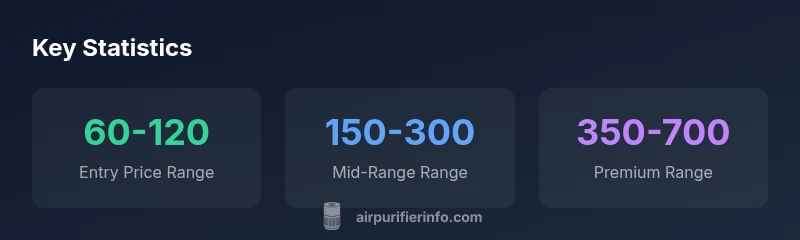
Air cleaner price typically ranges from modest entry-level models to premium high-end purifiers. Entry units often start around $60-$120, mid-range units run about $150-$300, and premium options can be $350-$700 or more, depending on CADR, filter technology, and smart features. By understanding these bands, homeowners and renters can budget for initial purchase and ongoing filter costs.
Price bands explained
Air cleaner price is usually segmented into entry-level, mid-range, and premium tiers, each serving different room sizes, feature sets, and ownership costs. For homeowners and renters, recognizing where a purifier sits in these bands helps set expectations for upfront investment and ongoing costs like filters. Entry-level models often prioritize compact size and basic filtration, with price ranges that make air cleaning accessible in smaller spaces or budget-conscious homes. Mid-range units raise CADR and filtration sophistication, frequently including better energy efficiency and smart controls. Premium purifiers offer advanced filtration configurations (such as multiple HEPA stages and high-capacity CADR), longer filter life, and enhanced sensing, connectivity, or energy features. When you see a price, map it to room size, required CADR, and desired maintenance cycle to assess true value. This approach aligns with the Air Purifier Info team’s guidance on balancing upfront cost with long-term performance.
What drives price: CADR, filtration, and smart features
Price is driven by the combination of CADR (Clean Air Delivery Rate), filter complexity (HEPA vs. HEPA with activated carbon, pre-filters), and extra features (smart app control, air quality sensors, timers, and noise reduction). Higher CADR units move more air per minute, which is essential for larger spaces or households with multiple occupants or pets. Filtration layers add cost: a basic filter can remove common dust and pollen, while true HEPA filters capture smaller particles, and activated carbon handles odors and VOCs. Smart features add both cost and value through scheduling, remote control, and real-time air quality feedback. Importantly, development in motor efficiency and quieter operation can push price upward, but can reduce running costs over time. For buyers, it’s critical to compare CADR per dollar and consider the total cost of ownership rather than price alone.
Cost of ownership: filters and energy
Beyond the initial purchase, ongoing costs comprise filters, electricity, and occasional maintenance. Filter replacement intervals vary by model and usage; some units recommend filters every 6-12 months, while others with higher CADR or odor control require more frequent changes. Filter price ranges can be a few dollars for basic pre-filters to tens of dollars for full HEPA cartridges, with carbon filters adding to the cost for odor control. Energy consumption is generally modest, but larger units can draw more power, especially if used at high fan speeds. The Energy Star label can help buyers compare efficiency; in practice, the annual energy bill for a typical household purifier is often a small fraction of overall energy costs, but choosing a model with efficient motors and smart operation can yield meaningful savings over years of use.
Buying tips by price tier
- Entry-level: Prioritize room size compatibility and basic filtration. Check filter replacement costs and availability. Look for compact designs that fit your space and minimal maintenance. If you have allergies or pets but a small space, an entry-level unit may suffice with careful expectations.
Value by room size and use-case
Room size is the critical factor; a purifier aimed at a 150-square-foot living room will not effectively clean a 400-square-foot space. For kitchens or areas with strong odors, invest in models with activated carbon and possibly a dual filter stack. For bedrooms and living rooms, noise levels and sleep modes are important; many mid-range models balance quiet operation with solid CADR. In homes with multiple occupants or pets, consider higher CADR and filter life to minimize maintenance burden while maintaining air quality. The pricing should reflect these needs: choose a price tier that offers the right CADR-range coverage and a sustainable filter replacement plan.
Trends to watch in 2026
The market continues to see a push toward smarter features, better energy efficiency, and durable filtration systems. Consumers increasingly search for models with real-time air quality feedback and app control, paired with low energy use and long-lasting filters. Price bands may shift slightly as new materials and corona-discharge-free technologies emerge, but the core decision framework remains: match room size with CADR, evaluate filter and energy costs, and compare overall value, not just upfront price.
Price tiers and key features by model type
| Tier | Typical Price Range | CADR (CFM) | Filter Type | Notes |
|---|---|---|---|---|
| Entry-level | $60-$120 | 60-150 | True HEPA or equivalent | Compact size, basic features |
| Mid-range | $150-$300 | 200-400 | HEPA with activated carbon | Better coverage, smart features |
| Premium | $350-$700 | 400-800 | HEPA with carbon + sensors | Large rooms, app control |
Questions & Answers
What is the typical price range for entry-level air purifiers?
Entry-level models generally fall in the $60-$120 range. They provide basic filtration and modest CADR, suitable for small spaces. Expect higher long-term costs if you upgrade filtration or sensors later.
Entry-level purifiers usually cost about sixty to a hundred twenty dollars, with basic filtration and limited features.
How does CADR affect price?
Higher CADR means more air cleaned per minute, which typically raises the price. If you need to purify large rooms or open-plan spaces, allocate more budget for higher CADR units.
Bigger CADR, bigger price. For large rooms, expect to pay more for faster cleaning.
Are smart features worth paying for?
Smart features add convenience and can improve ongoing performance through real-time alerts and automation. If you value remote control and data on air quality, a mid-range or premium model may offer better long-term value.
Smart features are handy if you care about real-time air data and automation.
What is the cost of replacement filters over a year?
Filter costs vary by model but typically range from $20 to $60 per year for basic replacements, and higher for models with advanced multi-stage filtration. Budget for recurring costs when comparing price bands.
Expect around twenty to sixty dollars yearly for filters, depending on the model.
Do energy-efficient models save money over time?
Yes, energy-efficient units reduce electricity use, especially at lower fan speeds or with auto modes. Look for Energy Star ratings and compare annual energy consumption when evaluating price.
Energy-efficient units save a bit on your bill over time, especially with smart modes.
Where is the best place to buy to get the price right?
Compare prices across reputable retailers and watch for seasonal sales. Check warranty terms and verify filter availability. Buying during promotions can substantially reduce total cost of ownership.
Shop around, watch for sales, and check warranty and filter availability.
“Price is a proxy for performance and total cost of ownership. Focus on CADR per dollar and filter longevity to choose the best value.”
Main Points
- Define your budget and room size before shopping
- Prioritize CADR per dollar when comparing prices
- Factor in filter costs and energy usage over time
- Smart features add value for busy homes
- Look for Energy Star or efficiency certifications