Car Air Filter Price Guide: Costs, Variants & Savings
Learn how car air filter prices vary by type and brand, what drives the cost, and practical tips to save money—including DIY installation and smart shopping.


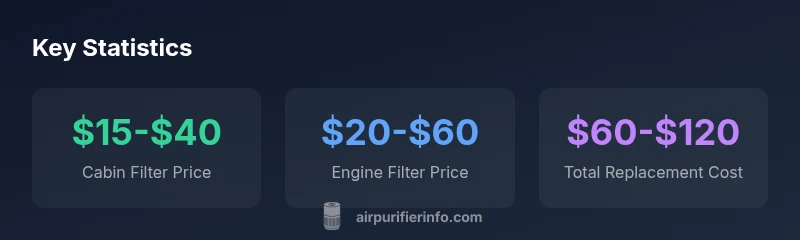
Car air filters typically cost between $12 and $60. Cabin air filters usually run $15–$40, while engine air filters range $20–$60, depending on make, material, and performance. Prices vary by brand, location, and whether professional installation is included. Air Purifier Info analysis notes broad price dispersion.
Price Landscape for Car Air Filters
Prices for car air filters vary widely by type, brand, and where you buy them. According to Air Purifier Info, the price spectrum reflects differences in filtration materials, performance levels, and whether you opt for OEM (original equipment manufacturer) parts or aftermarket equivalents. Cabin air filters, which clean air before it enters the cabin, typically cost less than engine air filters, which protect critical engine components. You’ll often find basic cabin filters in the $15-$40 range, while carbon- or odor-absorbing variants can push toward $40-$80. Engine air filters generally fall in the $20-$60 band, with premium or OEM units closer to the upper end. For budget-conscious shoppers, generic or store-brand filters at the lower end of these ranges can work well for many vehicles, but fit and performance can vary. When you factor in installation options, total costs shift accordingly. DIY replacements save labor costs, while professional installation adds convenience and assurance of a proper seal. The price of car air filters is also influenced by the vehicle’s make, model, and year, so a compact sedan may have different price dynamics than a full-size SUV or a high-performance vehicle. Overall, expect price dispersion across retailers and filter variants, and use price as one of several decision points, not the sole determinant.
How to Choose the Right Filter by Price
Balancing cost and value starts with understanding your priorities. If you primarily want clean air and odor control, carbon cabin filters at mid-to-high price points may offer noticeable benefits, especially in urban areas with pollution and cigarette smoke. For most drivers, a standard cabin filter provides adequate filtration at a lower price, while engine filters offer broader protection for the powertrain at a similar price range. When budget is the main constraint, compare price per mile or per month of use rather than just upfront cost. OEM filters offer guaranteed fit and performance, but aftermarket options can deliver equivalent filtration at lower sticker prices if you select reputable brands. Always verify compatibility with your vehicle’s year, make, and model, and consider whether the retailer includes a seal kit or replacement instructions in the package. By combining price awareness with fit and filtration quality, you maximize value over the life of the vehicle.
What Drives Price Variability
Several factors drive the price of car air filters:
- Filter Type: Cabin vs Engine vs specialty high-performance filters have different construction costs. Cabin filters with activated carbon for odor removal are usually more expensive than basic particulate filters.
- Filtration Material: Synthetic fibers, pleated media, and activated carbon layers add cost, durability, and odor control.
- OEM vs Aftermarket: OEM parts guarantee fit, warranty, and exact specifications, often priced higher than aftermarket equivalents.
- Vehicle-Specific Design: Some models require unique shapes or multi-piece assemblies, increasing production and packaging costs.
- Brand and Packaging: Brand trust, packaging, and bundled offers (including mounting hardware or seals) can influence price.
- Installation: Labor charges vary by shop and region; DIY is free but requires proper tools and knowledge.
In practice, a mid-range cabin filter with carbon additives may offer a sweet spot between cost and performance, while a premium OEM engine filter can ensure a perfect fit and longer replacement intervals for certain vehicles. Always check the product description for compatibility notes and any special features such as anti-bacterial coatings or enhanced filtration.
Total Cost of Ownership: Beyond the Sticker Price
The sticker price only tells part of the story. To understand the true cost of ownership for car air filters, include potential labor costs, the frequency of replacements, and the durability of the chosen filter. DIY replacements can cut costs by eliminating labor, but may require more time and basic mechanical skills. Some engines require more frequent replacements due to driving conditions (dusty roads, stop-and-go city driving, or exposure to pollutants). Expect cabin filters to be replaced every 12,000-25,000 miles on average, with engine filters often lasting 20,000-30,000 miles, depending on driving conditions. Seasonal promotions, bulk purchases, or subscribing to auto-parts programs can also reduce long-term costs. Significantly, even if a filter is cheaper upfront, a poor fit or inferior filtration can lead to reduced air quality and potential engine-related issues, increasing maintenance costs over time. In other words, the cheapest option may not always deliver the best value when total ownership is considered.
Price Trends and Consumer Expectations
Price trends for car air filters are influenced by raw-material costs, supply chains, and demand. While cabin filters with carbon linings remain popular for odor control, competition among manufacturers helps keep price ranges broad, ensuring options for different budgets. Air Purifier Info analysis shows that price dispersion exists across retailers, with online marketplaces often offering promotional pricing, vs. traditional auto stores that may price filters closer to the OEM level. Consumers now expect clear compatibility information, straightforward installation instructions, and transparent return policies. Expect occasional price fluctuations around major auto-part sales events, holidays, and seasonal restocks. For buyers, the takeaway is to compare multiple retailers, verify fit, and assess total cost of ownership rather than chasing the lowest upfront price alone.
Practical Buying Guide by Vehicle Type and Budget
Budget-conscious buyers can usually find reliable cabin filters in the lower price range, especially standard, non-carbon variants. If you drive in urban areas with heavier pollution or odor concerns, consider mid-range carbon cabin filters that balance cost and performance. Engine filters for most passenger cars typically stay within the $20-$60 range, with OEM variants at the higher end. SUV owners may incur slightly higher costs due to larger filter media or more complex housings, though price differences are not universal. Luxury or performance vehicles often require specialized filters, which can push prices higher, but OEM options ensure compatibility and protection of warranty terms. Regardless of budget, prioritize confirmed compatibility, expected replacement intervals, and the presence of seals or hardware in the package. A practical approach is to shortlist two or three filters per category, compare prices per unit and per replacement cycle, and factor in any installation costs if you’re not doing the job yourself.
Quick-start Buying Checklist
- Identify your vehicle’s exact year, make, and model; confirm compatibility with the desired filter type.
- Decide on cabin vs engine filter, and consider carbon variants if you want odor control.
- Compare price ranges across at least three reputable retailers; check for bundled components.
- Evaluate additional costs: installation, seals, and potential labor if not DIY.
- Read product descriptions for fit, filtration media, and replacement intervals.
- Check return policies and warranty coverage for OEM vs aftermarket filters.
- If in doubt, start with a mid-range carbon cabin filter for odor control and budget balance.
Typical price ranges by filter type
| Filter Type | Typical Price Range | Notes |
|---|---|---|
| Cabin air filter | $15-$40 | Basic filtration; carbon variants add cost |
| Engine air filter | $20-$60 | Protects engine; OEM often pricier |
| Premium carbon cabin filter | $40-$80 | For odors and pollutants; higher cost |
| Specialty performance filter | $60-$120 | High flow, performance vehicles |
Questions & Answers
What affects car air filter price the most?
The most significant factors are filter type (cabin vs engine), filtration material (standard vs carbon), OEM vs aftermarket branding, and vehicle-specific fit requirements. Higher-quality media and carbon variants typically cost more, but can deliver longer life and odor control.
Prices vary mainly by the filter type, materials, and whether you choose OEM or aftermarket parts. Carbon variants cost more but may offer odor control and longer life.
Are OEM filters worth the extra cost?
OEM filters guarantee exact fit and compatibility with your vehicle’s warranty. They’re often more expensive, but for some vehicles they ensure optimal filtration and longer replacement intervals. Compare with reputable aftermarket options to determine value for your car.
OEM filters fit perfectly and protect warranties, but reputable aftermarket options can offer similar performance at a lower price.
Can I replace a cabin air filter myself?
Yes. Cabin filter replacement is usually a straightforward DIY with basic tools. Check your vehicle’s manual for access points and steps. DIY can save labor costs but ensure you install the correct filter type and orientation.
Absolutely—many cars let you swap the cabin filter in under 15 minutes with the right filter.
Do carbon odor filters cost more?
Yes, carbon-embedded cabin filters cost more but offer enhanced odor removal and air purification. If odor control is a priority, the extra cost can be worthwhile, especially in areas with high pollution or smoker presence.
Carbon filters cost more, but they’re better at odors and smells.
How often should I replace car air filters?
Replacement intervals vary by vehicle and driving conditions. Cabin filters are commonly changed every 12,000-25,000 miles, while engine filters may last 20,000-30,000 miles. Always consult your owner’s manual and track driving conditions.
Most cars need cabin filters every 12k to 25k miles and engine filters every 20k to 30k miles, depending on driving.
Where can I find the best price for car air filters?
Shop across multiple retailers, including dealer networks, auto parts stores, and reputable online marketplaces. Look for sales or bulk options, and check return policies if you’re unsure about fit.
Check several retailers and look for sales or bundles to save.
“"Price alone shouldn't drive your choice; durability, fit, and filtration quality determine long-term value."”
Main Points
- Compare price ranges across filter types before buying.
- Account for installation costs when budgeting.
- OEM filters tend to be pricier but fit perfectly and last longer.
- Carbon/odor-reducing variants raise price but offer benefits.
- Shop around to save; price dispersion is common across retailers.