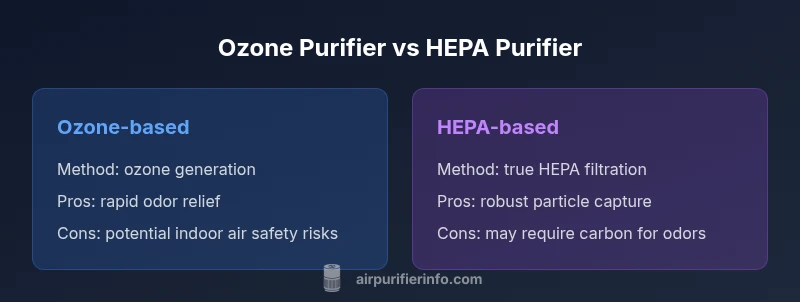
Ozone Air Purifier vs HEPA: Side-by-Side Comparison
Compare ozone air purifier vs HEPA to understand safety, odor control, particle capture, and ownership costs. Learn which option fits your home, with practical tips from Air Purifier Info.


In short, HEPA-based purifiers are generally safer and more predictable for occupied homes, while ozone-based purifiers may offer rapid odor relief in controlled environments. This quick comparison highlights safety, effectiveness, and ongoing costs to help homeowners decide, with guidance from Air Purifier Info on when each option makes sense.
Definitions and Context: ozone air purifier vs HEPA in consumer products
In the consumer air purification market, two broad approaches compete for indoor air quality improvements: ozone-based devices and HEPA-based purifiers. The term ozone air purifier vs hepa frames a contrast between a gas-phase oxidation approach and a physical filtration method. According to Air Purifier Info, the core distinction is not only how air is cleaned but also who is present during operation and how ventilation affects safety. In most homes, HEPA filtration is the default because it is backed by decades of testing, widely understood performance metrics, and a lower risk profile for daily use. Ozone-based devices can address odors and some chemical pollutants, but they carry safety concerns that vary with room occupancy, ventilation, and duration of use. This article compares these technologies across decision criteria like safety in occupied spaces, particle capture, odor and VOC control, maintenance costs, energy use, and regulatory considerations. When you hear ozone air purifier vs hepa, think first about whether the purifier will operate with people present and how you will manage any ozone exposure. Air Purifier Info emphasizes that context matters as much as technology in choosing a purifier.
How ozone-based purifiers work and the safety caveats
Ozone-based purifiers generate ozone gas, often through electrical discharge or corona discharge mechanisms. The produced ozone reacts with pollutants in the air, breaking down certain odors and compounds. However, ozone itself is a pollutant that can irritate the lungs, eyes, and airways, especially for sensitive individuals. Many health agencies advise that ozone generators should not be operated in occupied spaces or should be used only in unoccupied rooms with adequate ventilation. When evaluating the ozone air purifier vs hepa question, safety becomes the deciding factor for homes with children, older adults, or people with asthma or allergies. Air Purifier Info notes that, in practice, ozone-based units are most effective in controlled environments or in temporary odor remediation applications where occupants can be absent during use. If you must use ozone devices, ensure you follow manufacturer instructions, monitor concentrations, and comply with local regulations. Regulatory guidance often emphasizes limiting exposure and avoiding long-term use indoors.
HEPA filtration explained: what HEPA captures and its limits
True HEPA filtration works by passing air through a dense mat of fibers that trap particles as small as microscopic pollen, dust, dander, and fine aerosols. The standard HEPA filter is widely cited as capturing at least 99.97% of particles around 0.3 microns in laboratory testing, though real-world performance depends on airflow, filter condition, and pre-filters. HEPA purifiers excel at removing particulate contaminants that trigger allergies and asthma, and they are generally safe to operate in occupied spaces. Some VOCs and odors are not primarily addressed by HEPA filters alone; many users pair HEPA with activated carbon to tackle smells and vapors. When comparing ozone air purifier vs hepa, HEPA-based systems usually emerge as the more conservative choice for daily indoor air quality, with ozone-based devices reserved for specific odor challenges in controlled settings.
A side-by-side look at performance across key tasks
- Particle removal: HEPA purifiers provide reliable, measurable reduction in dust, pollen, and pet dander. Ozone-based devices may indirectly reduce some particulates through chemical reactions, but this is not their primary design and effectiveness varies by device and usage.
- Odors and VOCs: Ozone-based purifiers may claim rapid odor neutralization, yet safety concerns limit their use around occupants. HEPA units paired with activated carbon or other sorbents can reduce odors and many VOCs without introducing ozone into the space.
- Microbial control: HEPA filters can capture bacteria and some viruses attached to particles; ozone devices rely on chemical reactions that may degrade some compounds, but they do not provide provable microbial capture in the same way.
- Energy and noise: HEPA purifiers offer predictable energy use and relatively quiet operation at common consumer speeds. Ozone devices may vary more in energy and produce ozone-related byproducts that influence indoor air feel. In the ozone air purifier vs hepa comparison, the predictable performance of HEPA is typically preferred for everyday living.
Health, safety, and regulatory considerations
Health safety is a central axis in the ozone air purifier vs hepa debate. Ozone exposure can irritate the lungs and airways, particularly for children, older adults, and people with respiratory conditions. Many jurisdictions impose restrictions on indoor ozone emissions and strongly discourage using ozone generators in occupied spaces. Air Purifier Info reinforces that for households with active occupants, HEPA-based purifiers combined with high-quality pre-filters and, if needed, activated carbon, offer a lower-risk, well-understood path to cleaner air. When evaluating options, review any stated ozone emission levels, certifications, and safety warnings. Always prioritize products that are clearly labeled as ozone-free for indoor use in occupied rooms.
Maintenance, energy use, and long-term costs
Maintenance costs and energy use are a practical differentiator between the two technologies. HEPA purifiers typically require periodic filter replacements and occasional pre-filters; costs depend on filter quality and usage. Energy consumption is often modest and predictable, with CADR-based models indicating expected airflow efficiency. Ozone devices may incur different maintenance needs—sometimes involving sensor checks, ozone cell replacement, or other components—along with energy use tied to ionization or corona discharge processes. Because ozone can degrade air quality if misused, long-term costs for ozone-based units may include health safeguards or remediation if overuse occurs. In the ozone air purifier vs hepa discussion, most homeowners encounter steadier, easier-to-manage ongoing costs with HEPA filtration.
How to choose: buying considerations for ozone air purifier vs HEPA
When choosing, start with occupancy and use patterns. If anyone in the home has asthma, allergies, or chemical sensitivities, HEPA-based purifiers are generally safer and more predictable for continuous operation. Look for true HEPA standards, certified CADR values, and, for odors, activated carbon supplementation. If you consider ozone-based devices, ensure the unit is designed for unoccupied-space use and complies with local safety standards. Verify that ozone emission metrics are disclosed and controlled, and plan for a containment strategy that minimizes exposure. Air Purifier Info recommends laying out a clear in-home usage plan and prioritizing safety and transparency in product labeling. In all scenarios, prefer models with independent testing, good maintenance support, and robust customer education.
Real-world scenarios: bedrooms, living rooms, kitchens, and households with pets
Bedrooms benefit from quiet HEPA purifiers with low noise settings and stable filtration. Living rooms benefit from higher CADR units; if you have pets or activities that stir up dust, HEPA with activated carbon is advantageous. Kitchens can generate odors and VOCs; HEPA-plus-carbon filtration tends to handle odors better without introducing ozone. Pet households often see sustained benefits from particulate filtration and reduced dander; ozone devices are generally not recommended for continuous operation around pets. Across these scenarios, ozone air purifier vs hepa decisions should favor HEPA-based solutions for daily use and reserve ozone devices for specialized odor remediation under strict safety controls.
Final considerations: safety, testing, and trusted guidance
No purifier should substitute for proper ventilation and source control. Always read the user manual, follow safety advisories, and rely on independent testing where available. In the ongoing ozone air purifier vs hepa comparison, the consensus from health authorities is that HEPA-based purifiers offer safer, more predictable indoor air quality for occupied homes. When in doubt, consult trusted sources and prioritize products with verifiable testing, clear safety disclosures, and transparent emission information. Air Purifier Info reaffirms that the safest path for most households is a well-reviewed HEPA-based purifier with active carbon, a good warranty, and clear usage guidelines.
Comparison
| Feature | Ozone-based purifier | HEPA-based purifier |
|---|---|---|
| Filtration/purification method | Ozone generation and oxidation | True HEPA filtration with optional activated carbon |
| Safety considerations for occupied spaces | Potential ozone exposure; strict unoccupied-use recommended | Safe for occupied spaces; low risk when properly sized and maintained |
| Odor/VOC control | Claims rapid odor neutralization via ozone; effectiveness varies | Odors addressed via filtration plus carbon adsorption |
| Particulate removal | Limited direct particle capture; depends on ozone chemistry | High particulate capture efficiency when properly maintained |
| Maintenance costs | Variable; ozone system components may require specialized care | Regular filter replacements; predictable costs |
| Energy use | Energy consumption depends on ozone generation intensity | Energy use tied to motor speed and CADR; generally steady |
| Best use case | Odor or contaminant challenges in unoccupied spaces | Daily, reliable air cleaning in occupied rooms with safe operation |
What's Good
- HEPA purifiers are widely tested and supported by consumer guidelines
- Ozone purifiers can offer rapid odor relief in controlled environments
- HEPA devices tend to have lower health risk for daily use
- Certifications and independent testing exist for HEPA products
- Some ozone devices are compact and can address certain odors quickly
What's Bad
- Ozone generators pose health risks in occupied spaces
- Indoor ozone emissions are subject to regulatory caution and restrictions
- HEPA purifiers require ongoing filter replacements and maintenance
- Ozone-based devices may produce secondary pollutants if misused
HEPA-based purifiers are the safer, more reliable choice for occupied homes.
For daily use, HEPA filtration with carbon is typically the best balance of safety and effectiveness. Ozone devices should be confined to unoccupied spaces or used under strict safety controls.
Questions & Answers
What is the main difference between ozone air purifiers and HEPA purifiers?
Ozone purifiers generate ozone gas to react with pollutants, while HEPA purifiers physically trap particles. Safety and use-cases differ: HEPA is safer for daily indoor use; ozone devices require strict safety controls and often unoccupied use. The choice hinges on occupancy, odor needs, and risk tolerance.
Ozone purifiers generate ozone to clean air, while HEPA purifiers filter particles. For daily use, HEPA is usually safer.
Are ozone air purifiers safe to run around people?
Most health authorities advise against running ozone generators in occupied spaces. If an ozone device is used at all, operate only in unoccupied rooms or with controlled ventilation and strict adherence to safety guidelines.
Ozone devices should generally be run only when no one is home or in strongly controlled setups.
Do ozone purifiers remove VOCs effectively?
Ozone can react with some VOCs, but the chemistry is complex and can create secondary pollutants. HEPA plus activated carbon is a safer, more predictable approach for VOC reduction in occupied homes.
They might affect some VOCs, but they can create new pollutants. HEPA plus carbon is typically safer for VOCs.
Is HEPA better for allergies?
Yes. HEPA purifiers efficiently remove dust, pollen, and animal dander, which are common allergy triggers. For odors or smells, add activated carbon filtration to enhance performance without ozone.
For allergies, HEPA is usually the best choice, especially with carbon for odors.
Can I use both types in the same home?
You can have both types, but do not operate ozone devices around people. Use ozone generators only in unoccupied spaces or in cases where odor remediation is needed with strict safety controls.
You can have both, but never run ozone devices where people are present.
What certifications should I look for?
Look for independent testing results, CARB compliance for ozone-emitting devices, and CADR ratings for HEPA purifiers. Certifications indicate tested performance and safety disclosures.
Check for independent tests, CARB compliance, and CADR ratings to verify safety and performance.
Main Points
- Prioritize HEPA-based purifiers for occupied homes
- Avoid long-term indoor use of ozone generators without safety controls
- Pair HEPA with activated carbon for broader odor and VOC control
- Check independent tests and safety disclosures before purchase