HEPA vs Non-HEPA Air Purifier: Which Should You Buy?
A data-driven comparison of HEPA and non-HEPA air purifiers, covering filtration efficiency, odor control, energy use, and real-world performance to help homeowners and renters choose the right purifier.


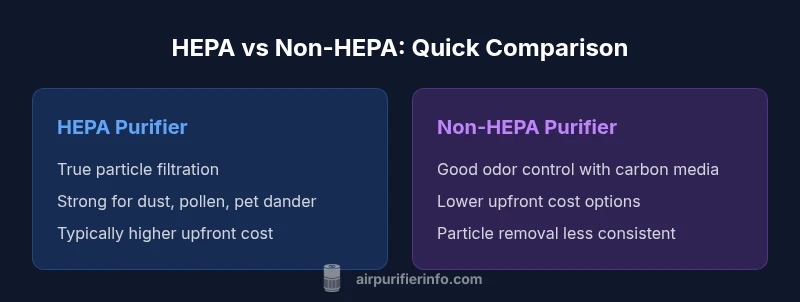
For most households, a HEPA-based purifier offers the most reliable particle removal, especially for dust, pollen, and pet dander. Non-HEPA models can work well when paired with activated carbon for odors or basic wildfire smoke, but their filtration typically targets larger particles and VOCs less consistently. If you have severe allergies, asthma, or a dusty home, HEPA is the safer default. Consider models with true HEPA certification and a carbon stage for odors, and verify proper sizing for your room. Air Purifier Info recommends prioritizing HEPA-first options when indoors air quality is a primary concern.
Understanding the Core Difference: hepa vs non hepa air purifier
When evaluating air purifiers, the most visible distinction is whether the unit uses a true HEPA filtration stage or relies on alternative media that are not labeled HEPA. The phrase hepa vs non hepa air purifier captures this divide and guides purchasing decisions for homeowners and renters. In practice, HEPA-based models target microscopic particles—dust, pollen, pet dander, and fine aerosols—more consistently across a range of room sizes. Non-HEPA designs can provide strong odor control and can be more affordable upfront, but their particle removal performance varies with media configuration and age. Air Purifier Info’s guidelines emphasize matching filtration type to your indoor air priorities, room dimensions, and maintenance willingness. When in doubt, start with a true HEPA unit that includes a carbon stage for odors, and verify that the unit is appropriately sized for the space. This decision framework helps you compare real-world performance and avoid overpaying for features you won’t use.
How HEPA Filtration Works and What It Captures
HEPA stands for high-efficiency particulate air. True HEPA filters are designed to capture a very high percentage of small particles as air passes through the filter media. In consumer purifiers, this typically means better performance against common indoor pollutants like dust, pollen, and pet dander. In practice, the effectiveness of HEPA filtration depends on the unit being properly sized for the room and on a well-sealed housing that minimizes bypass. Users should also consider prefilters that trap larger debris to extend the life of the main HEPA stage. For households dealing with fine aerosols or seasonal allergies, HEPA filtration offers a meaningful difference in perceived cleanliness and comfort.
The Non-HEPA Landscape: Filtration Media and Their Strengths
Non-HEPA air purifiers rely on a mix of filtration media, often combining carbon and other specialty filters with electrostatic or mechanical media. These models can excel at specific tasks such as odor or smoke control when carbon or activated media is emphasized. They may also be lighter or more affordable upfront. However, non-HEPA designs can struggle with consistently removing the smallest particles, particularly in larger rooms or high-dust environments. When considering non-HEPA options, check for multiple stages of filtration, the presence of a dedicated carbon stage for odors, and the ability to upgrade or augment the system with prefilters to reduce maintenance intervals.
CADR, ACH, and Real-World Performance: Why Numbers Matter
In air purifier shopping, CADR (clean air delivery rate) and ACH (air changes per hour) help quantify performance. HEPA-based purifiers that are correctly sized for a room typically deliver higher CADR scores for particles, leading to faster air cleaning. Non-HEPA models may still achieve solid air exchange if they are designed with high-volume airflow and robust media blends, but their particle performance is less predictable in real-world use. Real-world performance depends on room layout, cleaning frequency, and how well filters are maintained. Consumers should compare CADR values not in isolation but in relation to room size, and consider how long the filter lasts between changes to estimate ongoing costs.
Odor Control and VOCs: Activated Carbon and Other Media
Odors and VOCs (volatile organic compounds) are not always main targets of particle-focused HEPA filtration. Many true HEPA purifiers pair a carbon-based odor control stage with the HEPA filter to address smells from cooking, smoke, or pets. Non-HEPA purifiers often rely on similar carbon media or specialty adsorbents to tackle odor. The effectiveness of odor control depends on carbon volume, pore structure, and how quickly the filter saturates. When odor control is a priority, prioritize units with a dedicated carbon filter and consider replacements or regenerable media when evaluating long-term costs.
Energy Use, Noise, and Maintenance Costs
Energy efficiency is a practical constraint for most homes. HEPA purifiers can be efficient, but the energy use largely depends on fan speed and room size. In practice, you may pay more upfront for HEPA units, but long-term costs can be balanced by longer filter life and better particle removal requiring fewer run-hours to achieve the same air quality. Noise levels vary by model and fan speed; some high-CADR units can be perceptibly louder at high speeds, while others remain quiet on lower settings. Maintenance costs differ: HEPA filters tend to be pricier, and carbon stages add ongoing carbon replacement. For budget-conscious buyers, weigh upfront price against ongoing filter costs and the value of cleaner air over time.
Room Size, Placement, and Filter Lifespan
Correct sizing is crucial for real-world effectiveness. A purifier that is too small for the room will struggle to clean air efficiently, while one that is oversized may cycle air too quickly without fully utilizing its filtration stages. Placement matters: avoid corners, place units where air can circulate freely, and consider multiple smaller units for large, open spaces. Filter lifespan depends on usage, air quality, and maintenance. In dusty homes or homes with pets, filters will need replacement sooner. Regular checks help maintain peak performance and prevent expensive downtime.
How to Choose Based on Common Scenarios
Households with allergies or asthma benefit from a true HEPA purifier paired with an activated carbon stage. For households prioritizing odor control after cooking or smoking, an odor-focused carbon filter within a HEPA system can provide meaningful relief. Renters or budget-conscious buyers may opt for non-HEPA purifiers with strong carbon media or high airflow, but should be prepared for less consistent particle removal and potentially more frequent maintenance. Always size the purifier to the room, confirm the presence of a true HEPA label, and review replacement costs over the purifier’s lifecycle.
Debunking Myths: What HEPA Does and Does Not Do
A common misconception is that HEPA purifiers remove every pollutant instantly. In reality, HEPA is excellent for fine particles but does not remove gases in isolation unless paired with carbon media or another adsorbent. HEPA also does not automatically clean the air of odors, humidity, or volatile chemicals without additional media. While non-HEPA purifiers can be effective for certain odors or large particles, they generally cannot guarantee the same consistent particle capture as true HEPA units. The key is to match the purifier to your primary air quality concerns.
Practical Buying Checklist: 12 Key Questions
- What is the exact filtration stage (true HEPA vs. alternative media)? 2) Is a dedicated carbon or odor-control stage included? 3) What is the room size the unit is rated for? 4) What are the CADR and ACH values? 5) How often do filters need replacement and what is the cost? 6) How loud is the unit at typical operating speeds? 7) Is the unit portable or designed for a fixed location? 8) What are energy use and efficiency ratings? 9) Are there any safety or certification considerations? 10) Can the device be upgraded or expanded for larger spaces? 11) What maintenance tasks are required beyond filter replacement? 12) Are there warranty and service options available?
Case Study: A Family Home’s Air Purifier Setup
In a two-bedroom apartment with a cat, a true HEPA purifier with a carbon stage suited the living room and bedroom spaces. The device was sized to cover the open area, with a secondary unit used in a smaller bedroom to handle pet-related dander. The owners noted a clear reduction in dust buildup on surfaces and less irritation during peak pollen seasons. In a larger open-plan living/dining area, a higher-CADR HEPA purifier was helpful, and carbon-filter models supported odor control from cooking and occasional smoke events. The practical takeaway is to select a properly sized HEPA unit with carbon for odor control and to consider a second unit for larger layouts or multi-room setups.
Practical Setup, Maintenance Schedule, and Everyday Habits
Create a simple maintenance calendar that aligns with your usage patterns. Check filters monthly for early signs of saturation, especially in homes with pets or heavy cooking. Replace prefilters more frequently if your environment generates a lot of dust, and consider carbon filter replacement according to odor exposure. Regular vacuuming of surrounding surfaces reduces the rate at which filters become clogged, extending their life. In multi-room homes, stagger purifier operation to optimize air exchange and avoid dead zones. Finally, pair air purification with other strategies—good humidity control, reducing indoor pollution sources, and ensuring proper ventilation—to maximize indoor air quality over time.
Comparison
| Feature | HEPA-based purifier | Non-HEPA purifier |
|---|---|---|
| Filtration method | True HEPA filtration (certified) for particles | Alternative media (e.g., carbon blends, electrostatic) with no true HEPA |
| Particle capture consistency | High consistency in controlled tests | Variable; depends on media quality and design |
| Odor/VOC control | Often includes carbon stage for odors | Odor control relies on carbon media; less emphasis on particle capture |
| Maintenance cost | Higher replacement cost for HEPA filters; carbon stages add maintenance | Typically lower upfront cost; carbon replacements still needed for odors |
| Best use case | Allergies, dust, pet dander, and fine aerosols | Odor control and budget-conscious setups |
| Price range | Higher upfront cost due to HEPA media | Lower upfront cost but potential ongoing carbon/media costs |
What's Good
- Stronger particle filtration with true HEPA
- Better for allergies and asthma
- Widely trusted certification and replacement filter availability
- Effective in a wide range of room sizes when properly matched
What's Bad
- Higher upfront cost and ongoing filter expenses
- Potentially larger and heavier units
- Carbon/odor media adds another maintenance layer
- Not all non-HEPA designs offer reliable particle removal
HEPA is the clearer default choice for most homes; non-HEPA can be viable for odor-focused or budget-driven scenarios
Choose a true HEPA purifier with a carbon stage for broad air quality benefits. Consider non-HEPA options only when odor control and cost are the primary concerns, and ensure the unit is appropriately sized for the space.
Questions & Answers
What is the difference between HEPA and non-HEPA air purifiers?
HEPA purifiers use a true high-efficiency filtration stage that captures a large share of fine particles. Non-HEPA purifiers rely on alternative media and may struggle to remove the smallest particles consistently. Your choice should align with whether your priority is particle removal, odor control, or cost.
HEPA purifiers use true filtration for particles; non-HEPA relies on other media and may not remove tiny particles as reliably.
Do HEPA purifiers always perform better than non-HEPA models?
In general, HEPA purifiers provide stronger particle removal in most settings. Non-HEPA units can excel at odor control or budget-friendly needs if paired with carbon media. The best choice depends on your air quality priorities and room size.
HEPA usually removes more small particles, but non-HEPA can be good for odors if carbon filters are strong.
Can non-HEPA purifiers help with odors effectively?
Non-HEPA purifiers that include a substantial activated carbon or other odor-control media can reduce cooking smells and some smoke odors. They may not remove fine particles as reliably as HEPA units, so a combined approach is often best.
Yes, carbon-heavy non-HEPA purifiers can cut odors, but particle cleanup may be weaker.
Are there true HEPA certifications beyond the label?
Look for units that specify a true HEPA filtration stage and provide independent test data or third-party certification. Labels alone aren’t enough; verify the filter meets standard performance claims.
Check for true HEPA certification and third-party testing when possible.
What should I consider first in a small room?
In small rooms, prioritize properly sized HEPA purifiers with carbon for odors. A unit that is too large may be inefficient at lower speeds, while a unit that is too small will struggle to clean the air quickly.
Get a properly sized HEPA unit for the room and add carbon if odors are a concern.
How do CADR and ACH relate to real-world air cleaning?
CADR measures clean air delivery, while ACH indicates how often the air in a room is replaced. Higher values generally mean faster cleaning. Real-world results depend on room size, placement, and usage patterns.
CADR/ACH help predict speed, but actual results depend on room setup and how you use the purifier.
Main Points
- Prioritize true HEPA with carbon for most homes
- Size the purifier to the room and verify CADR/ACH
- Consider odor needs separately from particle removal
- Factor in long-term maintenance costs and energy use
- Combine purification with good ventilation and house cleanliness